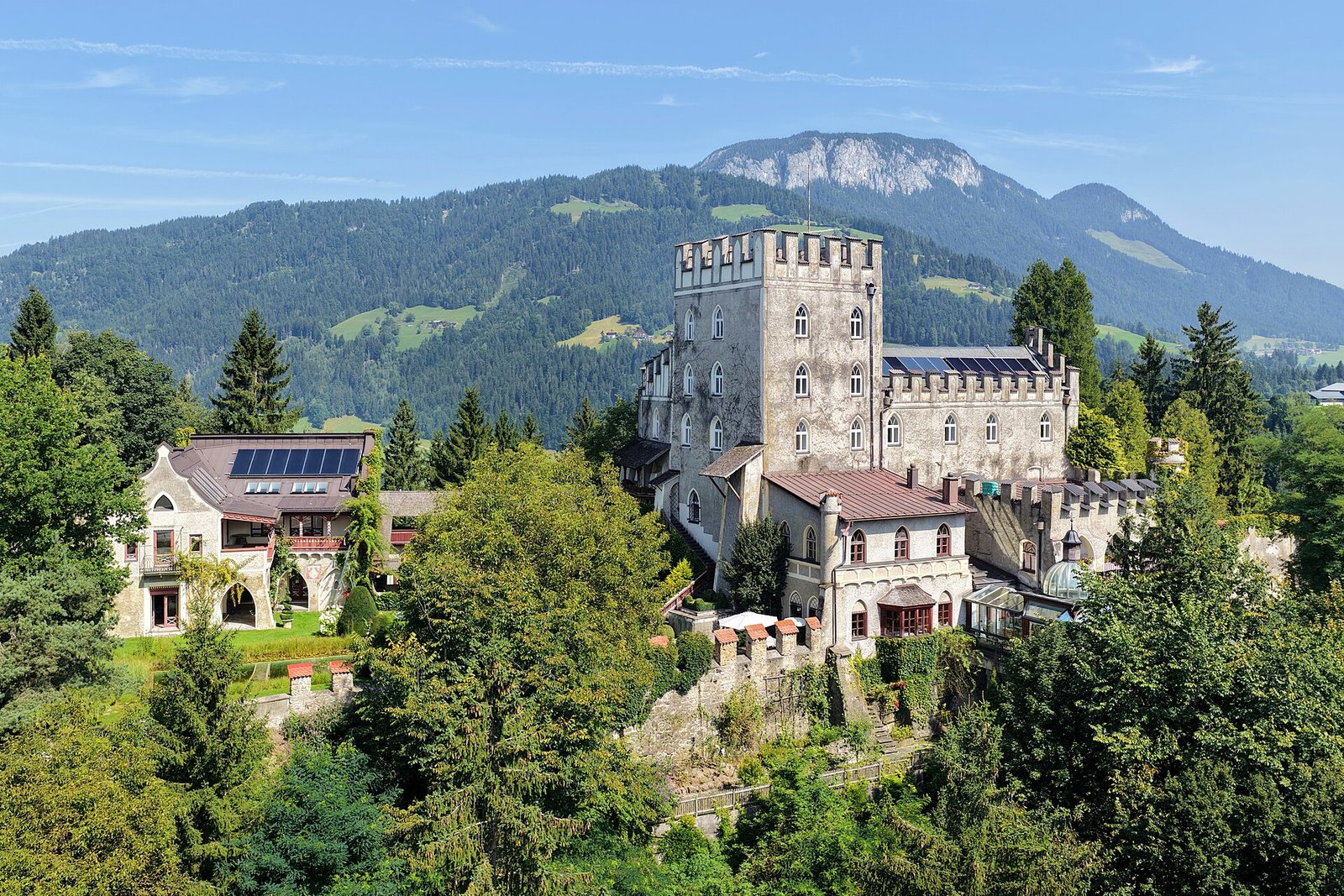

On 5 May 1945, five days after Adolf Hitler shot himself in his Berlin bunker and two days before Germany’s unconditional surrender, one of the strangest battles of the Second World War was fought around a small castle on a hill in the Austrian Tyrol. On one side were soldiers of the Waffen-SS. On the other, fighting together, were a handful of American tank crewmen and infantrymen, a few soldiers of the German Army, an SS officer who had switched sides, and a group of elderly and famous French prisoners who refused to stay out of the fight.1
A prison for important people
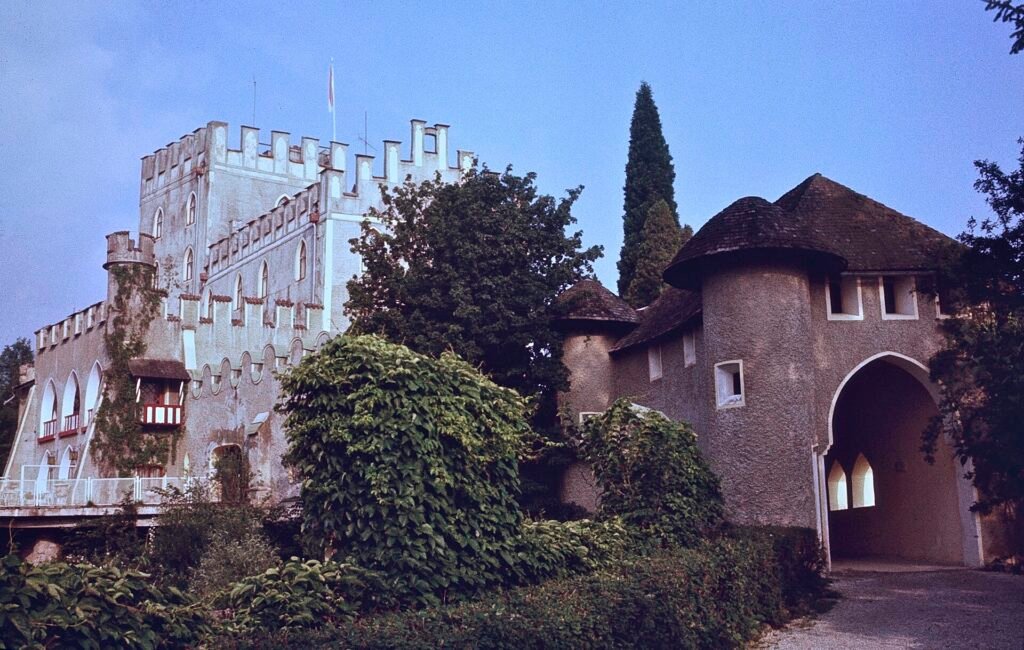
Schloss Itter is a modest castle on a wooded spur above the village of Itter, near the town of Wörgl in the Inn valley. After Austria was absorbed into Germany in 1938, the German government leased it, and in February 1943 the SS seized it on Heinrich Himmler’s orders. By the end of April 1943 it had been turned into a special prison, run as an annex of the Dachau concentration camp.1
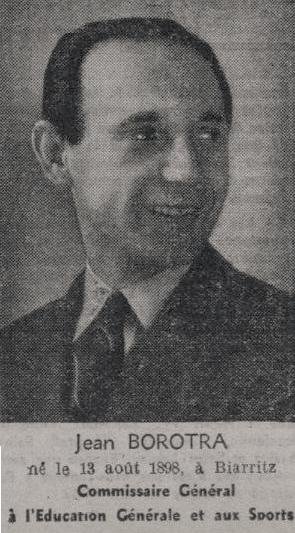
Its prisoners were French men and women whom the Nazis thought valuable as hostages. They included two former prime ministers, Édouard Daladier and Paul Reynaud, who had led France when the war began and when it fell; two former commanders-in-chief of the French army, General Maxime Gamelin and General Maxime Weygand; the tennis champion Jean Borotra, one of the famous “Four Musketeers” who had dominated tennis in the 1920s and a former Wimbledon winner; the trade union leader Léon Jouhaux; the right-wing politician and resister François de La Rocque; and Marie-Agnès Cailliau, the elder sister of General Charles de Gaulle. Eastern European prisoners from Dachau were held there too, to do the castle’s maintenance and menial work.1
The French prisoners were comfortable compared with the inmates of the camps, but they were prisoners, and they did not get on. Daladier and Reynaud had hated each other for years; Weygand and Reynaud blamed each other for the defeat of 1940. For two years they lived together in the castle, eating at the same table and barely speaking.1,2
The prisoners take over
By the beginning of May 1945 the Reich was collapsing. American troops were driving into the Tyrol. On 2 May Eduard Weiter, the last commandant of Dachau, who had fled to Itter, died there in suspicious circumstances. The castle’s own commandant, Sebastian Wimmer, began to fear for his life.1
On 3 May a Yugoslav prisoner, Zvonimir Čučković, a Croatian communist who worked as the castle handyman, was sent out on an errand and did not come back. He had gone to find the Americans, carrying a note from the prisoners asking for help. Wörgl, the nearest town, was still held by German troops, so he walked on up the Inn valley towards Innsbruck, some forty miles away, and late that night found an advance party of the American 103rd Infantry Division. A rescue column set out at dawn, but was stopped by shellfire and then recalled because it had strayed into another division’s area.1
When Čučković failed to return, Wimmer and the SS guards fled. The prisoners took over the castle and armed themselves with the weapons the guards had left behind. But the countryside was full of SS units still loyal to the dying regime, and the prisoners knew they could not hold out against a determined attack. On 4 May the castle’s Czech cook, Andreas Krobot, set off by bicycle for Wörgl with another appeal for help.1
A German major and an American lieutenant
In Wörgl, Krobot was taken to Major Josef “Sepp” Gangl, a decorated German Army officer who had disobeyed orders to retreat and joined forces with the local Austrian resistance. Gangl’s aim was to protect the townspeople from the SS, who were shooting at windows showing white flags and executing men they suspected of deserting. He had been hoping to surrender to the Americans as soon as they arrived. Now he drove out under a white flag to find them.1
In the town of Kufstein, eight miles to the north, he found Lieutenant John C. “Jack” Lee Jr. of the 23rd Tank Battalion, 12th Armored Division, waiting in the square with a small unit of Sherman tanks. Lee listened to Gangl’s story, got permission from his headquarters, and volunteered to lead a rescue. Gangl drove him to look at the castle in his own Kübelwagen, the German army’s jeep.1
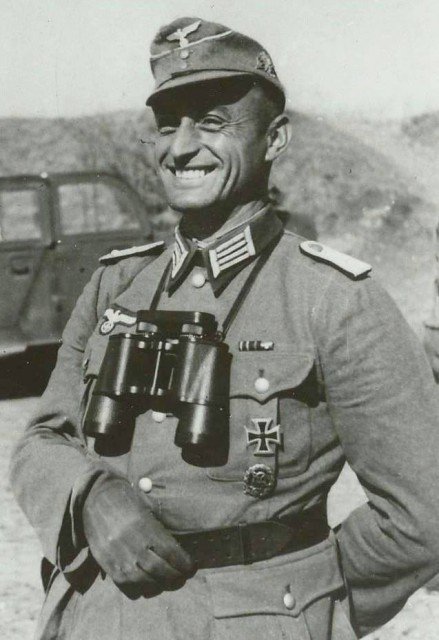
Lee set out with tanks and infantry from the newly arrived 142nd Infantry Regiment, but a bridge on the way was too weak for the whole column, and he sent most of it back. He went on with one Sherman, his own, named Besotten Jenny, about fourteen American soldiers, Gangl and a truck carrying some ten of Gangl’s German soldiers. On the way they drove off a party of SS troops trying to set up a roadblock. They reached the castle on the evening of 4 May.1
An SS officer changes sides
The French prisoners were delighted to see them, and disappointed that there were so few. They had already found another ally. Kurt-Siegfried Schrader, a Waffen-SS captain who had been recovering from wounds in the village and had befriended some of the prisoners, had agreed to help organise their defence, and had brought his wife and child into the castle for safety. It is the only known case of a serving member of the Waffen-SS fighting on the Allied side.1
Lee placed his men around the walls and parked Besotten Jenny across the main gate. He ordered the French prisoners to keep out of the way. They refused. Several of them, by the defenders’ own accounts including the two former prime ministers, took up rifles and pistols and joined the defence.1
The attack
An SS force estimated at 100 to 150 men, from the 17th SS Panzergrenadier Division, had been occupying the hills nearby, and during the night its scouts probed the castle’s defences. Gangl telephoned the resistance leader in Wörgl for reinforcements; two more German soldiers and a teenage Austrian resistance fighter, Hans Waltl, were all that could be spared, and they drove up to join them.1
In the morning of 5 May the SS attacked. Machine-gun and anti-aircraft fire hammered the walls so hard that masonry fell inside, injuring Schrader’s wife. Besotten Jenny fired her machine guns at the attackers until an SS 88mm gun destroyed her; the only man inside, a radio operator trying to fix the set, got out unhurt. The defenders were running short of ammunition.1
Major Gangl was killed during the fighting. He was shot by a sniper while trying to pull Paul Reynaud, the former prime minister, out of the line of fire. He was the only defender to die at Itter.1
The tennis champion runs
The castle’s telephone line had been cut, and Lee could not tell the relief force what it would face. Jean Borotra, forty-six years old and still remarkably fit, offered to go. He vaulted the castle wall, ran through the SS positions and ambushes, and reached the approaching relief column of the 142nd Infantry. A French-Canadian war correspondent travelling with the Americans, René Lévesque, recognised him; many years later Lévesque would become Premier of Quebec. Borotra borrowed an American uniform and rode back with the column to the castle.1
The relief force arrived around four in the afternoon. The SS attack collapsed, and about a hundred SS men were taken prisoner. That evening the French prisoners were driven away to safety; they reached Paris on 10 May.1
Afterwards
Jack Lee was promoted to captain and awarded the Distinguished Service Cross. He went home to the United States and died in 1973. Sepp Gangl was honoured in Austria as a national hero, and a street in Wörgl was named after him. Kurt-Siegfried Schrader was arrested by the Americans for his SS membership and sentenced to two years, a sentence reduced in recognition of what he had done at Itter; he later worked as a civil servant in West Germany.1
The French prisoners went back to a France that had moved on without them. Reynaud and Daladier returned to politics. Weygand was put on trial for his part in the Vichy regime, and cleared. Borotra returned to tennis, and played in veterans’ events at Wimbledon into his old age.1,2
The battle was forgotten for decades, a footnote in the chaos of the last days of the war. It is one of only two known occasions when American and German soldiers fought side by side against a common enemy in the Second World War. The historian Stephen Harding brought it back to light in 2013 in his book The Last Battle, and it has since inspired a song, by the Swedish band Sabaton, and a feature film released in 2025.1
Timeline
- 7 February 1943 The SS seize Schloss Itter.
- 25 April 1943 The castle becomes a prison under Dachau’s administration.
- 30 April 1945 Hitler kills himself in Berlin.
- 3 May 1945 Zvonimir Čučković leaves to find the Americans.
- 4 May 1945 The guards flee; the cook Andreas Krobot reaches Major Gangl in Wörgl; Lieutenant Lee’s small force reaches the castle.
- 5 May 1945 The SS attack; Gangl is killed; Jean Borotra runs for help; the 142nd Infantry arrives around 4 p.m.
- 7 May 1945 Germany signs its unconditional surrender.
- 10 May 1945 The French prisoners reach Paris.
- Stephen Harding, The Last Battle: When U.S. and German Soldiers Joined Forces in the Waning Hours of World War II in Europe (Da Capo, 2013).
- Memoirs and diaries of the French prisoners, including Paul Reynaud and Édouard Daladier, as used by Harding.
- U.S. Army, 12th Armored Division and 36th Infantry Division records for 4–5 May 1945.
- The strength of the attacking SS force is uncertain; estimates range from about 100 to 150 men.
Found an error, or hold a related record? Tell the research desk.

Share what you know