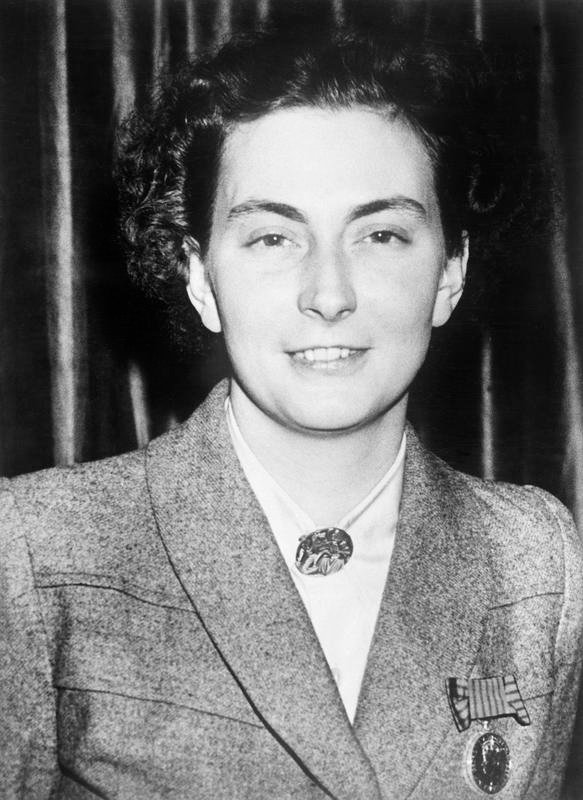
Andrée de Jongh was born on 30 November 1916 in Schaerbeek, a district of Brussels, while Belgium was under German occupation in the First World War. She was the younger daughter of Frédéric de Jongh, the headmaster of a primary school, and his wife, Alice Decarpentrie.1
Her childhood heroine was Edith Cavell, the British nurse who had run a hospital in Brussels and was shot by the Germans in 1915, not far from the de Jongh home, for helping Allied soldiers escape to the neutral Netherlands. Andrée trained as a nurse, and before the war worked as a commercial artist in Malmedy, in the east of Belgium.1
Soldiers in hiding
Germany invaded Belgium again in May 1940. De Jongh moved to Brussels and volunteered with the Red Cross, caring for wounded Allied soldiers. Many British soldiers had been left behind when the British army was evacuated from Dunkirk, and others had escaped after being cut off at Saint-Valery-en-Caux. They were being hidden by Belgian families who had no way of getting them out. She began to find safe houses for them, and civilian clothes and false identity papers.1,2
In the spring of 1941 she set up an escape organisation with two friends, Henri de Bliqui and Arnold Deppé. The idea was bold: to move men not north to the sea, but south, the length of occupied France, over the Pyrenees into Spain, and from there to the British territory of Gibraltar. De Bliqui was arrested that April, betrayed by an informer. Deppé travelled to the Basque coast and found a family willing to help at the border: Elvire de Greef, known to everyone as Tante Go, and her husband and children, who lived at Anglet, near Bayonne.1,2
The first crossings
The first attempt, in July 1941, went wrong. De Jongh and Deppé brought a party of ten Belgians and a woman agent over the mountains, but once in Spain the group was arrested by the Spanish police, and some of the Belgian soldiers were handed back to the Germans. She realised that the line would need the help of the British once its travellers reached Spain.1
In August she tried again. Deppé took a group of six men by a shorter, riskier route; he was betrayed and arrested, and spent the rest of the war in prison. De Jongh took three men by a safer route: a Scottish soldier from Aberdeen, Private James Cromar of the Gordon Highlanders, and two Belgian volunteers. They went by train from Brussels to Bayonne, and then crossed the Pyrenees on foot at night with a Basque smuggler as their guide.1,2
In Spain she walked into the British consulate in Bilbao with Cromar and asked for money. The diplomats found it hard to believe that a young woman had brought a soldier across two borders and hundreds of miles of occupied territory, and for weeks they suspected she might be a German agent. But her offer was simple: she would keep bringing men out if Britain paid the costs. In the end the British escape service, MI9, agreed. De Jongh refused their advice and their control. The line would remain Belgian, and hers. The British gave her the code name Postman.1,2
How the Comet Line worked
The organisation became known as Comète, the Comet Line. Airmen shot down over Belgium and northern France were found and hidden by helpers, given civilian clothes and false papers, and passed from safe house to safe house. De Jongh moved her base to Paris; her father left his school and took over the Brussels end of the line. From Paris the airmen travelled south by train to Bayonne or Saint-Jean-de-Luz, then walked with a guide over the mountains at night, and crossed the Bidasoa river into Spain. British diplomats collected them and drove them to Gibraltar.1,2
Her favourite guide was Florentino Goikoetxea, a Basque smuggler wanted by the police on both sides of the border, who knew every path through the hills. She often made the crossing herself. To the airmen she introduced herself with her nickname, Dédée, and told them that she would be their little mother and get them to Spain. One of them later remembered thinking that their lives depended on a schoolgirl.1
From October 1941 the groups came regularly, two or three airmen at a time, then larger parties; eleven men crossed in two groups in December alone. The Comet Line association credits her with personally escorting 118 people across the border between August 1941 and December 1942, more than eighty of them airmen. Estimates of the number of round trips she made range from sixteen to twenty-four.2
Arrest at Urrugne
On 15 January 1943 she took three British airmen by train to Saint-Jean-de-Luz, and walked with them in the rain to Urrugne, the last village before the mountains. With them were Florentino and Frantxia Usandizanga, the Basque woman who owned the safe house there. The Bidasoa was in flood and too dangerous to cross. Florentino went elsewhere for the night; the others stayed at the farmhouse.1
At dawn German soldiers surrounded the house and arrested them all. They had been betrayed, probably by a farm worker de Jongh had never trusted. She was interrogated nineteen times by the German military intelligence service and twice by the Gestapo. To protect her father, who was under suspicion, she told them that she was the leader of the whole line. They did not believe that a slight young woman could have organised it, and treated her as a minor helper. It probably saved her life.1
Of the Comet Line’s helpers, some seven hundred were arrested. Around two hundred and ninety died.
Comet Line association figures
Ravensbrück and Mauthausen
She was held at Fresnes prison in Paris and then sent to the concentration camps at Ravensbrück and Mauthausen. Her father was arrested in Paris in June 1943 and shot on 28 March 1944. Frantxia Usandizanga died at Ravensbrück shortly before the camp was liberated. The line itself carried on under new leaders; by the end of the war it had brought out 776 people, most of them British and American airmen, with the help of some three thousand civilians.1,2
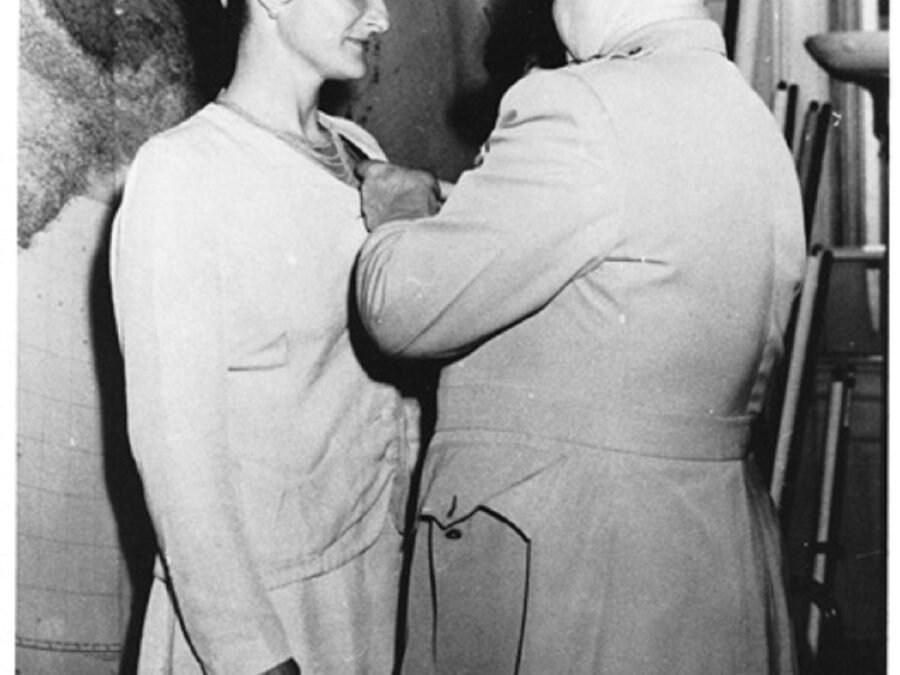
De Jongh was freed in April 1945, gravely ill and starved. On 13 February 1946 she received the George Medal at Buckingham Palace. The United States gave her the Medal of Freedom with golden palm; France made her a Chevalier of the Légion d’honneur; Belgium gave her the Order of Leopold and the Croix de Guerre, and later the honorary rank of lieutenant-colonel.1,3
The hospitals of Africa
After the war she finished her nursing training and spent most of the next thirty years in leprosy hospitals: in the Belgian Congo, Cameroon, Ethiopia and Senegal. In 1959, at a leprosy colony in the Congo, she met the novelist Graham Greene, who recorded their conversation in his journal. She told him that she had wanted to cure lepers since she was fifteen, and that if she had waited any longer it would have been too late.1,4
In 1985 King Baudouin made her a countess. Andrée de Jongh died in Brussels on 13 October 2007, aged ninety, and was buried in her parents’ crypt at Schaerbeek.
Timeline
- 30 November 1916 Born in Schaerbeek, Brussels.
- May 1940 Germany invades Belgium; she volunteers with the Red Cross.
- Spring 1941 Founds the escape line that becomes Comète.
- August 1941 First successful crossing: reaches the British consulate in Bilbao with Private James Cromar.
- October 1941 – December 1942 Regular crossings of the Pyrenees; escorts 118 people herself.
- 15 January 1943 Arrested at Urrugne with three airmen.
- 28 March 1944 Her father, Frédéric, is executed.
- April 1945 Freed from Mauthausen.
- 13 February 1946 Receives the George Medal at Buckingham Palace.
- 1985 Made a countess by King Baudouin.
- 13 October 2007 Dies in Brussels, aged 90.
- Airey Neave, Little Cyclone (Hodder & Stoughton, 1954).
- Evasion Comète, the Comet Line association’s archive of escapers and helpers, evasioncomete.be.
- Imperial War Museums, photograph HU 55451 and caption.
- Graham Greene, In Search of a Character: Two African Journals (Bodley Head, 1961).
- The number of her own round trips across the Pyrenees is given variously as sixteen to twenty-four; totals for escapers and helpers follow the Comet Line association.
Found an error, or hold a related record? Tell the research desk.
Share what you know