Virginia Hall wanted to be a diplomat. She had the languages for it: French, Italian and German, learned at Radcliffe, Barnard and George Washington University and polished in France, Germany and Austria. She had the nerve for it too. But in the 1930s the United States Foreign Service barely admitted women, and after 1933 it had another reason to keep her out. That year, out hunting birds in the marshes near Smyrna in Turkey, where she worked as a clerk at the American consulate, she tripped climbing a fence and her shotgun went off into her left foot. Gangrene set in, and surgeons amputated her leg below the knee.1,2
She learned to walk again on a wooden leg with an aluminium foot, and gave it a name: Cuthbert. In 1937 the State Department turned down her application to become a diplomat, citing a rule against hiring people who had lost limbs. An appeal that reached President Franklin Roosevelt got nowhere. In March 1939, still a consular clerk after eight years, she resigned.1,2
An American in the French ambulance service
Hall was born in Baltimore on 6 April 1906, the daughter of a well-off banker and cinema owner, and grew up on the family farm in Maryland, where she learned to ride, shoot and skin a rabbit. She was bold even as a girl. At school she edited the yearbook and was elected class president.2
When the Second World War began she was in Paris. In February 1940 she joined the French army’s ambulance service as a driver, and was at the front when France collapsed in June. Making her way to Spain, she met by chance a British intelligence officer, George Bellows, who was struck by her calm and her French. He gave her the telephone number of a friend in London. The friend was Nicolas Bodington of the newly formed Special Operations Executive, the organisation Winston Churchill had created to “set Europe ablaze”.2,4
A reporter in Lyon
SOE recruited her in April 1941. She was the first woman its French section sent into France to stay, arriving in the unoccupied Vichy zone on 23 August 1941. Her cover was ideal, and true: she was a correspondent for the New York Post, which gave her every reason to travel, ask questions and meet people. She settled in Lyon, the centre of the growing resistance in the south.1,2,4
For fifteen months she was, in effect, the hub of British clandestine work in southern France. She found safe houses, arranged false papers, paid bribes, recruited helpers and passed messages. Among her recruits were a gynaecologist, Dr Jean Rousset, whose surgery became a meeting point, and Germaine Guérin, who ran one of Lyon’s best-known brothels. Guérin hid agents in her rooms and passed on what German officers said to her women.2
She was cautious in a trade where carelessness killed. In October 1941 she sensed something wrong about a meeting of SOE agents in Marseille and stayed away. French police raided it and arrested a dozen agents, leaving Hall among the very few still at liberty, and for a while the only one who could reach London. She did it through an American diplomat in Lyon, George Whittinghill, who let her send reports home in the consulate’s diplomatic bag.2,4
Shot-down airmen who reached Lyon were told to go to the American consulate and ask for news of “Olivier”. Olivier was Hall. With Guérin and her other helpers she hid, fed and clothed dozens of them and passed them along escape routes to Spain.2
The escape from Mauzac
The agents arrested in October 1941 ended up in the prison camp at Mauzac, near Bergerac. Hall set out to get them out. Too well known by now to go near the camp herself, she worked through Gaby Bloch, whose husband Jean-Pierre was one of the prisoners. On her visits Gaby Bloch brought food, including tins of sardines, and the prisoners used the tins and smuggled tools to make a key to the door of their barracks. A priest smuggled in a radio set, and the wireless operator Georges Bégué began transmitting to London from inside the camp. Hall organised the safe houses, the vehicles and the helpers waiting outside.2,4
On the night of 15–16 July 1942 eleven men walked out. They hid in the woods while the police searched, then made their way to Lyon, where Hall had them hidden and passed on to Spain and England. M. R. D. Foot, the official historian of SOE, called it one of the most useful operations of its kind in the war. Several of the escapers went back to France to lead networks of their own.4
The priest who was a spy
The Germans were furious, and so was their pressure on Vichy. Hundreds more Gestapo and Abwehr officers came south, and Hall’s friends in the French police began to fall silent. In August 1942 a Catholic priest, Robert Alesch, came to her claiming to be an agent of a Paris resistance group, with valuable intelligence to offer. She had doubts, which grew when she learned the group had been broken up, but London vouched for him and she let him in. Alesch was an agent of the Abwehr, German military intelligence. He learned her contacts, and wireless operators linked to her network were arrested.2
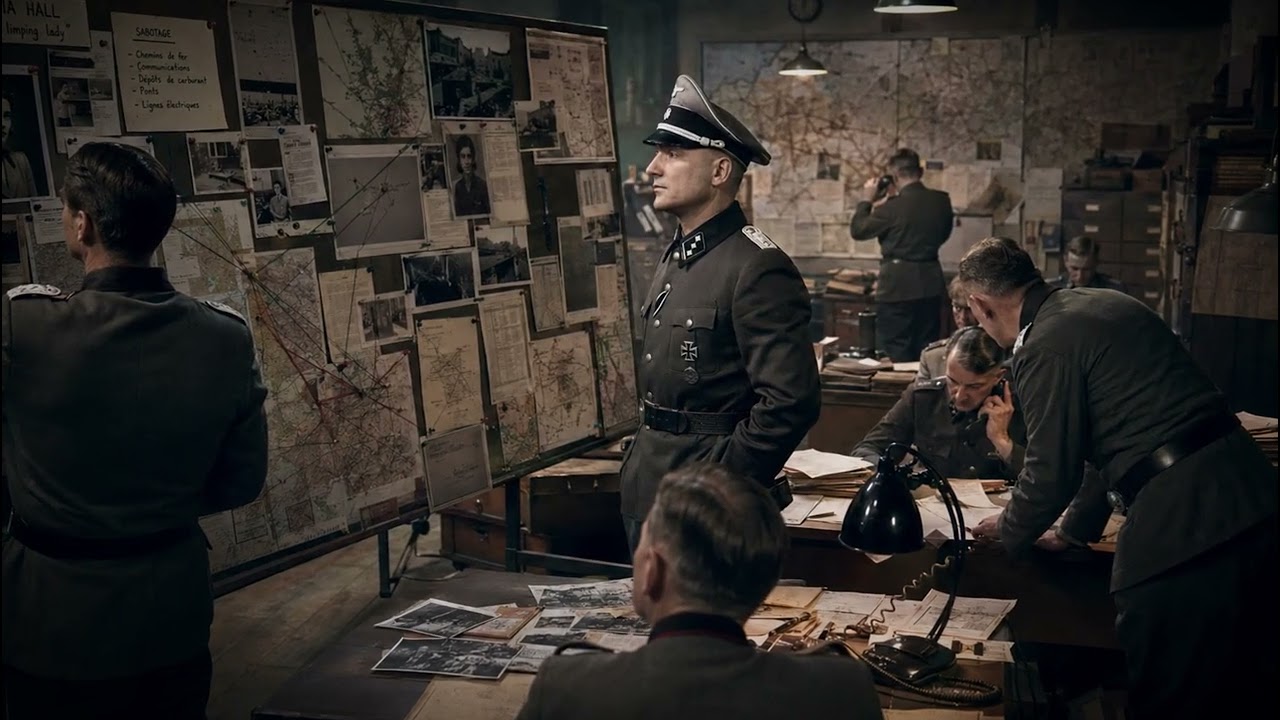
By then the Germans knew there was a woman at the centre of it all, and they knew one thing about her. The French called her la dame qui boite, the lady who limps. The phrase went on German wanted notices. Her biographers and the CIA say the Gestapo called her the most dangerous of all Allied spies; no German document with those words has ever been published, but the manhunt was real.1,2
Over the Pyrenees on one leg
On 7 November 1942 the American consulate warned Hall that an Allied landing in North Africa was imminent. The Germans would answer it by occupying the rest of France, and she would be arrested within days. The next day she left Lyon without telling even her closest friends, took a train to Perpignan near the Spanish border, and with a guide set off on foot across the Pyrenees in winter, climbing through snow over a pass at about 7,500 feet, walking perhaps fifty miles in two days on her wooden leg.1,2
Before she left she sent London a message saying she hoped Cuthbert would not give her trouble on the way. According to the story that has been told ever since, someone in London who did not know who Cuthbert was replied: “If Cuthbert troublesome, eliminate him.”2,5
The Spanish arrested her for entering the country illegally and held her in prison until the American embassy secured her release. She worked for SOE in Madrid for a time, but wanted to go back. In London her superiors refused: she was too well known, and the Germans had her description. Quietly, she was made an honorary Member of the Order of the British Empire.1,2
Back as a milkmaid
Hall took a course in wireless operating and went to the Americans. The Office of Strategic Services, the new American secret service under General William Donovan, took her on at the rank and pay of a second lieutenant. On 21 March 1944 a British motor gunboat landed her on the coast of Brittany at Beg-an-Fry. Her leg ruled out a parachute.1,2
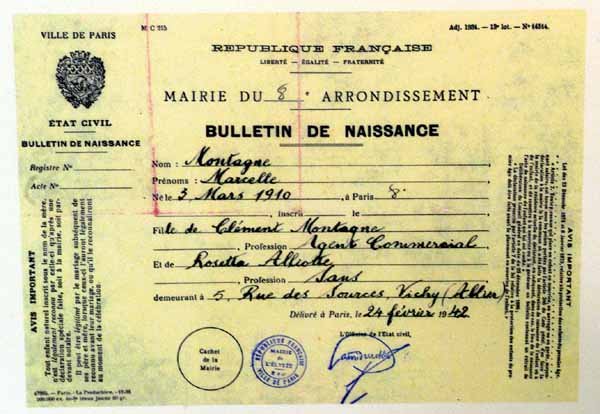
This time she went in disguise. She dyed her hair grey, wore long peasant skirts, had her teeth filed down to look like a country woman’s, and turned her limp into the shuffle of an old woman. Her papers named her Marcelle Montagne. Her codename was Diane. Officially she was the wireless operator to an older agent who led the new network; she soon decided he talked too much and quietly cut him out.2
For four months she moved through the countryside south of Paris, living with farmers, herding cows and making cheese, which she once sold to German soldiers. Between the chores she found fields where aircraft could drop supplies, radioed their positions to London, and organised and armed groups of resistance fighters for sabotage in the weeks around D-Day. Operating a radio was among the most dangerous jobs in occupied France, because the Germans hunted transmitters with direction-finding vans; she moved her set often.1,2
Haute-Loire
In July 1944 the OSS sent her to the Haute-Loire, in the hills of south-central France, to help the maquis there harass the Germans ahead of the Allied landings in the south. She set up in a barn near Le Chambon-sur-Lignon. The local maquis leaders, some of whom had given themselves colonel’s rank, were not eager to take advice from a woman lieutenant. She won them round with what they needed most, arms and money, arranging parachute drops of weapons and paying their expenses on condition that they worked with her.2
By August the three battalions of fighters in her area, about 1,500 men, were blowing up bridges and railway lines, cutting telephone lines and ambushing German convoys. The German garrison at Le Puy withdrew, and the department was cleared. A three-man Jedburgh team parachuted in on 25 August to take charge of training and supply. Hall noted drily that they had arrived after the Germans in the Haute-Loire had been dealt with.1,2
A medal she would not collect in public
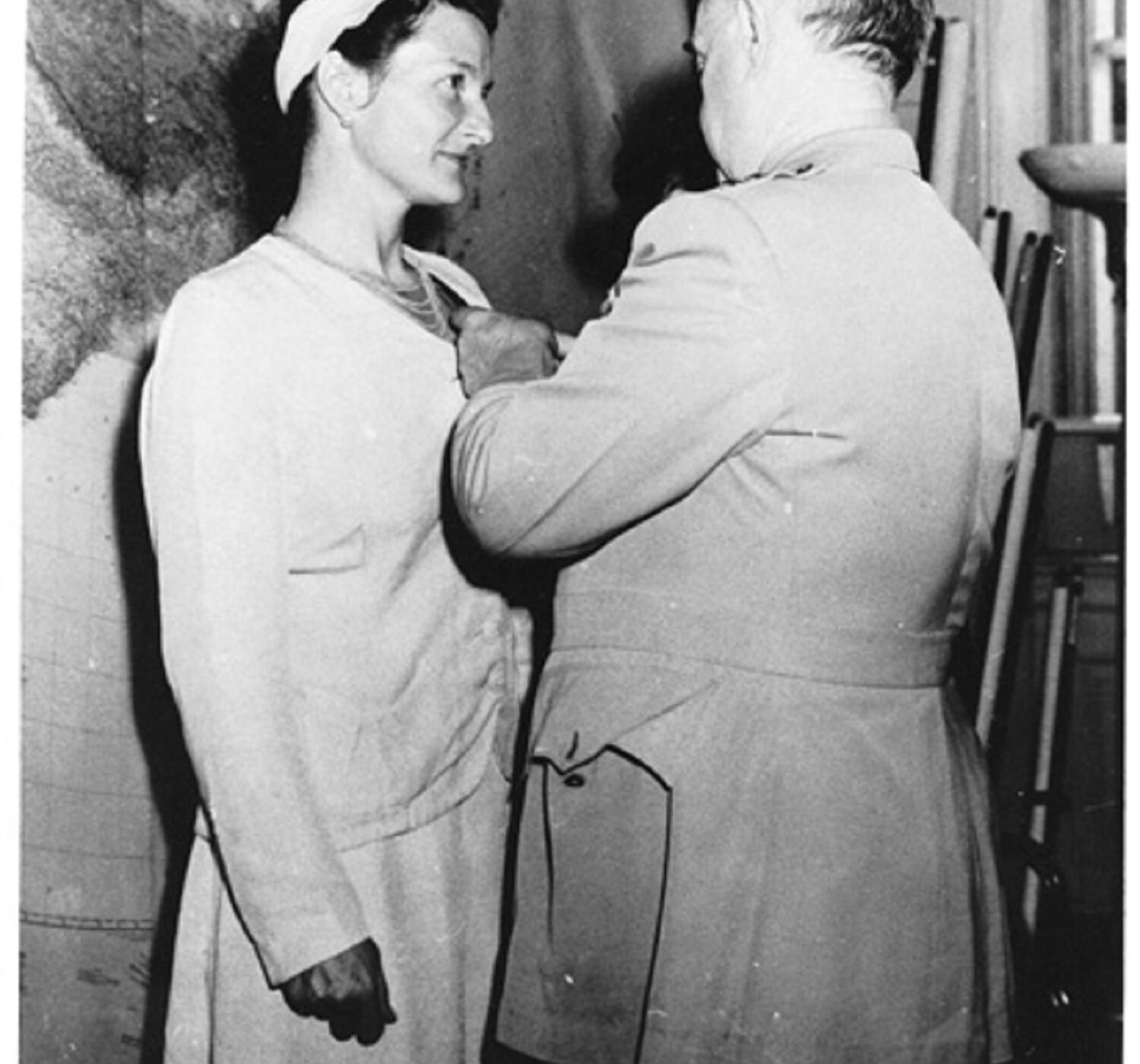
In September 1945 General Donovan pinned the Distinguished Service Cross, America’s second-highest award for valour, on Virginia Hall in his office. She was the only civilian woman to receive it in the Second World War. President Truman had wanted to present it in public. She declined, saying she was still operational and anxious to get back to work. France gave her the Croix de Guerre with Palm.1,2
After the war she went back to Lyon to find the people who had helped her. Many had been arrested after she fled. Germaine Guérin and Dr Rousset had survived the concentration camps; Hall pressed the British to compensate Guérin. Others were dead. The priest Robert Alesch was tried in Paris and executed in 1949.2
A desk at the CIA
In 1947 Hall joined the new Central Intelligence Agency, one of its first women officers. The agency did not know what to do with her. She was given desk jobs, passed over for promotion and posts for which she was well qualified, and received a poor report from a supervisor who had never seen her work. A later CIA history admitted that her male colleagues had felt threatened by her and that her experience “was never properly utilized”. She retired in 1966, at the compulsory age of sixty.1
In 1957 she married Paul Goillot, a French-American OSS officer she had worked with in France. They lived on a farm at Barnesville, Maryland. She rarely spoke about the war and never wrote about it. She died in Rockville, Maryland, on 8 July 1982.1,2
Recognition came late. In 1988 she was named to the Military Intelligence Corps Hall of Fame. In 2006 the British and French ambassadors honoured her in Washington on the hundredth anniversary of her birth. In 2016 the CIA named a training facility for field officers after her. The woman the State Department had turned away because of her leg is now held up by the CIA as one of the finest intelligence officers of her generation.1
Timeline
- 6 April 1906 Born in Baltimore, Maryland.
- 1933 Loses her left leg below the knee after a hunting accident in Turkey.
- 1937 Turned down by the Foreign Service.
- February 1940 Joins the French army ambulance service.
- April 1941 Recruited by SOE.
- 23 August 1941 Arrives in Vichy France; builds the Heckler network in Lyon.
- 15–16 July 1942 Eleven SOE prisoners escape from Mauzac with her help.
- 8 November 1942 Flees Lyon and crosses the Pyrenees on foot.
- 21 March 1944 Lands in Brittany as an OSS agent.
- July–August 1944 Arms and directs maquis groups in the Haute-Loire.
- September 1945 Awarded the Distinguished Service Cross.
- 1947 Joins the CIA.
- 1966 Retires.
- 8 July 1982 Dies in Rockville, Maryland.
- Central Intelligence Agency, “Virginia Hall: The Courage and Daring of ‘The Limping Lady’”, cia.gov
- Sonia Purnell, A Woman of No Importance: The Untold Story of the American Spy Who Helped Win World War II (Viking, 2019).
- Judith L. Pearson, The Wolves at the Door: The True Story of America’s Greatest Female Spy (Lyons Press, 2005).
- M. R. D. Foot, SOE in France: An Account of the Work of the British Special Operations Executive in France, 1940–1944 (HMSO, 1966).
- The line that the Gestapo thought her “the most dangerous of all Allied spies” is repeated in many accounts, including the CIA’s, but no German document containing it has been published. The “eliminate Cuthbert” exchange comes from SOE lore and Hall’s biographers.
Found an error, or hold a related record? Tell the research desk.
Share what you know