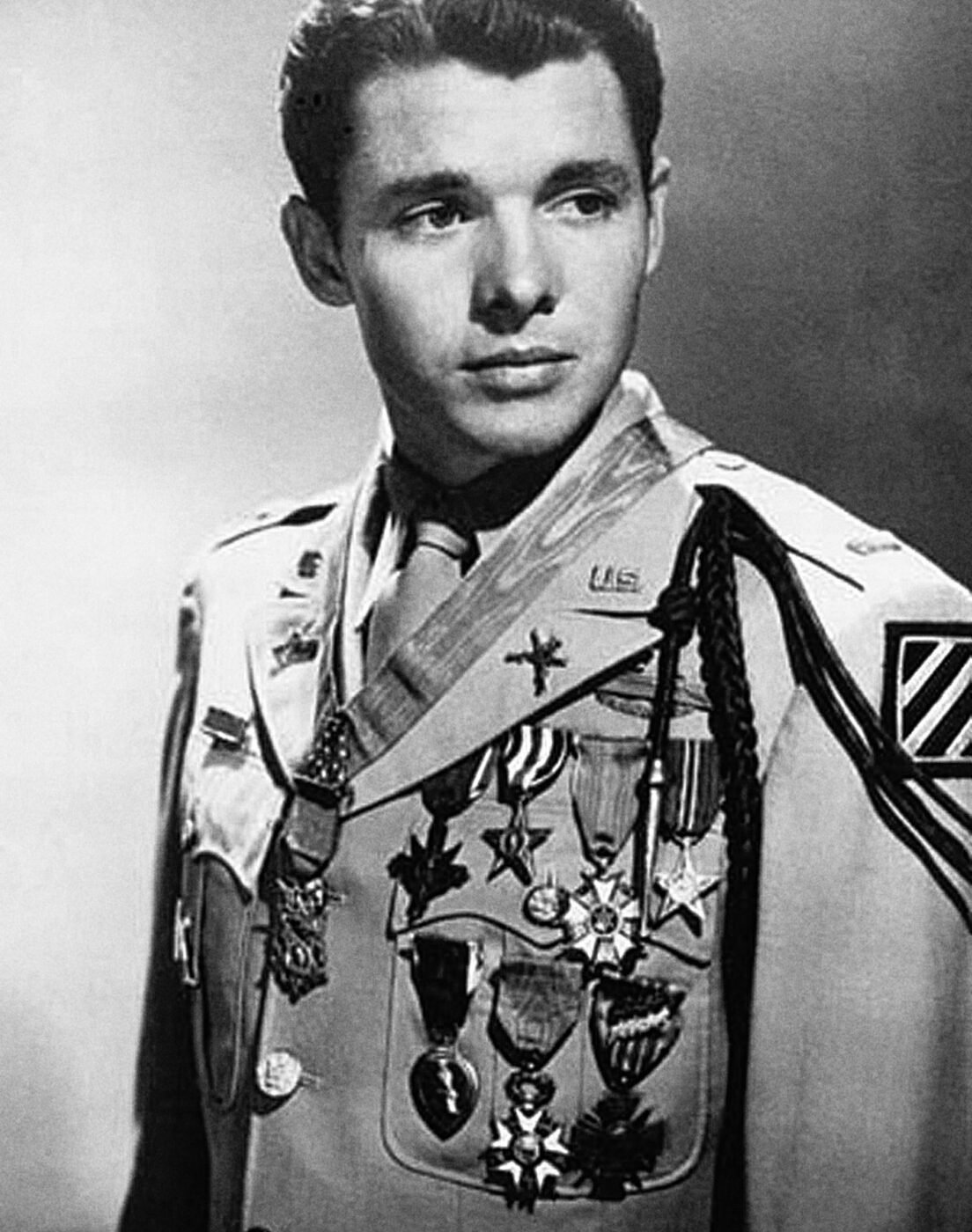

Audie Leon Murphy was born on 20 June 1925 near Kingston, Texas, the seventh of twelve children of Emmett and Josie Murphy, sharecroppers who moved from farm to farm across the cotton country of north-east Texas. His father walked out on the family. Audie left school in the fifth grade to pick cotton, and learned to shoot straight by hunting rabbits and birds to put food on the table for his brothers and sisters.2,3
In 1941 his mother died of endocarditis and pneumonia. The three youngest children were placed in an orphanage, the Boles Children’s Home at Quinlan. Audie was sixteen.3
Too small for the Marines
After Pearl Harbor he tried to enlist. The Army, the Navy and the Marine Corps all turned him down at first; he was slight, underweight and obviously young. His older sister Corinne signed an affidavit that made him a year older than he was, and on 30 June 1942 the Army accepted him. His official records give his birth year as 1924 for the rest of his life. In basic training at Camp Wolters, Texas, he earned the marksman and expert badges.3
In February 1943 he shipped to Casablanca and joined Company B, 1st Battalion, 15th Infantry Regiment, in the 3rd Infantry Division under General Lucian Truscott. He would stay with the same regiment for the rest of the war.3
Sicily, Salerno and Anzio
The division landed in Sicily at Licata on 10 July 1943, and in Italy in September. Murphy was promoted to corporal, then sergeant. On a scouting patrol near the Volturno River his group was ambushed and one of his companions was killed; Murphy fought back with grenades and automatic fire, killing five Germans. In the fighting for the Volturno Line his company beat off an attack by seven German soldiers, killing three and capturing four.3
He caught malaria in January 1944 and missed the first days of the landing at Anzio, then rejoined his company in time for the fighting around Cisterna, where he became a platoon sergeant. On 2 March 1944, sheltering with his platoon in an abandoned farmhouse, he crawled out alone and destroyed a German tank with rifle grenades. It won him his first Bronze Star with “V” device.3
The vineyard in Provence
On 15 August 1944 the 3rd Division landed in southern France, near Ramatuelle. Moving inland through a vineyard, Murphy’s platoon came under fire. Two Germans in a house nearby waved as if to surrender, and when Murphy’s closest friend in the platoon, Lattie Tipton, stood up to accept, they shot him dead. Murphy advanced alone on the house under direct fire, killed six Germans, wounded two and took eleven prisoners. He was awarded the Distinguished Service Cross, the Army’s second-highest award for valour.3
In the weeks that followed he was wounded in the heel by a mortar round, won a Silver Star for knocking out a German machine-gun position at the L’Omet quarry, and a second for crawling forward alone with a radio to direct his men’s fire for an hour. On 14 October 1944 he received a battlefield commission as a second lieutenant. Twelve days later a German sniper shot him in the hip; gangrene set in, and he did not return to his unit until January 1945.3
26 January 1945: the counter-attack at Holtzwihr
By then the division was fighting to clear the Colmar Pocket, the last German foothold on the west bank of the Rhine in Alsace. On 26 January, near the village of Holtzwihr, Murphy was commanding what was left of Company B when the Germans counter-attacked with tanks and waves of infantry.1,3
He ordered his men to pull back into prepared positions in the woods and stayed forward alone, directing artillery by field telephone. An American M10 tank destroyer near his command post took a direct hit and caught fire. Murphy climbed up onto the burning vehicle and turned its .50-calibre machine gun on the advancing Germans. He killed a German squad that was crawling towards him along a ditch.1,3
For about an hour he stood on the burning tank destroyer, under fire from German infantry and tanks on three sides, firing the machine gun and calling in artillery. He was wounded in the leg. He stopped only when the ammunition ran out. Then he rejoined his men and led a counter-attack that drove the Germans back. The citation estimates that he killed or wounded about fifty German soldiers.1
“They were killing my friends.”
Audie Murphy, asked why he had taken on a German company alone
The most decorated soldier
Lieutenant General Alexander Patch presented him with the Medal of Honor near Salzburg, Austria, on 2 June 1945. By the end of the war Murphy had received every American award for valour open to an Army soldier: the Medal of Honor, the Distinguished Service Cross, two Silver Stars, two Bronze Stars with “V”, three Purple Hearts and the Legion of Merit, along with the French Légion d’honneur and Croix de Guerre and the Belgian Croix de Guerre.1,3
On 16 July 1945 his face was on the cover of Life magazine as the most decorated soldier of the war. The actor James Cagney saw it and invited him to Hollywood. Murphy was discharged as a first lieutenant on 21 September 1945, with a fifty per cent disability rating. He had just turned twenty.3,4
To Hell and Back
He wrote a memoir, To Hell and Back, published in 1949, and in 1955 he played himself in the film of it, which became Universal’s biggest hit up to that time. He made more than forty films in all, most of them westerns. He also bred quarter horses, wrote country songs and served in the Texas National Guard.2,3
The war never left him. He slept with a loaded pistol under his pillow, suffered from insomnia and nightmares, and for years depended on sleeping pills until he broke the habit in the 1960s. At a time when few veterans would talk about it, he spoke openly about what was then called battle fatigue, and urged the government to do more for returning soldiers with the same wounds. Though often short of money, he turned down offers to advertise alcohol and cigarettes because he did not want to set a bad example to young people.3
Audie Murphy was killed on 28 May 1971 when the small plane he was travelling in crashed into a mountain near Roanoke, Virginia. He was forty-five. He was buried at Arlington National Cemetery, where his simple government headstone is said to be the most visited grave after President Kennedy’s.3
Timeline
- 20 June 1925 Born near Kingston, Texas.
- 1941 His mother dies; younger siblings placed in an orphanage.
- 30 June 1942 Enlists in the Army, his age raised by a year.
- 10 July 1943 Lands in Sicily with the 3rd Infantry Division.
- 2 March 1944 Destroys a German tank at Anzio; first Bronze Star.
- 15 August 1944 Lands in southern France; action that earns the Distinguished Service Cross.
- 14 October 1944 Battlefield commission as a second lieutenant.
- 26 January 1945 Holds off a German attack from a burning tank destroyer at Holtzwihr.
- 2 June 1945 Receives the Medal of Honor near Salzburg.
- 16 July 1945 On the cover of Life magazine.
- 1949 and 1955 Memoir To Hell and Back published; plays himself in the film.
- 28 May 1971 Killed in a plane crash near Roanoke, Virginia.
- Medal of Honor citation for Second Lieutenant Audie L. Murphy, U.S. Army Center of Military History.
- Audie Murphy, To Hell and Back (Henry Holt, 1949).
- Don Graham, No Name on the Bullet: A Biography of Audie Murphy (Viking, 1989).
- Life magazine, 16 July 1945.
- The number of enemy killed or wounded at Holtzwihr is the estimate given in the citation. The total of 241 enemy killed often credited to him is an estimate, not an official count.
Found an error, or hold a related record? Tell the research desk.
Share what you know