
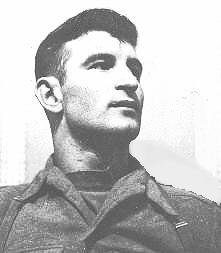
Léo Major was born on 23 January 1921 in New Bedford, Massachusetts, to French-Canadian parents who moved back to Montreal before his first birthday. He did not get on with his father, and at fourteen he went to live with an aunt. In 1940, wanting to prove himself, he joined the Canadian Army and was posted to the Régiment de la Chaudière, a French-speaking infantry regiment from Quebec.1,2
D-Day and the lost eye
On 6 June 1944 the regiment landed on Juno Beach in Normandy. On a reconnaissance that first day, Major is credited with capturing a German half-track vehicle and the communications equipment and codes inside it.2
Days later, in his first encounter with the Waffen-SS, he killed four German soldiers, but one of them set off a phosphorus grenade. It cost him his left eye. The Army was ready to send him home. He refused, arguing that a sniper only needs one good eye to aim, and that with his patch he looked like a pirate. He stayed on as a scout and sniper.2,4
The Scheldt: a disputed story
In the autumn of 1944 the Canadian Army fought a long, bitter campaign to clear the banks of the Scheldt estuary in the southern Netherlands and open the port of Antwerp. The popular story of Major’s part in it is extraordinary: that, out alone one night, he captured one German after another, used a captured officer to talk the rest of a company into surrendering, and brought ninety-three prisoners back to the Canadian lines, even after SS troops opened fire on the column and killed several of them.2,4
That story is told in many places, including in books about him and in his own later interviews. Modern historians, among them researchers at Dutch museums, have questioned whether one man could have taken and controlled so many prisoners alone, and the documentation for the event is thin. It is also often said that he was nominated for the Distinguished Conduct Medal for it and turned the medal down because he thought Field Marshal Montgomery incompetent; the records do not settle that either.2
Wounded again
In February 1945, near Keppeln in Germany, Major was helping a chaplain recover the bodies of the crew of a destroyed tank when their carrier hit a land mine. The chaplain and the driver were killed. Major was knocked unconscious and badly injured in the back, and was taken thirty miles to a field hospital. Once again he returned to his unit.2
13 April 1945: two men volunteer
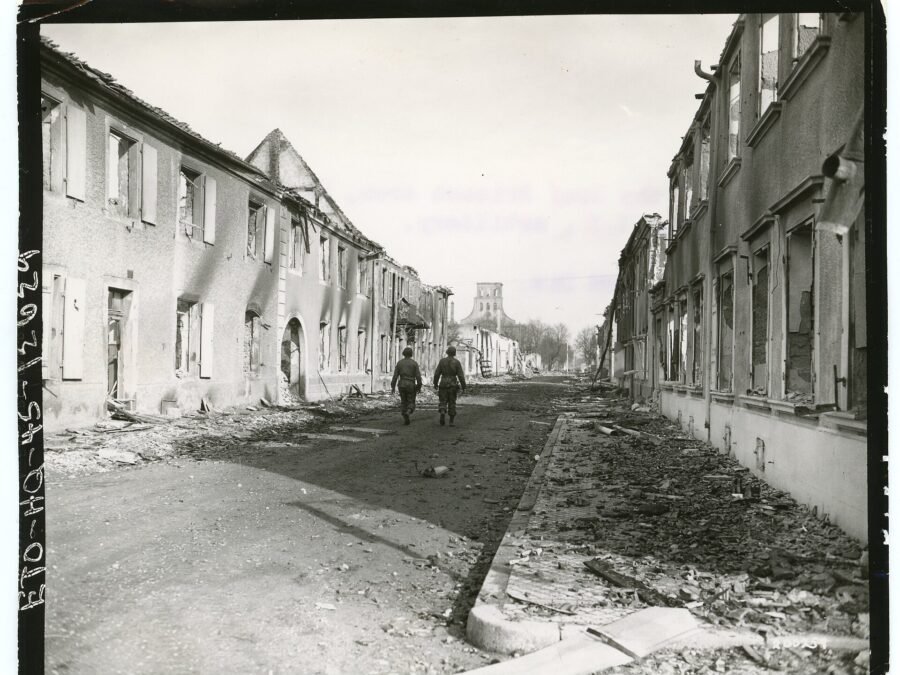
By April the Canadians were advancing into the northern Netherlands. On 13 April the Régiment de la Chaudière reached the outskirts of Zwolle, a medieval city on the IJssel river. Reports suggested strong German resistance, and Canadian artillery was preparing to shell the city before the regiment attacked. The commanding officer asked for volunteers to go in and find out what was there.2,3
Major and his friend Corporal Wilfrid Arsenault volunteered. They agreed to try to get into the city at night and, if they could, to find a way of sparing it from the bombardment. That evening a local farmer told them where the Germans were. Soon after they set out, Arsenault was killed by German fire.2,3
Alone in the city
Major killed two Germans and went on alone, entering the city through the Sassenpoort, one of its old gates. What happened over the following hours is where the accounts divide.2
In the popular version, told in documentaries and on the internet, he spent the night running through the streets firing a machine gun and throwing grenades, making so much noise that the Germans believed a large Canadian force had arrived and fled; some versions add that he set fire to the Gestapo headquarters. The official recommendation for his Distinguished Conduct Medal is more restrained. It says he patrolled alone for six hours, made contact with the Dutch resistance, organised patrols of local civilians, and that the German garrison withdrew because its position had become untenable.1,2
“After a while I was so tired that I couldn’t think straight anymore.”
Léo Major, in a radio interview about that night
Dutch historians point out that German forces were already withdrawing from the area, and that much of the city may have been quiet. Either way, when morning came the Germans had gone, the artillery bombardment was called off, and the Régiment de la Chaudière entered Zwolle the next day without firing a shot. Major received the Distinguished Conduct Medal, the second-highest award for gallantry for soldiers of his rank in the Commonwealth.1,2,3
Hill 355, Korea
After the war Major went back to Montreal, had surgery on his back and worked as a pipefitter. When the Korean War began, he was recalled and joined the scout and sniper platoon of the Royal 22e Régiment.2
In November 1951, in the fighting around Hill 355, nicknamed “Little Gibraltar”, Chinese forces had taken a nearby hill from the Americans. Major led a group of eighteen men, wearing running shoes to move quietly, up through the Chinese positions, and they retook the hill in the early hours. The Chinese counter-attacked with far larger forces. Major refused an order to withdraw and held on through the night, calling artillery fire in so close to his own position that the officer directing it later said Major kept asking for it to come closer. His platoon held the hill for three days, until relieved.2
For that action he received a bar to his Distinguished Conduct Medal: a second award, in a second war. He was one of very few Commonwealth soldiers, and the only Canadian, to receive the medal twice in separate wars.2
An honorary citizen
Major married Pauline De Croiselle in 1951, and they had four children. For decades he was little known outside his family and his regiment. In Zwolle he was not forgotten. The city made him an honorary citizen on 14 April 2005, sixty years to the day after its liberation, and named a street after him.2,3
Léo Major died in Candiac, Quebec, on 12 October 2008, aged eighty-seven. In 2020 Canada Post issued a stamp in his honour for the seventy-fifth anniversary of the end of the war in Europe.2
Timeline
- 23 January 1921 Born in New Bedford, Massachusetts.
- 1940 Joins the Canadian Army; Régiment de la Chaudière.
- 6 June 1944 Lands on Juno Beach.
- June 1944 Loses his left eye to a phosphorus grenade.
- Autumn 1944 Battle of the Scheldt: the disputed 93 prisoners.
- February 1945 Badly injured by a mine near Keppeln, Germany.
- 13–14 April 1945 Enters Zwolle alone; the Germans withdraw by morning.
- November 1951 Retakes and holds a hill near Hill 355 in Korea.
- 1951 Awarded a bar to his Distinguished Conduct Medal; marries Pauline De Croiselle.
- 14 April 2005 Made an honorary citizen of Zwolle.
- 12 October 2008 Dies in Candiac, Quebec, aged 87.
- 2020 Canada Post issues a stamp in his honour.
- Library and Archives Canada, recommendation for the Distinguished Conduct Medal, Pte. L. Major, 1945.
- Canadian War Museum and Veterans Affairs Canada, material on Léo Major.
- Dutch museum and archive research on the liberation of Zwolle, April 1945, as reported in Dutch and Canadian media.
- The popular account of his solo liberation of Zwolle, and of his capture of 93 prisoners in the Scheldt, goes beyond what the official records show. Dutch historians have questioned both. We give the official record and note where the stories differ.
Found an error, or hold a related record? Tell the research desk.
Share what you know