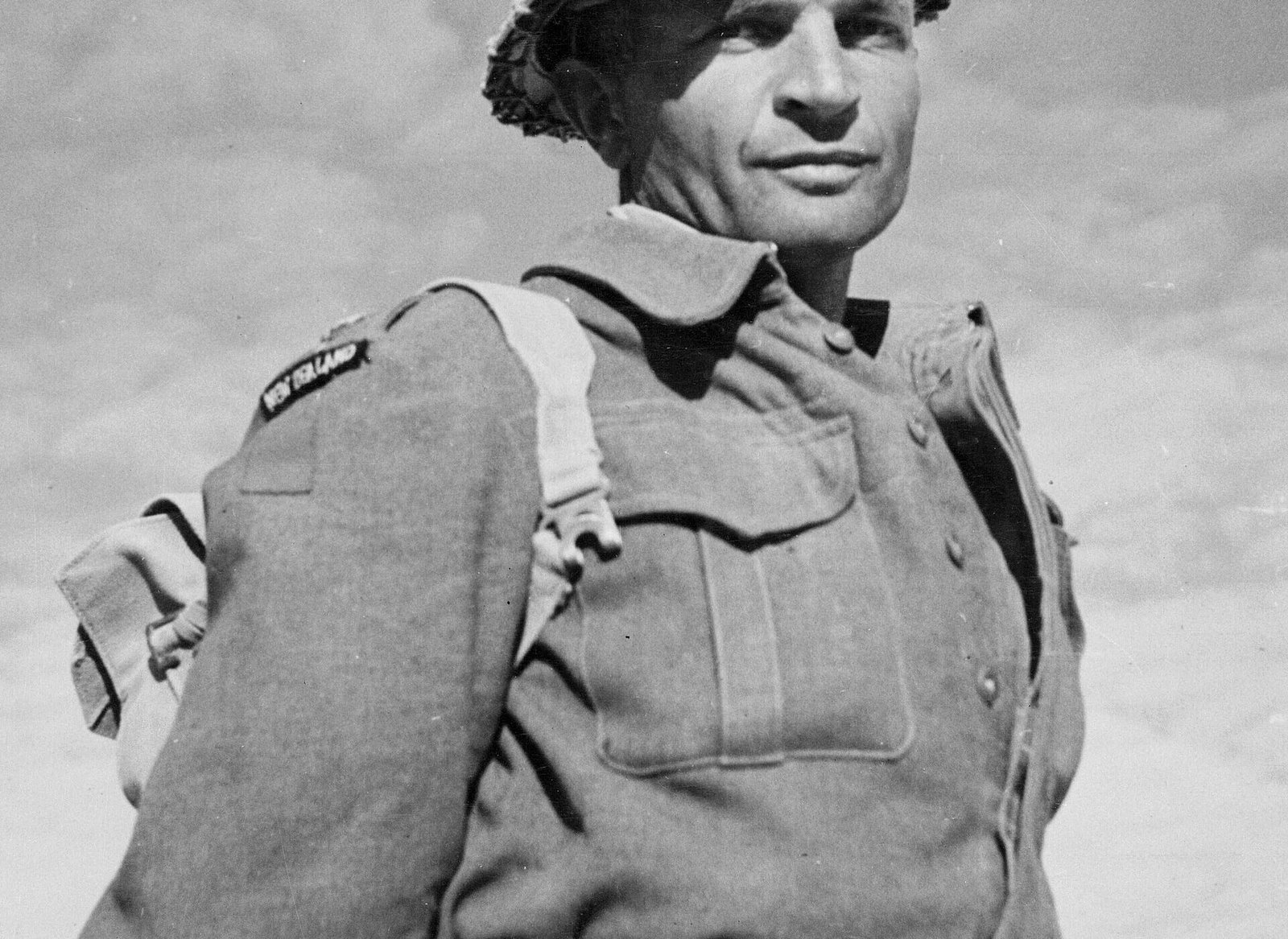

Only three people have ever been awarded the Victoria Cross twice. Two were doctors of the Royal Army Medical Corps, decorated for rescuing the wounded under fire: Arthur Martin-Leake in South Africa and Flanders, and Noel Chavasse, who died of wounds on the Western Front in 1917. The third was a quiet New Zealand sheep farmer who went to war at thirty and spent most of it either fighting or trying to escape. Charles Upham is the only fighting soldier ever to win the Victoria Cross and Bar.1,2
A farmer from Canterbury
Charles Hazlitt Upham was born in Christchurch on 21 September 1908, the only son of a lawyer. He was a slight, shy boy, not strong as a child, with one leg a little shorter than the other. At school, a friend remembered, he kept to himself, walking to class wrapped in his own thoughts. He was normally placid, but capable of a fierce temper, and once he gave his word, nothing would move him.3
His father hoped he would join the family law practice. Charles said he would always be jealous of his friends on farms. He went to Canterbury Agricultural College, now Lincoln University, finished at the top of his class, and spent six years as a shepherd, musterer and farm manager in the high country of Canterbury. In 1937 he joined the government’s land valuation department. He had met a nurse named Molly McTamney at the Riccarton races in 1935; he proposed to her the next day, with an armful of red roses. She said no. They became engaged three years later.3
A private who would not be an officer
When war came in September 1939, Upham volunteered for the 2nd New Zealand Expeditionary Force. He already held the rank of sergeant in the part-time Territorial Force, but he signed on as a private in the 20th Battalion, drawn from Canterbury and Otago. He turned down an offer of officer training; he wanted to stay with the men. He sailed for Egypt as a sergeant in January 1940, and in the summer was finally persuaded to go to officer cadet school. He was commissioned as a second lieutenant on 2 November 1940 and given a platoon.3
His men found him an odd kind of officer: modest, untidy, careless of his own comfort and obsessive about theirs, and utterly calm under fire. He trained them hard, and hated any order that wasted their lives.3
Greece and Crete
In March 1941 the New Zealanders were sent to Greece to meet the German invasion. The campaign was short and disastrous. The Allied force was driven back through Greece and evacuated by sea, and many of the New Zealanders were landed on Crete, where they dug in to meet the next German attack.1,3
It came on 20 May 1941, from the sky: the largest airborne assault the world had yet seen. German paratroopers and glider troops landed around the airfield at Maleme in the west of the island. On 22 May Upham led a forward platoon of the 20th Battalion in the counter-attack to retake it. For more than 3,000 yards his men fought their way forward without artillery or other support, through a German defence organised in depth.1
Three times his sections were held up, and three times Upham dealt with it himself. He went forward with pistol and grenades against one machine-gun nest until its crew broke. He walked up to a house where two machine guns were firing and threw a grenade through the window. He crawled to within fifteen yards of another post and killed the gunners with a grenade. When the attack failed and his company withdrew, he helped carry a wounded man out under fire. Then, with a corporal, he went more than 600 yards through territory held by the enemy, killing two Germans on the way, to bring back a company that had not received the order to retire and would otherwise have been cut off.1
Galatas and Sphakia
The retreat that followed lasted a week. Upham’s platoon held a position on exposed forward slopes under constant fire. A mortar bomb blew him over; another put a splinter in his left shoulder; a bullet lodged in his foot, which he cut out himself later in Egypt. He had dysentery the whole time and could hardly eat. At Galatas on 25 May, when the Germans advanced, he brought his platoon forward to meet them, and they killed more than forty with rifle fire and grenades.1
Ordered to fall back, he sent his men off under the platoon sergeant and went to warn another company that it was about to be cut off. Coming back alone, he was fired on by two Germans. He fell and lay still, pretending to be dead. With the use of only one arm, he rested his rifle in the fork of a tree, and as the Germans came up to look, he shot them both. The second fell on the muzzle of his rifle.1
On 30 May, near the evacuation beach at Sphakia on the south coast, a German party worked its way down a ravine towards the force headquarters. Exhausted, Upham climbed the steep hill beside the ravine, placed his men on the slope, and went to the top with a Bren gun and two riflemen. He drew the Germans into the open and, at 500 yards, killed twenty-two of them. The rest scattered. Over the last nights of May the Royal Navy took as many of the survivors off the island as it could.1
“For the whole unit”
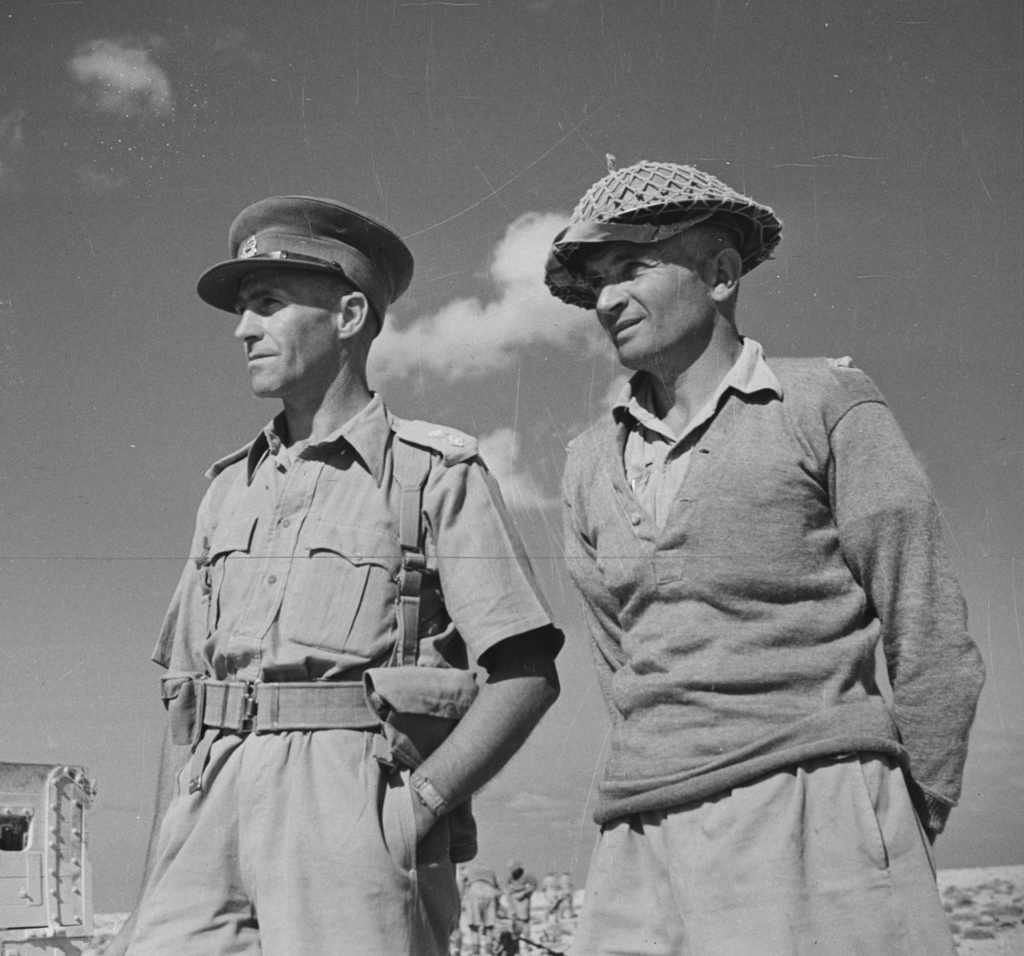
His commanding officer, Lieutenant Colonel Howard Kippenberger, recommended him for the Victoria Cross. Upham did not want it. Other men, he said, had done as much. Kippenberger persuaded him to accept it as recognition for the whole platoon. The award was announced in the London Gazette on 14 October 1941, and on 4 November General Sir Claude Auchinleck pinned the ribbon on him in front of the 4th Brigade.1,3
Kippenberger then kept him out of the next battle, the Libyan campaign of November 1941. Upham, he wrote, was fretting for action and would get himself killed too quickly. Upham was furious. The battalion lost heavily, and he was put to work rebuilding it as commander of C Company.3
Minqar Qaim
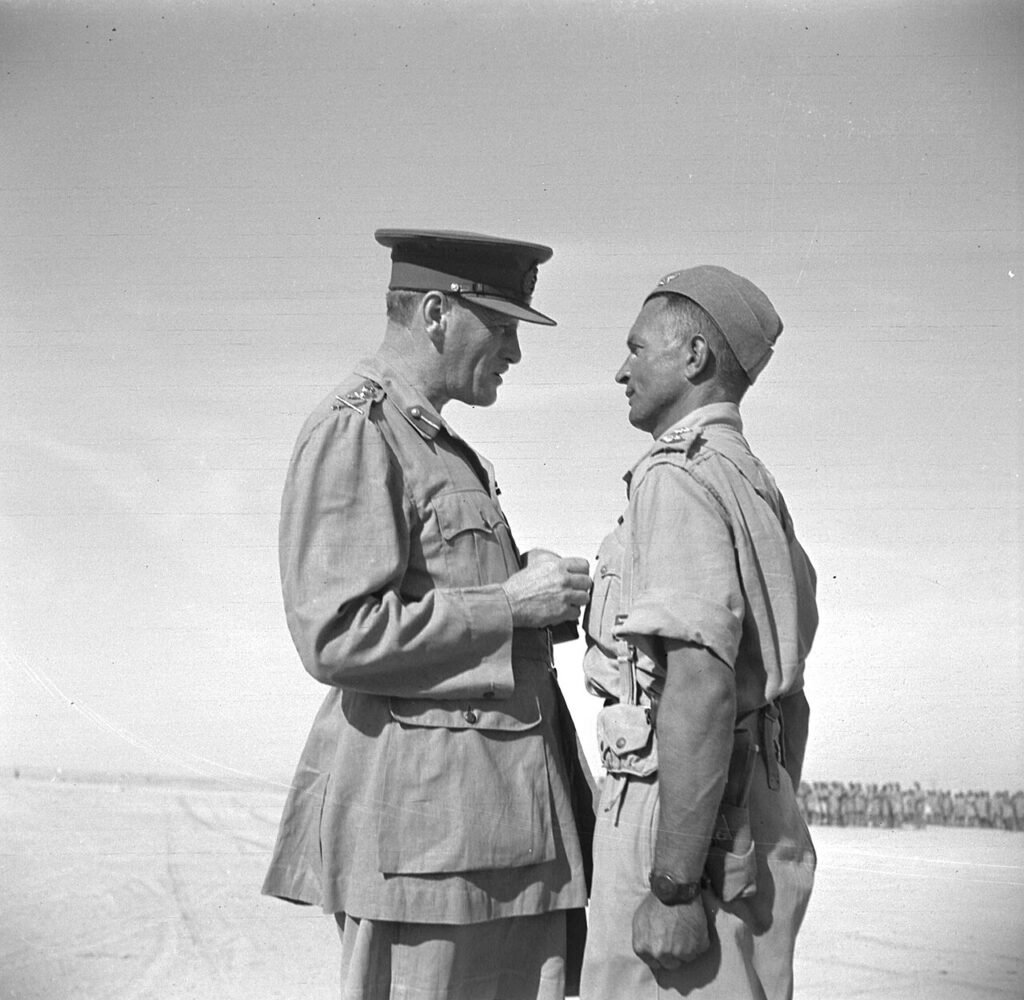
By June 1942 Rommel’s Afrika Korps had driven the British Eighth Army back into Egypt. The New Zealand Division, surrounded at Minqar Qaim, broke out through the German lines on the night of 27–28 June in savage hand-to-hand fighting. Upham, now a captain, threw grenades at such close range that he was wounded in both arms by the fragments of his own bombs. In one action before Ruweisat, according to his second citation, he destroyed an entire truckload of German soldiers with grenades.2,3
Ruweisat Ridge
The Eighth Army stood at El Alamein. On the night of 14–15 July 1942 the New Zealanders attacked Ruweisat Ridge. Upham’s company was in the reserve battalion. When communications with the forward troops broke down, he was told to send an officer to find out what was happening. He went himself, armed with a captured German machine gun, fought his way through several enemy posts, and came back with the information.2
Just before dawn the reserve battalion was ordered forward and ran into a strongly held position of four machine-gun posts and several tanks. Upham led his company straight at the two nearest strongpoints. His voice could be heard above the noise of the battle, cheering his men on. They took the position. Upham destroyed a German tank and several guns and vehicles with grenades. A machine-gun bullet went through his elbow and broke his arm; he went forward again to bring back some of his men who had been cut off.2
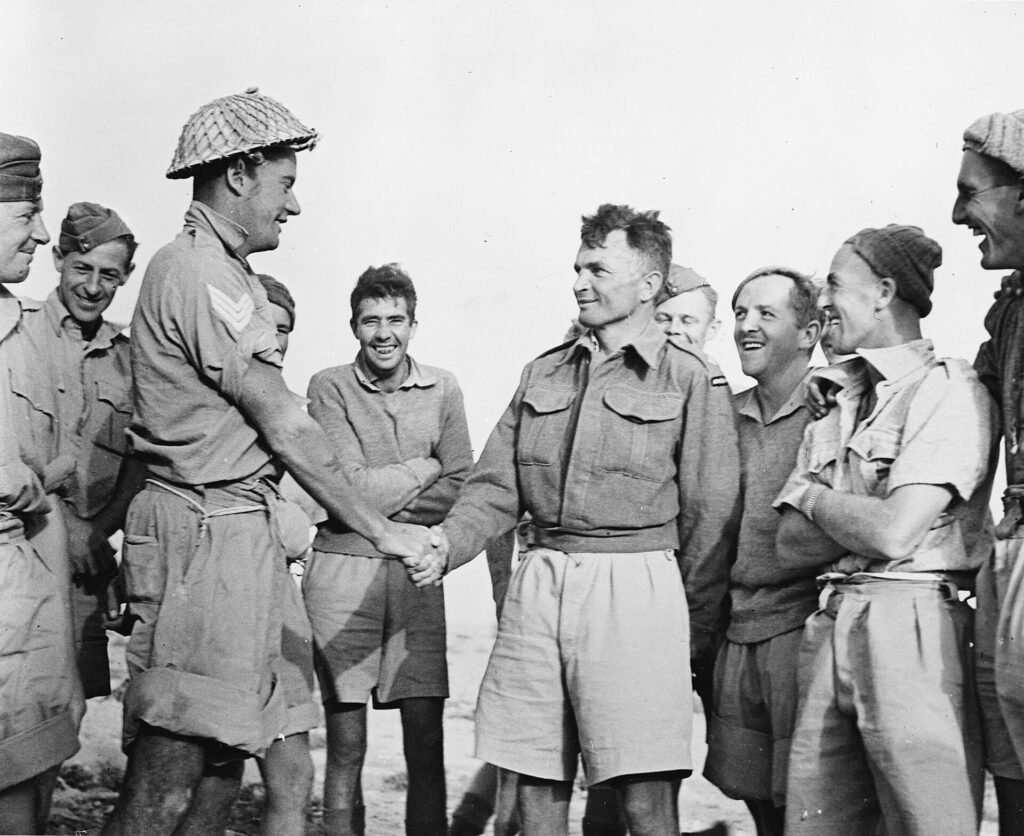
Weak from loss of blood, he was taken to the regimental aid post, had the wound dressed, and went straight back to his men. He stayed with them all day under artillery and mortar fire until he was hit again, in the leg, and could no longer move. By then his company was down to six men. When the Germans overran the position that afternoon, Upham was captured with them, one of about a thousand New Zealanders taken that day.2,3
The prisoner who would not stay
In an Italian hospital a doctor wanted to amputate his shattered arm. Upham refused; he had watched other men suffer and die after operations without proper anaesthetic. A fellow prisoner, an Allied doctor, dressed the wound instead, and the arm was saved.3
From then on he tried to escape at every opportunity. At the camp at Modena in 1943 he smashed through the plasterboard ceiling of his cell, only to find a second ceiling wired in above it. After Italy surrendered in September 1943 and the Germans moved the prisoners north, he jumped from a lorry on a bend and got four hundred yards, on a broken ankle, before he was caught. At Weinsberg camp in Germany he tried to climb the double fence in broad daylight and fell between the wires. When a guard held a pistol to his head, Upham ignored him and lit a cigarette. The Germans photographed the scene.3
That was enough for them. He was sent to Colditz Castle, the prison for Allied officers who had made persistent escape attempts. On the way, guarded on a civilian train and allowed to the lavatory only when the train was going fast, he forced open the window and jumped, knocking himself unconscious on the track. He came round, ran into an orchard, and was recaptured among its bare, even rows of trees.3
“Mostly eating, sir”
American troops liberated Colditz in April 1945. Upham went straight to the American headquarters in the town, collected a uniform, a Thompson gun, a revolver, grenades and a compass, and tried to join the fighting. For four days he waited with the Americans for the order to move forward, until word came that released prisoners were on no account to join fighting units. He was sent to England.3
On 11 May 1945 King George VI invested him with his Victoria Cross at Buckingham Palace. The King congratulated him on a mention in despatches for his escape attempts and asked what he had been doing since arriving in London. “Mostly eating, sir,” Upham replied. On 20 June he married Molly McTamney, then nursing in England, at Barton on Sea in Hampshire.3
His officers had already put him forward for a second Victoria Cross. Separate recommendations were written for Minqar Qaim and for Ruweisat Ridge, and each argued that one action alone deserved the award; because a Bar was so rare, the two were combined. When the King asked Kippenberger whether Upham deserved a second, Kippenberger answered that in his respectful opinion Upham had won the VC several times over. The Bar was gazetted on 26 September 1945.2,3
A farm at Conway Flat
At home the people of Canterbury raised £10,000 to buy him a farm. Upham would not take it. The money was used instead for a scholarship for the children of servicemen to study at the agricultural college he had loved. He took an ordinary rehabilitation loan and bought a sheep farm at Conway Flat, Hundalee, in North Canterbury, where he and Molly raised three daughters. His wartime wounds made the work hard, but he farmed there for almost fifty years. He rarely spoke of the war and disliked the fuss when others did.3
Charles Upham died in Christchurch on 22 November 1994, aged eighty-six. More than 5,000 people lined the streets for his funeral with full military honours. He is buried at St Paul’s Church, Papanui. His Victoria Cross and Bar, bought from his daughters by the Imperial War Museum in 2006, are on permanent loan to the National Army Museum at Waiouru. In December 2007 they were among nine Victoria Crosses stolen from the museum; all were recovered two months later after a reward was offered.5
Timeline
- 21 September 1908 Born in Christchurch, New Zealand.
- September 1939 Enlists as a private in the 20th Battalion.
- 2 November 1940 Commissioned as a second lieutenant.
- 22 May 1941 Leads his platoon in the counter-attack at Maleme, Crete.
- 25–30 May 1941 Galatas and Sphakia.
- 14 October 1941 Victoria Cross gazetted.
- 27–28 June 1942 Breakout at Minqar Qaim.
- 14–15 July 1942 Ruweisat Ridge; wounded twice and captured.
- 1943 Repeated escape attempts; sent to Colditz.
- April 1945 Liberated at Colditz.
- 11 May 1945 Invested with the VC by King George VI.
- 26 September 1945 Bar to the Victoria Cross gazetted.
- 22 November 1994 Dies in Christchurch.
- The London Gazette, 14 October 1941: Victoria Cross citation, Second Lieutenant C. H. Upham.
- The London Gazette, 26 September 1945: Bar to the Victoria Cross citation, Captain C. H. Upham.
- Kenneth Sandford, Mark of the Lion: The Story of Capt. Charles Upham, V.C. and Bar (Hutchinson, 1962).
- Imperial War Museums and the National Army Museum of New Zealand, Waiouru, on the Victoria Cross and Bar.
Found an error, or hold a related record? Tell the research desk.
Share what you know