In July 1917 the soldiers of the 102nd Infantry Regiment, Connecticut National Guardsmen now part of the new 26th “Yankee” Division, were training for war on the fields around the Yale Bowl in New Haven. A small brindle dog with a short stump of a tail began turning up at their drills. Nobody knew where he came from. He was some kind of bull terrier mix, probably with a lot of the young Boston terrier breed in him, and he was friendly with everyone.2,3
One soldier took to him more than the rest: James Robert Conroy, a twenty-five-year-old from New Britain, Connecticut. Conroy fed him, let him sleep in his bunk, and named him Stubby. The dog learned the bugle calls and the drills, and marched with the men. Someone taught him to raise his right paw to his eyebrow when he saw an officer.2,3
Smuggled to France
Dogs were not allowed to go overseas with the troops. When the 102nd sailed for France in the autumn of 1917, Conroy smuggled Stubby aboard the troopship SS Minnesota and kept him hidden in the coal bunker. When the ship docked, he carried him off under his greatcoat. According to the story Conroy told, when an officer finally discovered the dog, Stubby sat up and saluted, and the officer let him stay.2,3
The United States Army of 1917 had no dogs of its own. The British, French and Germans used thousands of them in the war, to carry messages, find wounded men, pull carts and guard positions, but it would be another quarter of a century before the American military created a dog corps. Stubby was not a trained war dog. He was a mascot, and a soldier’s pet, who happened to go to war.2
The European armies took their dogs seriously. The Germans trained tens of thousands as sentries, messengers and ambulance dogs that searched no man’s land for the wounded, carrying first-aid kits on their backs. The French used them to haul supplies and machine guns. In 1917 the British opened a War Dog School under Lieutenant Colonel Edwin Richardson, whose messenger dogs ran through shellfire between the front line and headquarters when telephone wires were cut. Against that professional background, Stubby was an amateur, and all the more loved for it.2
Into the line
The 26th Division was one of the first American divisions to reach the front. On 5 February 1918 the 102nd went into the trenches at the Chemin des Dames, north of Soissons, in a sector held by the French, and Stubby went with it. For more than a month the regiment was under fire day and night.1,2
He adapted to the trenches as the men did. He learned to recognise the whistle of incoming shells before the soldiers could hear them and to dive for cover, and the men watched him and followed. He went out into no man’s land and came back, and stayed with wounded men until someone found them. Over the winter and spring, as the stories of him spread through the division, he became something more than a pet: a sign of luck, and of home.2,3
Gassed
In the spring of 1918 the regiment moved to a sector near Toul, in Lorraine. Poison gas was one of the worst terrors of the Western Front: chlorine, phosgene, and above all mustard gas, which lay in shell holes and low ground for days, blistering skin, blinding eyes and burning lungs. Stubby was gassed and had to be taken back to a field hospital to recover. When he returned, the men gave him a gas mask adapted for his head.1,2
The experience left him sensitive to the smell. According to his regiment, he would bark and run through the trench when he caught the first whiff of gas, and the soldiers learned to take his warning. One story, told by the regiment and repeated in every account since, has him rousing a sleeping sergeant and a trench full of men before a gas attack in the night.2
Seicheprey
On 20 April 1918 the Germans struck the 102nd at the village of Seicheprey in one of the first major attacks on American troops in the war. Hundreds of storm troops overran the forward positions before being driven back, and the Americans suffered heavy losses. In the fighting Stubby was wounded in the foreleg and chest by fragments from a German hand grenade. He was taken to the rear and treated, and while he recovered he went around the hospital wards, where, the doctors said, he did the wounded soldiers good. When he was well again, he went back to the trenches.1,2,3
The spy in the Argonne
The most famous story about Stubby is that he caught a German spy. The regiment said that a German soldier crept into the American lines, perhaps to map the trenches, and spoke to Stubby in German; the dog, instead of wagging his tail, went for him, bit him on the leg and held him by the seat of his trousers until American soldiers arrived. In gratitude, the story goes, the regiment’s commander declared him a sergeant, outranking his master, Conroy, who was a corporal.2,3,5
No official record of the incident exists, and the Army never gave a dog a rank. But the rank stuck, and so did the story. Stubby was Sergeant Stubby from then on.1,5
Château-Thierry and the Argonne
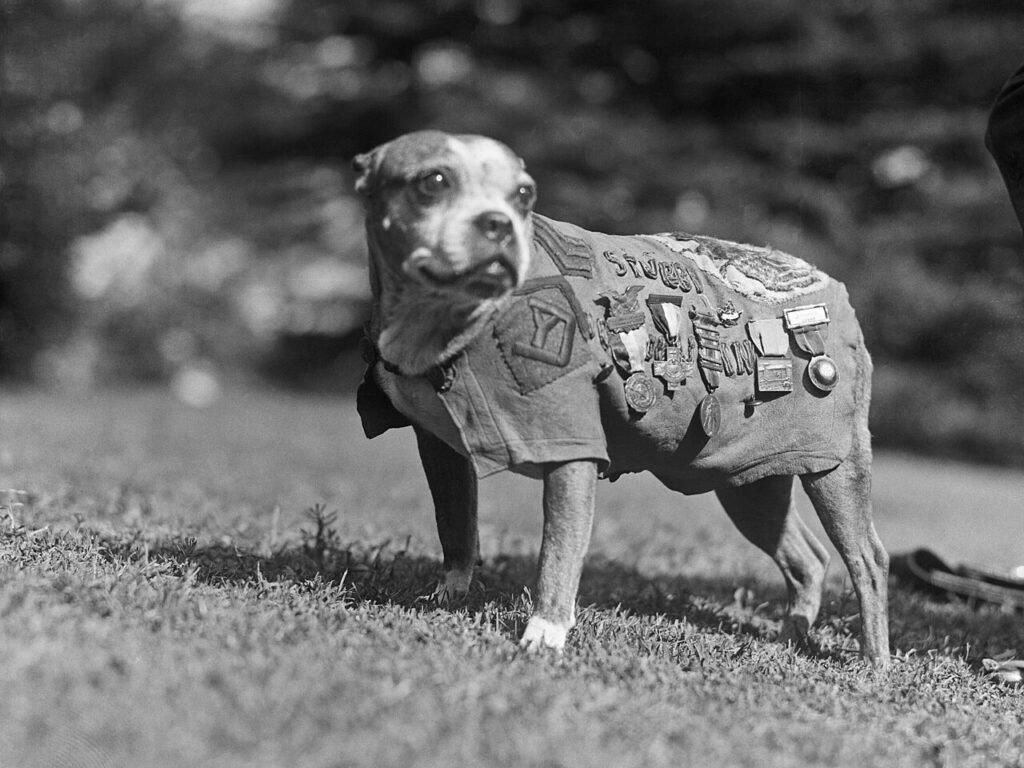
That summer the 26th Division fought in the counter-offensive near Château-Thierry, where the Germans’ last great offensive of the war had been stopped on the Marne. After the town was retaken, local women, it is said, sewed Stubby a chamois coat decorated with the Allied flags, and the soldiers pinned his medals and badges on it: a collection of regimental insignia, souvenir pins and medals, and the two wound stripes he had earned. In September the division fought at St. Mihiel, and in October and November in the great Meuse-Argonne offensive, the last and bloodiest American battle of the war. By the Armistice on 11 November 1918, the regiment reckoned Stubby had been through seventeen battles and four offensives.2,3
A celebrity
Conroy smuggled him home again in 1919. Back in the United States, Stubby became famous. He led parades, met Presidents Woodrow Wilson, Warren Harding and Calvin Coolidge, and appeared in vaudeville theatres. The American Legion and the YMCA made him a life member, and the YMCA promised him three bones a day and a place to sleep for life.1,2
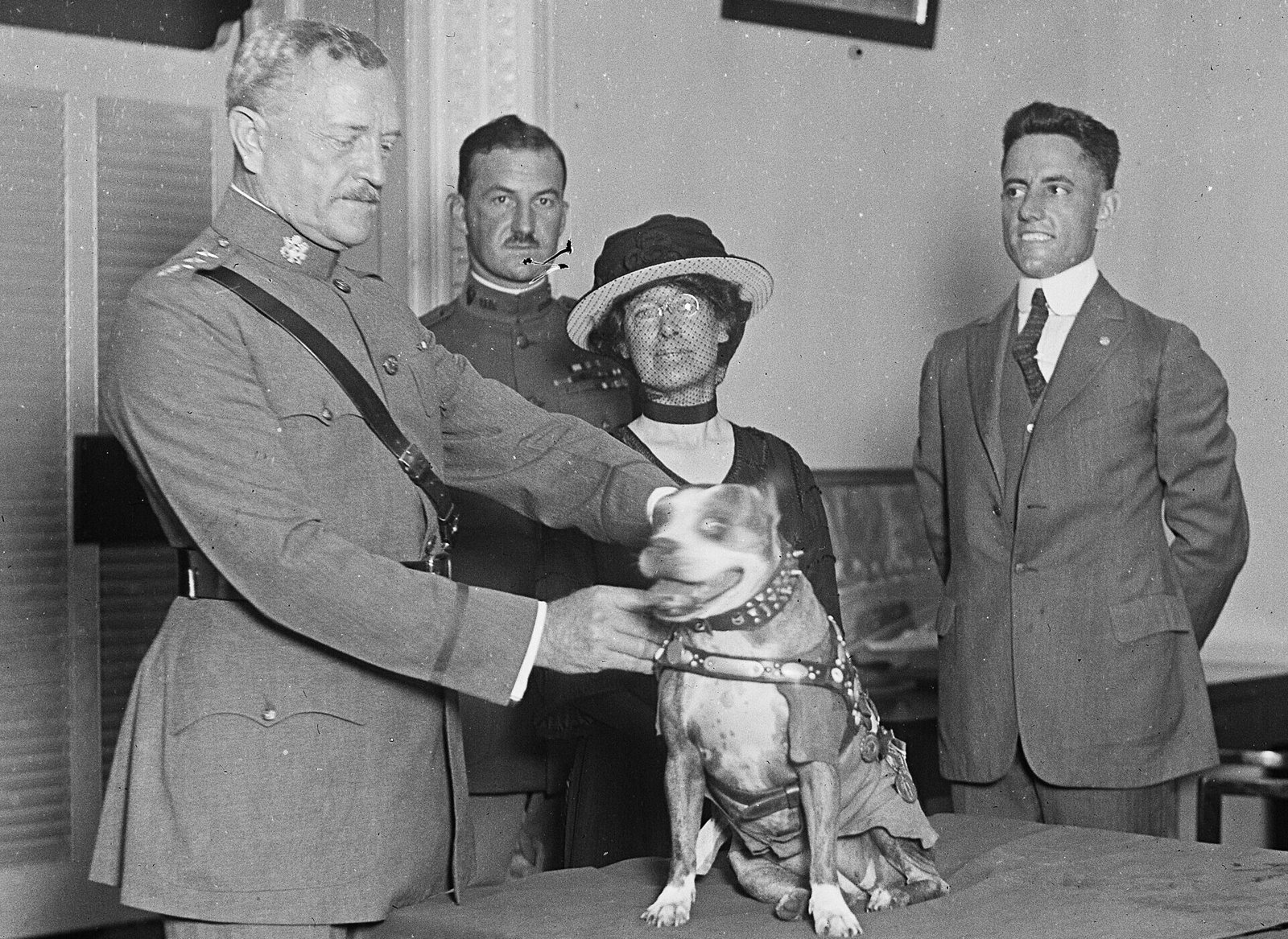
In 1921 General of the Armies John J. Pershing, who had commanded the American Expeditionary Forces in France, presented Stubby with a gold medal made for him by the Humane Education Society. The photograph of the scene, the most famous one of Stubby, shows the general standing beside the dog in his coat, with Conroy behind them.1,2
The Georgetown Hoya
Conroy went to Washington, where he studied law at Georgetown University and worked as a special agent of the Bureau of Investigation, which would later become the FBI. Stubby went with him and became the mascot of the Georgetown football team. At half-time he would be given a football and push it round the field with his nose, to the crowd’s delight. It is said to be the origin of Georgetown’s long tradition of dog mascots.1,2
Stubby died in Conroy’s arms, in his sleep, on 16 March 1926, when he was around ten years old. The New York Times gave him an obituary of half a page, more than it gave many famous people that year.4
In the Smithsonian
After his death Stubby was preserved by a taxidermist, with his ashes sealed inside the mount. In 1956 Conroy presented him to the Smithsonian Institution. He stands today in the National Museum of American History in Washington, in its exhibition on Americans at war, still wearing his coat.1
Robert Conroy died in 1987. In 2018 his descendants dedicated a life-size bronze statue of Stubby, saluting, at the Veterans Memorial Park in Middletown, Connecticut. The same year an animated film, Sgt. Stubby: An American Hero, told his story to children. In 2006 a brick was laid in his honour on the Walk of Honor at the National World War I Museum and Memorial in Kansas City.2,3
Stubby is often called the most decorated dog of the First World War. Much of what is told about him cannot be checked, and some of it was surely improved in the telling. But the core of it is documented: a stray dog went to war with a Connecticut regiment, was gassed and wounded, stayed with the men through the worst battles of 1918, and came home to be loved by a country. The soldiers of the 102nd never had any doubt that he had earned his stripes.1,2,5
Timeline
- July 1917 Wanders into the 102nd Infantry’s camp at the Yale Bowl, New Haven.
- Autumn 1917 Smuggled to France aboard the SS Minnesota by J. Robert Conroy.
- 5 February 1918 Enters the line at the Chemin des Dames.
- Spring 1918 Gassed; returns with a gas mask.
- 20 April 1918 Wounded by a grenade at Seicheprey.
- Summer 1918 Château-Thierry.
- September–November 1918 St. Mihiel and the Meuse-Argonne.
- 1921 Presented with a gold medal by General Pershing.
- 16 March 1926 Dies in Washington, D.C.
- 1956 Presented to the Smithsonian Institution.
- 2018 Bronze statue dedicated in Middletown, Connecticut.
- Smithsonian National Museum of American History, object record “Stubby”, americanhistory.si.edu
- Ann Bausum, Sergeant Stubby: How a Stray Dog and His Brave Buddy Took On the Enemy (National Geographic, 2014).
- Connecticut Humanities, “A True Dog of War: Sergeant Stubby”, connecticuthistory.org
- The New York Times, obituary of Stubby, April 1926.
- Much of Stubby’s war record comes from J. Robert Conroy and the newspaper stories of the 1920s. His sergeant’s rank was an honour given by the men, not an official Army promotion, and there is no official record of the German spy he is said to have caught.
Found an error, or hold a related record? Tell the research desk.

Share what you know