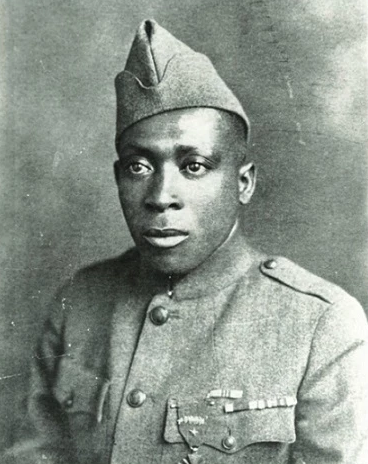
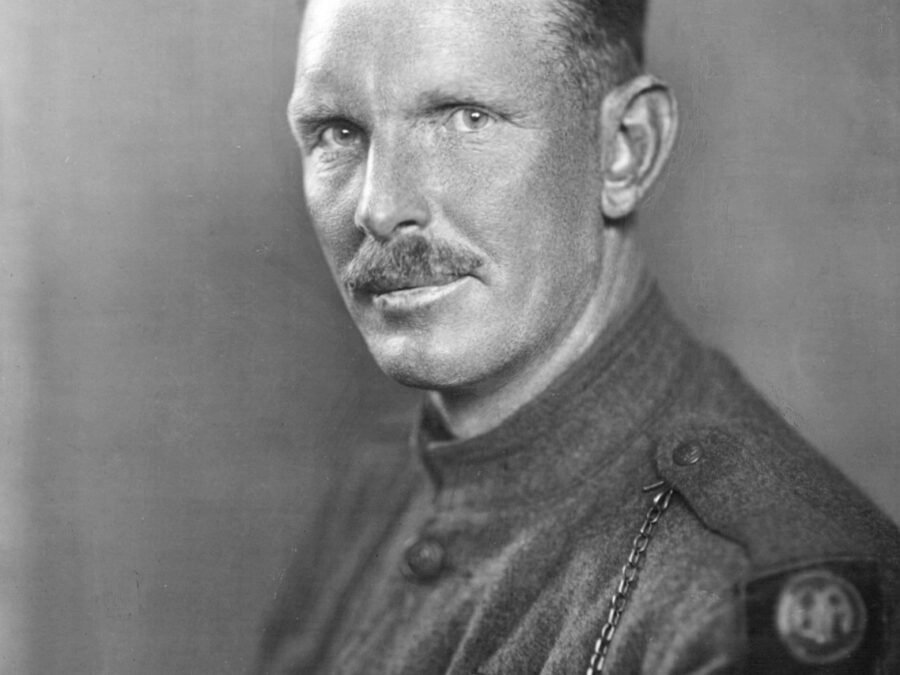
Henry Johnson said he was born on 15 July 1892 in Winston-Salem, North Carolina, though he gave other dates on other documents and may not have known for certain. As a teenager he moved north to Albany, New York, where he worked as a chauffeur, a soda mixer, and a porter carrying passengers’ bags at Albany’s Union Station. He stood five feet four inches tall.1,2
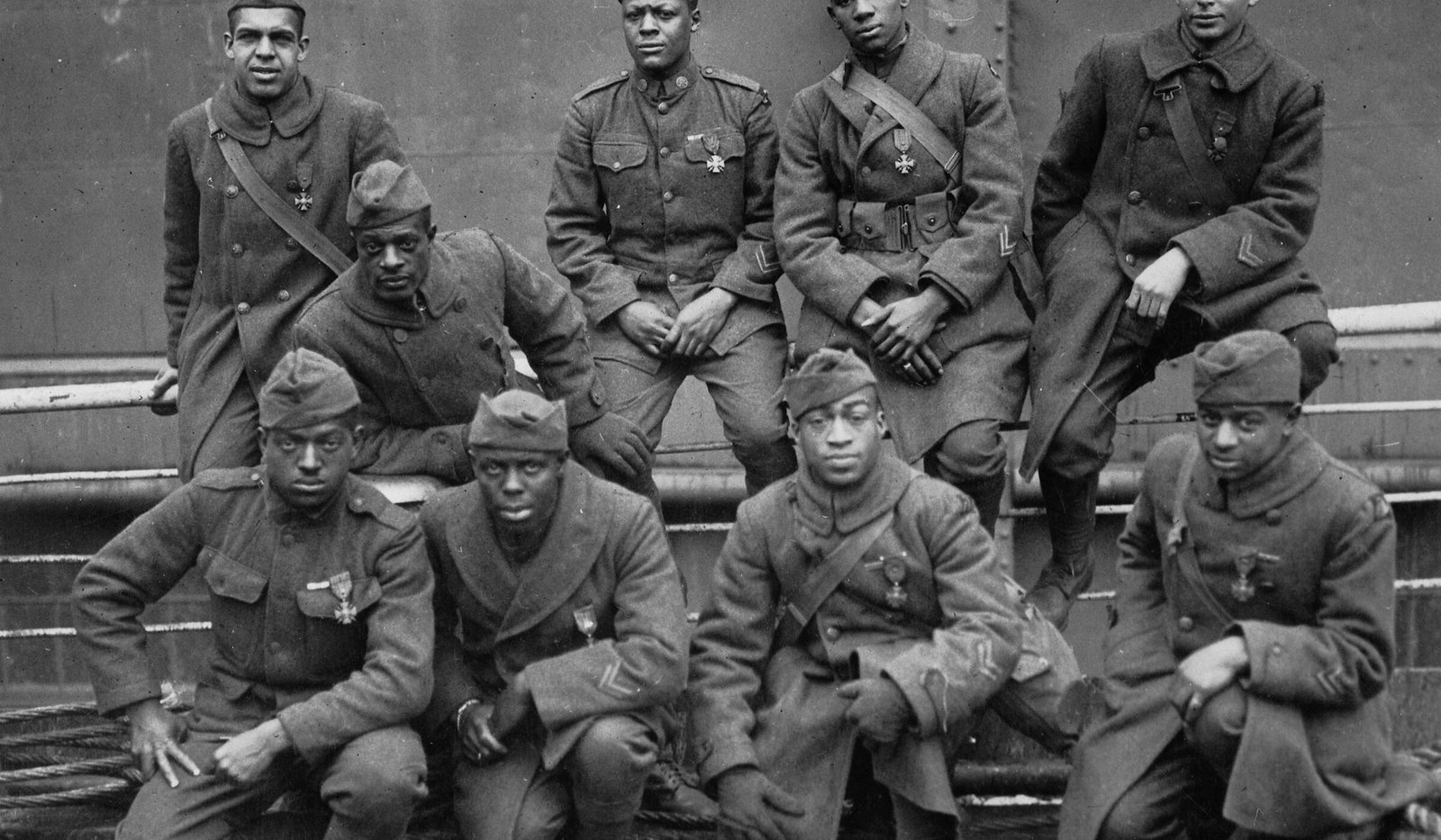
On 5 June 1917, two months after the United States entered the First World War, he enlisted in the 15th Infantry Regiment of the New York National Guard, a Black regiment raised largely in Harlem. When it was taken into federal service, the Army renamed it the 369th Infantry.1,2
Loaned to the French
The regiment landed at Brest at the end of December 1917, and Johnson arrived in France on 1 January 1918. At first its men were put to work unloading ships and building railways. The United States Army of 1918 would not have Black and white soldiers fighting in the same divisions, and many American commanders did not want Black combat troops at all. So the 369th was lent to the French Army, which was short of men after three and a half years of war.1,3
The regiment joined the French 161st Division. Its men were issued French helmets and French rifles and fought under French command. Its nickname, the Hellfighters, is usually said to have come from the Germans who faced it; at home the newspapers called its men the Harlem Hellfighters.2,3
The regiment’s band
The 369th became famous in France for more than its fighting. Its regimental band, led by the bandleader James Reese Europe, toured French cities and hospitals and played ragtime and early jazz to audiences who had never heard anything like it, and is often credited with introducing that music to France.3
For the men in the ranks, life was mostly hard labour, cold trenches and long spells in the line. The regiment spent months at the front with the French, and suffered heavy casualties.3
Night at Outpost 20
By May 1918 the 369th was holding part of the front line in the Argonne Forest, in the Champagne region. On the night of 14 to 15 May, Private Johnson and Private Needham Roberts were on sentry duty at an isolated forward post known as Outpost 20.1
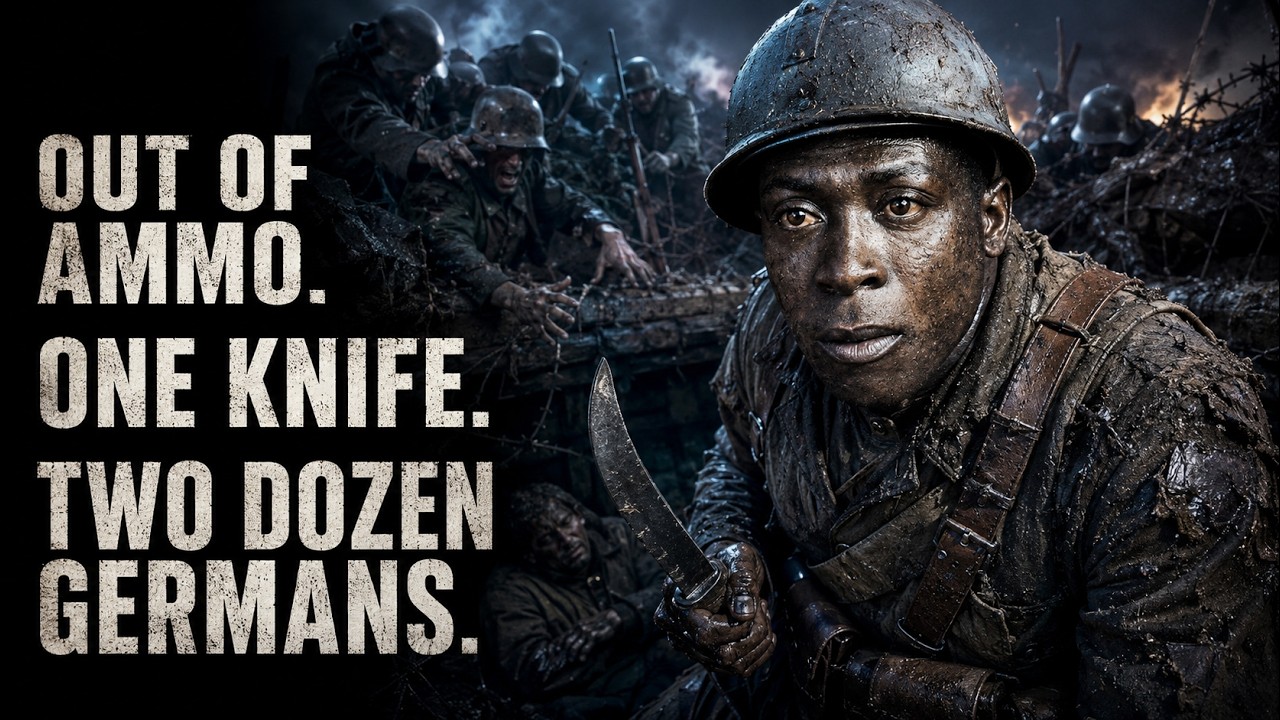
In the early hours a German raiding party crept up on the post and attacked. The Medal of Honor citation puts it at no fewer than twelve soldiers; other accounts from the time give twenty-four, and some more than thirty. Both Americans were wounded almost at once. Roberts, badly hurt, could no longer fight, but he kept passing grenades to Johnson, who threw them until they ran out.1,4
Then Johnson fired his rifle. When it jammed, he used it as a club. The Germans began to drag the wounded Roberts away as a prisoner. Johnson, bleeding from many wounds, went after them with his bolo knife, a heavy blade issued to American infantrymen, and fought them hand to hand until they let Roberts go. The raiders withdrew into the dark, taking their wounded with them. Johnson had killed four of them and wounded others. He had been wounded twenty-one times.1,2
Grenades, a jammed rifle used as a club, a bolo knife and his bare hands, against a raiding party at least twelve strong.
The fight at Outpost 20, 15 May 1918
Famous overnight
The French awarded both men the Croix de Guerre, and Johnson’s carried a palm for exceptional valour; he was among the first Americans to receive the medal in the war. American newspapers made him famous. The New York World reported his fight, and in August 1918 the writer Irvin S. Cobb told his story to millions of readers in The Saturday Evening Post. In 1919 Theodore Roosevelt Jr., himself a veteran of the war, called him one of the five bravest Americans who had fought in France.2,4
Johnson recovered and was promoted to sergeant. In February 1919 the 369th came home and marched up Fifth Avenue to Harlem in a victory parade watched by huge crowds. Johnson rode in an open car.2,3
After the parade
The recognition stopped there. His discharge papers did not record his wounds, and he received no disability pay and no Purple Heart. He went on paid lecture tours, but when he spoke about the mistreatment of Black soldiers he was arrested for wearing his uniform after the date he was allowed to. Unable to do the heavy work he had done before the war, he fell into poverty.2,3
In September 1927 the Veterans Bureau finally rated him permanently and totally disabled, from tuberculosis and his twenty-one wounds. He died on 1 July 1929 in Washington, D.C., of myocarditis, and was buried with military honours at Arlington National Cemetery five days later. He was about thirty-seven years old.2
Ninety-seven years later
The campaign to recognise him began in Albany, where a monument to him was put up in Washington Park in 1991. In June 1996 President Bill Clinton awarded him the Purple Heart. In February 2003 he received the Distinguished Service Cross, the Army’s second-highest award for valour.2
On 2 June 2015, President Barack Obama presented the Medal of Honor for Henry Johnson at the White House. No close relatives could be found to receive it. It was accepted by Command Sergeant Major Louis Wilson of the New York National Guard, standing in for the regiment Johnson had served in.1,2
In June 2023 the Army renamed Fort Polk in Louisiana as Fort Johnson in his honour. In June 2025 the post was renamed again. In Albany, a boulevard, a school and a high-school JROTC battalion carry his name.2
Timeline
- c. 1892 Born in Winston-Salem, North Carolina.
- 5 June 1917 Enlists in the 15th New York National Guard, later the 369th Infantry.
- 1 January 1918 Arrives in France.
- 14–15 May 1918 Fights off a German raiding party at Outpost 20; wounded 21 times.
- 24 August 1918 Irvin S. Cobb tells his story in The Saturday Evening Post.
- February 1919 Rides in the 369th’s victory parade up Fifth Avenue.
- September 1927 Rated permanently and totally disabled.
- 1 July 1929 Dies in Washington, D.C.; buried at Arlington.
- June 1996 Awarded the Purple Heart.
- February 2003 Awarded the Distinguished Service Cross.
- 2 June 2015 Awarded the Medal of Honor by President Obama.
- U.S. Army, “Sergeant Henry Johnson — Medal of Honor”, army.mil/medalofhonor/johnson, including the citation.
- National Museum of the United States Army, biography of Henry Johnson.
- Peter N. Nelson, A More Unbending Battle: The Harlem Hellfighters’ Struggle for Freedom in WWI and Equality at Home (Basic Civitas, 2009).
- Irvin S. Cobb, “Young Black Joe”, The Saturday Evening Post, 24 August 1918.
- The size of the raiding party differs between accounts: the Medal of Honor citation says at least twelve; other reports give twenty-four or more. His birth date is uncertain; he gave different dates on different documents.
Found an error, or hold a related record? Tell the research desk.

Share what you know