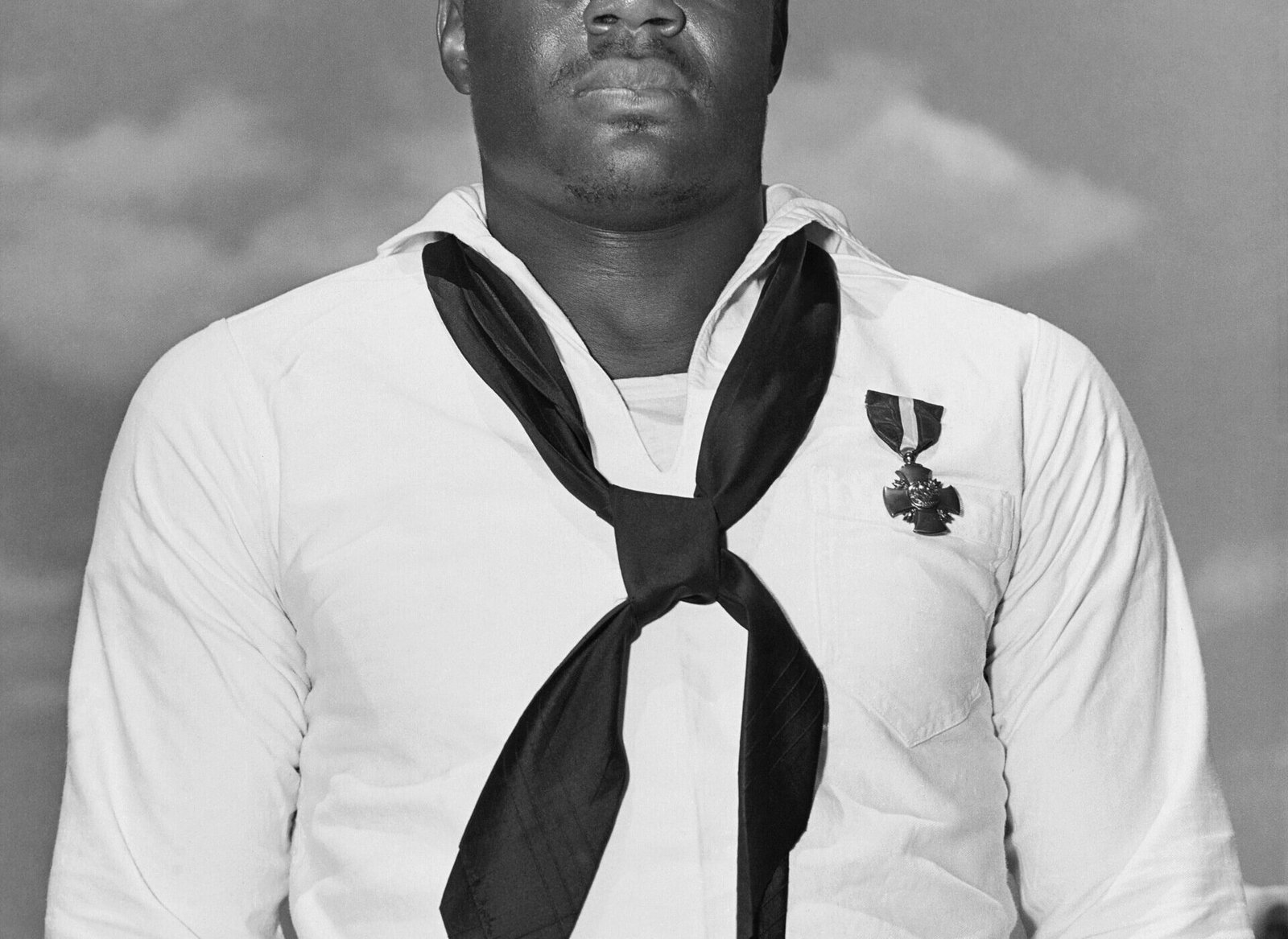

Doris Miller was born on 12 October 1919 in Waco, Texas, the third of four sons of Connery and Henrietta Miller, who were sharecroppers. As a boy he cooked, did the laundry and worked on the farm, and at Moore High School he played fullback on the football team. He grew to six feet three inches and more than two hundred pounds.1,2
The only job on offer
In September 1939 he joined the Navy. In the segregated Navy of the time, almost the only job open to a Black recruit was in the messmen’s branch: cooking, cleaning, serving officers’ meals and looking after their quarters. Black sailors were not trained to operate the ships’ guns.1,2
After training at Norfolk, Virginia, he served on the ammunition ship USS Pyro, and in January 1940 joined the battleship USS West Virginia. On board he took up boxing, and became the ship’s heavyweight champion.1
7 December 1941: seven torpedoes
On the morning of Sunday 7 December 1941, West Virginia was moored on Battleship Row at Pearl Harbor. Miller was collecting laundry when, at 7.57, Japanese carrier aircraft attacked. Torpedoes began to strike the ship; she was hit by as many as seven, and by two bombs.1,2
His battle station, an anti-aircraft magazine, had been wrecked by a torpedo. He made his way instead to a central passageway and offered to help. An officer, Lieutenant Commander Doir Johnson, saw a big, strong sailor and sent him to the bridge to help carry the ship’s captain, Mervyn Bennion, who had been badly wounded in the abdomen by a bomb fragment.1,2
Miller and another sailor carried the captain to a more sheltered spot. Bennion refused to leave the bridge and went on giving orders until he died of his wounds; he was awarded the Medal of Honor.1,2
Fifteen minutes on the machine gun
Then Lieutenant Frederic White had Miller help keep two .50-calibre Browning anti-aircraft machine guns supplied with ammunition. Miller had never been trained on the guns. White showed him how to fire one. For about fifteen minutes, as the second wave of Japanese aircraft came over, Miller fired it until the ammunition ran out.1,2
How many aircraft he hit cannot be known. Some accounts credit him with shooting down two; Miller and some of those who were with him believed it was more. With hundreds of guns firing from ships and shore, it was impossible to be sure which gun had hit which aircraft.1,2
“I’m sure that the future will see others similarly honored for brave acts.”
Admiral Chester Nimitz, presenting Miller’s Navy Cross, 27 May 1942
When the firing stopped, he helped move the wounded through oil and water towards safety as the crew abandoned ship. West Virginia settled on the bottom of the harbour, upright, in shallow water; she would later be raised and repaired. One hundred and thirty-two men of her crew were killed.1
The cost of the morning
The attack on Pearl Harbor lasted less than two hours. By the time it was over, 2,403 Americans had been killed, most of them sailors and Marines aboard the ships moored in the harbour. Eight battleships had been sunk or damaged, along with cruisers, destroyers and hundreds of aircraft. The next day the United States declared war on Japan.
Among the many acts of courage that morning, most went unrecorded. Miller’s was noticed because the officers around him saw it, and because Black newspapers and civil rights organisations refused to let it be forgotten.1,3
“An unnamed Negro messman”
At first Miller had no name in the story. When the Navy published its list of commendations on 1 January 1942, it included an unnamed Black mess attendant. The NAACP and the Black press demanded to know who he was, and on 12 March the Pittsburgh Courier, which had campaigned hard on the story, was able to name him. Bills were introduced in Congress to award him the Medal of Honor.1,2,3
That did not happen. On 27 May 1942, aboard the aircraft carrier USS Enterprise at Pearl Harbor, Admiral Chester Nimitz, commander of the Pacific Fleet, presented him with the Navy Cross, one of the Navy’s highest awards for valour. Nimitz said it was the first time in the war that such an honour had been given in the Pacific Fleet to a member of his race, and that he was sure others would follow.1,2
A recruiting poster
Miller was sent on a war bond tour, speaking in Oakland, Dallas and his home town of Waco, and at the Great Lakes naval training station. A Navy recruiting poster in 1943 showed him with his medal under the words “above and beyond the call of duty”. He was promoted to mess attendant first class, and later rated as a cook, third class.1,2
Liscome Bay
In the spring of 1943 he joined the crew of a new escort carrier, USS Liscome Bay. In November she took part in the invasion of the Gilbert Islands. Early on the morning of 24 November 1943, off Makin Atoll, the Japanese submarine I-175 torpedoed her. The torpedo set off the bombs stored aboard, and the ship sank in about twenty-three minutes. Of more than nine hundred men aboard, only 272 survived.1,2
Miller was among the missing. His parents were told on 7 December 1943, two years to the day after Pearl Harbor. He was officially declared dead a year later.1
An aircraft carrier
In 1973 the Navy commissioned a frigate, USS Miller, named in his honour. On 20 January 2020, Martin Luther King Jr. Day, the Navy announced that a future aircraft carrier would be named USS Doris Miller: the first carrier to be named after an African American, and the first named after an enlisted sailor for his actions while serving in the ranks. The campaign for his Medal of Honor goes on.1
Timeline
- 12 October 1919 Born in Waco, Texas.
- September 1939 Enlists in the Navy as a mess attendant.
- January 1940 Joins the battleship USS West Virginia.
- 7 December 1941 Pearl Harbor: carries his captain to cover and fires an anti-aircraft gun.
- 12 March 1942 Identified by name in the press.
- 27 May 1942 Awarded the Navy Cross by Admiral Nimitz.
- 1943 Appears on a Navy recruiting poster.
- Spring 1943 Joins the escort carrier USS Liscome Bay.
- 24 November 1943 Killed when Liscome Bay is torpedoed off Makin Atoll.
- 1973 Frigate USS Miller commissioned.
- 20 January 2020 Navy announces the aircraft carrier USS Doris Miller.
- Naval History and Heritage Command, “Doris Miller”, history.navy.mil.
- Thomas W. Cutrer and T. Michael Parrish, Doris Miller, Pearl Harbor, and the Birth of the Civil Rights Movement (Texas A&M University Press, 2017).
- The Pittsburgh Courier, reporting and campaign for recognition, 1942.
- The number of aircraft Miller shot down is uncertain. Some accounts credit him with two; he and others claimed more. It is impossible to be sure which guns hit which aircraft.
Found an error, or hold a related record? Tell the research desk.
Share what you know