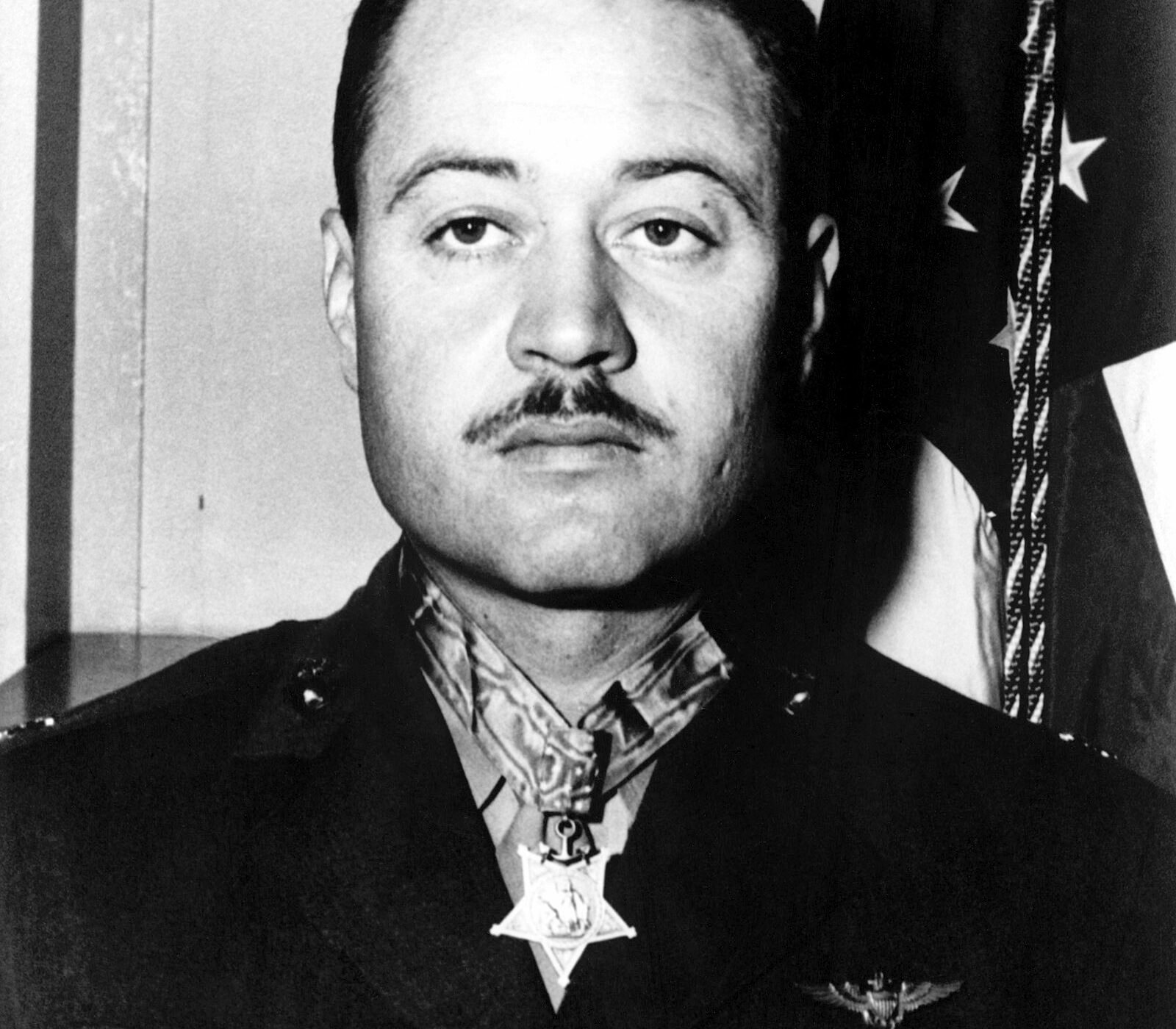
Gregory Boyington took his first aeroplane ride when he was six years old, in the logging town of St. Maries, Idaho. The pilot was a barnstormer named Clyde Pangborn, who would later fly the first non-stop flight across the Pacific. The boy never forgot it.1,2
He was born in Coeur d’Alene on 4 December 1912 and grew up believing his name was Gregory Hallenbeck. He was tough and quick-tempered. At high school in Tacoma, Washington, and then at the University of Washington in Seattle, he was a wrestler good enough to win the Pacific Northwest intercollegiate middleweight title, and he spent his summers in mining and logging camps. He graduated in 1934 in aeronautical engineering, married, and went to work as a draughtsman for Boeing.2
A new name
Boyington wanted to fly, but the Navy’s flight training programme did not take married men. When he sent for his birth certificate, he found that the man he had grown up calling father was his stepfather. His real father was a dentist named Charles Boyington, who had divorced his mother when he was a baby. No Gregory Boyington was on record as married. In 1935 he enrolled as a Marine Corps aviation cadet under that name.2
He earned his naval aviator’s wings in March 1937 and a regular commission as a Marine second lieutenant that summer. He was a natural pilot and a superb aerial gunner. He was also a heavy drinker, often in debt and quick with his fists, and his career did not prosper. By 1941 he was an instructor at Pensacola, in trouble for punching a fellow officer, and facing a likely court-martial.1,2
The Flying Tigers
That summer recruiters came to Pensacola looking for pilots for a secret venture: the American Volunteer Group, a unit of American airmen who would fly for China against Japan, officially as employees of an aircraft company. On 26 August 1941 Boyington resigned his commission and signed up. The group, soon famous as the Flying Tigers, flew Curtiss P-40s from bases in Burma and China under a hard-bitten former Army airman, Claire Chennault.2
Boyington became a flight leader, but he clashed with Chennault and was not popular with many of the other pilots. The group’s records credit him with about two Japanese aircraft shot down and one and a half destroyed on the ground; Boyington always said the real number in the air was six, and the Marine Corps later accepted his figure. In April 1942 he broke his contract and made his own way home.2,6
Gramps
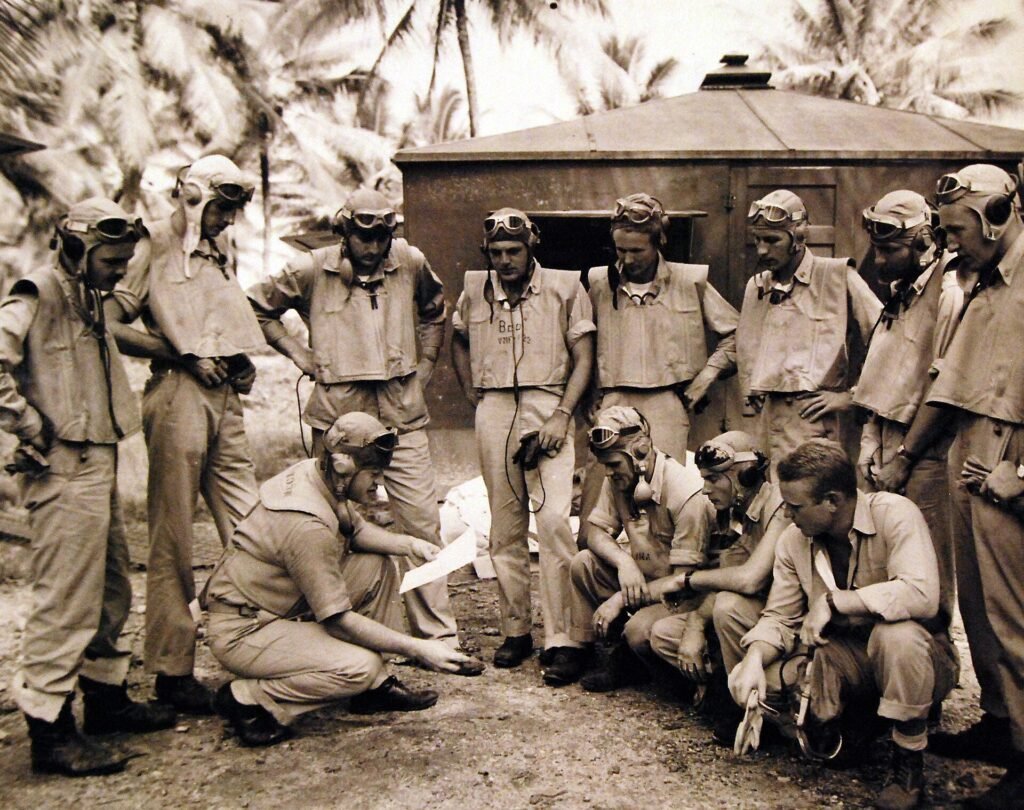
Back in the United States, Boyington pestered the Marine Corps to take him back. It needed experienced fighter pilots, and in September 1942 it gave him a major’s commission. In early 1943 he went to the South Pacific. For months he saw little action and shot nothing down. Then, in September 1943, he was given command of a new squadron being formed largely from pilots who were between assignments: replacements and casuals waiting in the rear areas. It was Marine Fighting Squadron 214, VMF-214. Its pilots named themselves the Black Sheep.1,2
At thirty, Boyington was about ten years older than most of his pilots, and they called him Gramps. One of them, Paul Mullen, wrote new words to a popular song in which Gramps became Pappy, and the war correspondents picked up the name. He did not look like a fighter pilot’s image. He was stocky, rumpled, argumentative and bad-tempered in the mornings. But he could teach, and he led from the front.1,2
The Corsair
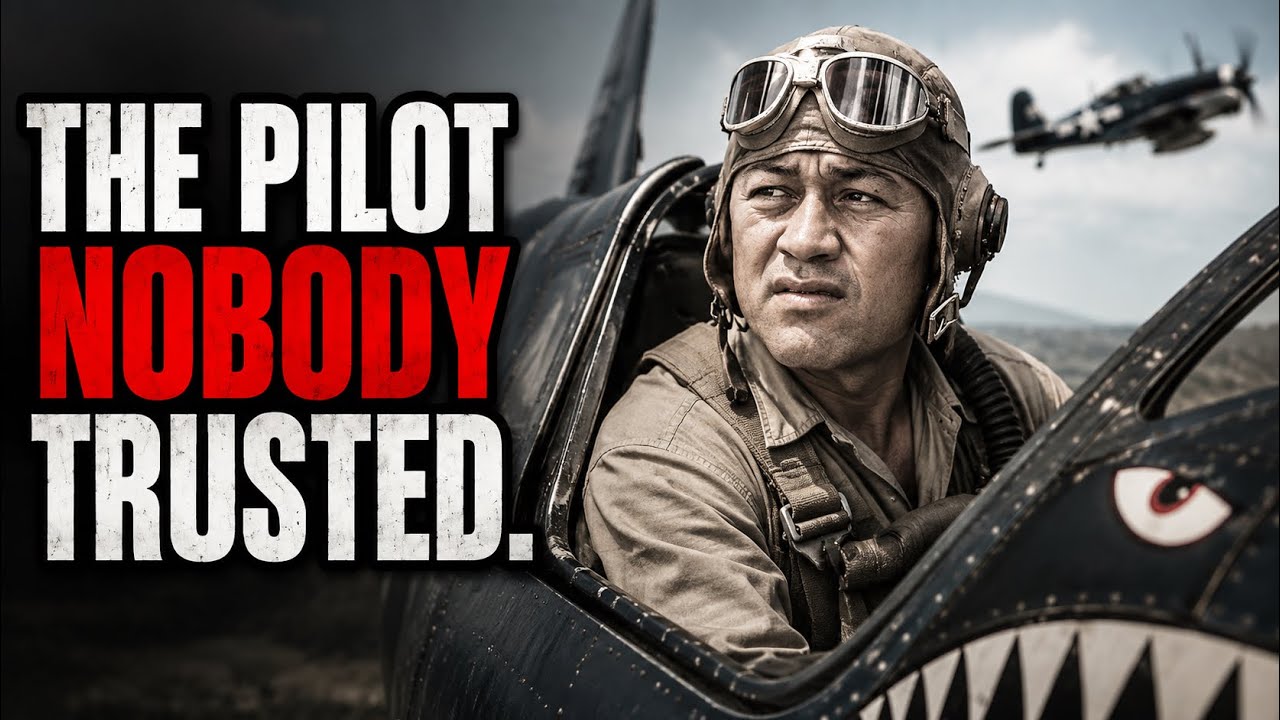
The Black Sheep flew the Vought F4U Corsair, a big, fast, gull-winged fighter that had been judged too tricky to land on carriers but was deadly from land bases. Boyington taught his pilots to use its speed and power rather than try to turn with the lighter, more agile Japanese Zero: to dive, strike and climb away, and to fight in pairs. On his first combat mission with the squadron, on 16 September 1943, he shot down five Japanese aircraft.1,2,3
Paintings and publicity photographs usually show him in a Corsair numbered 86, named Lulu Belle and covered in Japanese flags. In fact the famous photograph of him in that aircraft was taken on Espiritu Santo in November 1943, while the squadron was resting between tours, and he rarely flew the same Corsair more than a few times. By one account he deliberately took whichever fighter was in the worst condition, so that none of his pilots would be afraid to fly their own. His biographer Bruce Gamble concluded that the aircraft’s name was probably Lucybelle, not Lulu Belle.2
The squadron flew from the Russell Islands and later from Vella Lavella, sweeping over the Japanese bases in the northern Solomons. In one stretch of thirty-two days Boyington shot down fourteen enemy fighters. On 17 October 1943 he led twenty-four fighters over the Japanese airfield at Kahili, at the southern tip of Bougainville, where some sixty enemy aircraft were based, and circled overhead, taunting the Japanese over the radio to come up and fight. When they did, the Americans shot down twenty of them without losing a single aircraft. It was, his Medal of Honor citation would say, typical of his leadership.3
The Black Sheep had a gift for publicity. When the squadron heard that major league baseball players were sending gifts to the troops, it offered to shoot down a Japanese plane for every baseball cap sent by a player in the World Series. Twenty caps arrived. The squadron shot down more than twenty planes to pay for them.2
The record
By the end of December 1943 Boyington’s score stood at twenty-five, and the American newspapers were counting. The record for an American pilot was twenty-six, held by Eddie Rickenbacker, the leading ace of the First World War. Boyington was tired, drinking, and under enormous pressure. His tour was almost over.1,2
On the morning of 3 January 1944 he led a fighter sweep of forty-eight American aircraft over Rabaul, on New Britain, the most heavily defended Japanese base in the South Pacific. He was seen to shoot down one Japanese fighter, equalling Rickenbacker’s record. Then he and his wingman, Captain George Ashmun, disappeared into a swirling battle with dozens of Japanese fighters. Neither came home. A search found nothing. Boyington was listed as missing in action, and presumed dead.1,4
In the water
He was alive. By his own account, he and Ashmun had been jumped by a swarm of Zeros. Ashmun’s Corsair went down in flames. Boyington shot down two more, he later said, before his own aircraft was set on fire and he bailed out low over the sea, wounded in the head, arm, leg and shoulder. Japanese pilots strafed him in the water. He spent eight hours afloat in his life vest and dinghy before a Japanese submarine, I-181, surfaced beside him and took him prisoner. Thirteen days later the submarine was sunk with all hands.1,2
The Japanese never reported his capture to the Red Cross and did not treat him as an official prisoner of war. He was interrogated and beaten at Rabaul, flown to the island of Truk, where he lived through the great American carrier raid of February 1944, and taken to Japan. He spent most of his captivity at the secret interrogation camp at Ōfuna, where his fellow prisoners included the former Olympic runner Louis Zamperini, and at Ōmori camp near Tokyo. He later said, only half joking, that his health had improved in prison because for the first time in years he could not get a drink.1,2
A Medal of Honor for a dead man
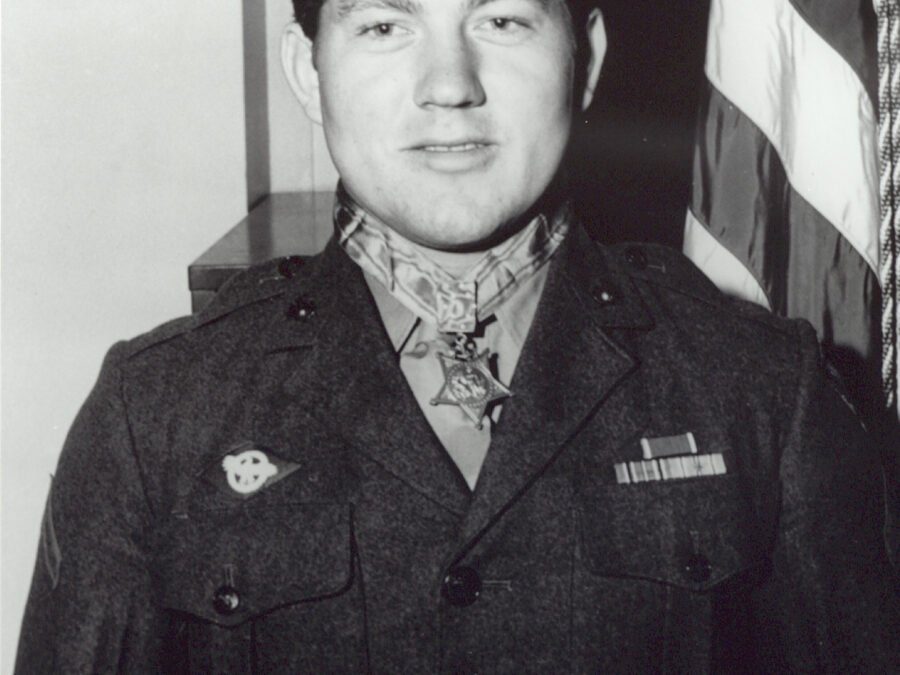
At home, in March 1944, President Roosevelt approved the award of the Medal of Honor to Boyington for his command of VMF-214 from September 1943 to January 1944. With no one to receive it, the medal was kept in Washington. His citation credited him with personally destroying twenty-six Japanese aircraft and praised the combat readiness he had built in his squadron.3
On 29 August 1945, after Japan surrendered, American forces liberated the prisoners at Ōmori. Boyington came out thin but alive and, to general astonishment, reported that he had shot down two more aircraft on his last mission. The Marine Corps accepted his claim, giving him a total of twenty-eight, then the highest of any American pilot. On 12 September 1945 he landed at Alameda, California, where twenty-one of his old pilots were waiting. That night they held a party at the St. Francis Hotel in San Francisco that Life magazine covered.1,2
On 4 October the Commandant of the Marine Corps gave him the Navy Cross for the Rabaul mission. The next day, 5 October 1945, President Truman presented him with the Medal of Honor at the White House.4
Hogwash and Hollywood hokum
Boyington retired from the Marine Corps on 1 August 1947 and was promoted to colonel on retirement for his combat record. Peace suited him less well than war. He drank heavily, married four times, and moved from job to job, including refereeing and taking part in professional wrestling matches. In 1958 he published a candid memoir, Baa Baa Black Sheep, which became a bestseller.1,2
In the 1970s the book was turned into a television series, Baa Baa Black Sheep, starring Robert Conrad. Boyington made brief appearances as a visiting general. Many of his old pilots were angry at it: the show made them out to be a gang of rogues and misfits, when most had been ordinary, well-trained young officers. Boyington himself called it hogwash and Hollywood hokum.2
His score has been argued over ever since. Researchers have pointed out that the Flying Tigers’ records support only two of the six aircraft he claimed in China, and that Japanese records for 3 January 1944 do not clearly confirm his last two victories. His official total as a Marine is twenty-two. For years a former Japanese pilot, Masajiro Kawato, claimed to have shot him down, and even appeared with him in public; later research showed that the claim could not be true. None of it changes the fact that the Black Sheep became one of the most successful fighter squadrons in the Pacific under his command.2,6
A good fight
A heavy smoker all his adult life, Boyington died of lung cancer in Fresno, California, on 11 January 1988, aged seventy-five. Before his body left Fresno, aircraft of VMA-214, the modern Black Sheep, flew over. He was buried with full honours at Arlington National Cemetery on 15 January. After the service a friend looked down at the neighbouring headstone, which belonged to the boxer Joe Louis, and remarked that old Pappy would not have far to go to find a good fight.2
The airport at Coeur d’Alene, where he was born, is named Pappy Boyington Field. A Corsair he signed during a reunion in 1981 hangs in the Smithsonian’s Udvar-Hazy Center near Washington.2
Timeline
- 4 December 1912 Born in Coeur d’Alene, Idaho.
- 1934 Graduates in aeronautical engineering from the University of Washington.
- March 1937 Designated a naval aviator.
- 26 August 1941 Resigns to join the American Volunteer Group, the Flying Tigers.
- September 1942 Rejoins the Marine Corps as a major.
- September 1943 Takes command of VMF-214, the Black Sheep.
- 17 October 1943 Leads the fighter sweep over Kahili; twenty Japanese aircraft shot down.
- 3 January 1944 Shot down over Rabaul and captured.
- March 1944 Awarded the Medal of Honor while missing.
- 29 August 1945 Liberated from Ōmori prison camp.
- 5 October 1945 Receives the Medal of Honor from President Truman.
- 1958 Publishes Baa Baa Black Sheep.
- 11 January 1988 Dies in Fresno, California.
- Gregory Boyington, Baa Baa Black Sheep (Putnam, 1958).
- Bruce Gamble, Black Sheep One: The Life of Gregory “Pappy” Boyington (Presidio, 2000).
- Medal of Honor citation for Major Gregory Boyington, for action from 12 September 1943 to 3 January 1944.
- Navy Cross citation for Major Gregory Boyington, for action on 3 January 1944.
- U.S. Navy photograph 80-G-54303, VMF-214 at Turtle Bay, Espiritu Santo.
- Boyington’s total is disputed. The Marine Corps credited him with 28 aircraft, including six he said he destroyed with the Flying Tigers; the American Volunteer Group’s own records credit him with about two in the air and one and a half on the ground. His official Marine total is 22.
Found an error, or hold a related record? Tell the research desk.
Share what you know