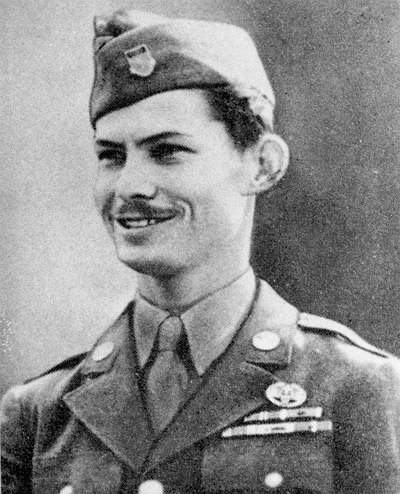
Desmond Thomas Doss was born on 7 February 1919 in Lynchburg, Virginia, the son of William Doss, a carpenter, and his wife Bertha, a homemaker who also worked in a shoe factory. He grew up in the Fairview Heights area of the town with his older sister, Audrey, and younger brother, Harold.2,3
His mother brought him up in the Seventh-day Adventist church, and from her faith he took two rules that he would never break. He would not kill, and he would keep the Sabbath, which Adventists observe from sunset on Friday to sunset on Saturday. He went to the church school until the eighth grade, and then went out to work to help his family through the Depression, first at a lumber company and later as a joiner in the shipyard at Newport News.2,3
A soldier who would not carry a rifle
His shipyard job would have entitled him to a deferment from the draft. He did not take it. On 1 April 1942 he was inducted into the Army at Camp Lee, Virginia, and sent to Fort Jackson, South Carolina, to train with the newly reactivated 77th Infantry Division.1,2
He was willing to serve his country, but not to carry a weapon; he called himself a conscientious cooperator rather than an objector. The Army made him a medic, in the 2nd Platoon of Company B, 1st Battalion, 307th Infantry. It was an uneasy arrangement. Some of the men he served with mocked and harassed him for refusing to touch a rifle and for asking to keep his Sabbath, and officers tried to have him discharged as mentally unfit. He refused to go.2
That August he married Dorothy Schutte. Two years later he went to war.3
Guam and Leyte
Doss first saw combat on Guam in July 1944, and then in the Philippines, on Leyte. Again and again he went forward under fire to treat and bring back wounded men, and he was awarded the Bronze Star with “V” device for valour. The men who had once mocked him began to trust him with their lives.1,2
The Maeda Escarpment
In April 1945 the 77th Division was sent to Okinawa, the last great island battle of the Pacific war. At the end of the month it was ordered to take the Maeda Escarpment, a jagged ridge about four hundred feet high that the soldiers called Hacksaw Ridge. The men climbed its face on cargo nets and fought for the top.2
On 29 April the battalion reached the top and was hit by artillery, mortar and machine-gun fire. Around seventy-five men went down. The rest were driven back off the plateau. Doss would not go. In the words of his citation, he “refused to seek cover and remained in the fire-swept area with the many stricken, carrying them one by one to the edge of the escarpment and there lowering them on a rope-supported litter down the face of a cliff to friendly hands.”1
He later said that as he worked he kept praying: Lord, please help me get one more. How many men he saved there could never be counted exactly. He thought it was about fifty; his officers put it at a hundred. The Medal of Honor citation settled on about seventy-five.1,4
“Lord, please help me get one more.”
Desmond Doss, as he later remembered his prayer on the escarpment
Three weeks under fire
The escarpment was not the end of it. On 2 May he went two hundred yards beyond the front line, under rifle and mortar fire, to rescue a wounded man. On 4 May he advanced through a shower of grenades to within eight yards of an enemy cave to treat four men who had been hit, and brought them out one at a time. On 5 May, a Saturday, his Sabbath, he went out under shellfire to bandage and give plasma to a wounded artillery officer.1
On the night of 21 May, in an attack on high ground near Shuri, a grenade landed among the men he was treating. He was badly wounded in the legs. Rather than call another medic forward into the fire, he dressed his own wounds and waited five hours for stretcher-bearers. As they carried him back he saw a man more badly wounded than himself, crawled off the litter and told them to take the other man first.1
While he waited, a sniper’s bullet shattered his arm. He tied a rifle stock to it as a splint and crawled some three hundred yards over rough ground to the aid station.1
The White House
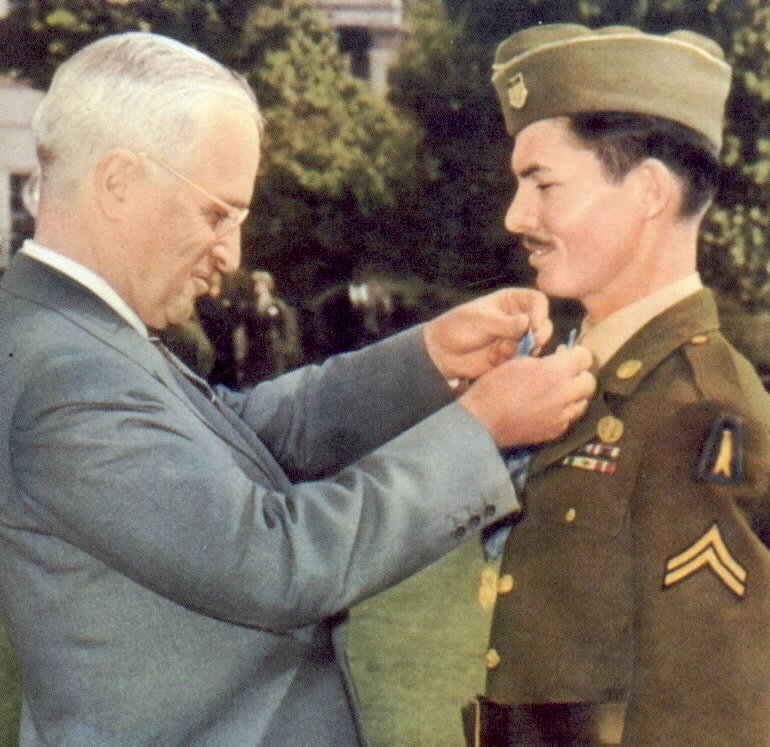
On 12 October 1945 President Harry Truman presented Doss with the Medal of Honor on the White House lawn. He was the first conscientious objector to receive it, and one of only three who ever have. He was also awarded a second Bronze Star and three Purple Hearts.1,2
The war had cost him more than his wounds. In 1946 he was found to have tuberculosis, which he had caught on Leyte. He spent five and a half years in hospitals and lost a lung and five ribs, and was discharged in 1951 as ninety per cent disabled. In 1976 an overdose of antibiotics left him completely deaf, until a cochlear implant restored his hearing in 1988.2
A quiet life
Doss and Dorothy raised their son, Desmond Jr., on a small farm at Rising Fawn, in north-west Georgia. Their son followed him into the Army as a medic and later became a firefighter and paramedic. Dorothy was killed in a car accident in 1991, while Doss was driving her to a medical appointment. In 1993 he married Frances Duman.2,3
For most of his life he spoke about his war mainly in churches and to young people, and a documentary about him, The Conscientious Objector, appeared in 2004. Desmond Doss died at his home in Piedmont, Alabama, on 23 March 2006, and was buried with full military honours at Chattanooga National Cemetery. Ten years later the film Hacksaw Ridge told his story to a new generation.2,4
Timeline
- 7 February 1919 Born in Lynchburg, Virginia.
- 1 April 1942 Inducted into the Army.
- 17 August 1942 Marries Dorothy Schutte.
- July 1944 First combat, on Guam.
- 29 April 1945 Lowers wounded men down the Maeda Escarpment on Okinawa.
- 21 May 1945 Badly wounded by a grenade and a sniper’s bullet.
- 12 October 1945 Receives the Medal of Honor from President Truman.
- 1946 Diagnosed with tuberculosis.
- 1951 Discharged, ninety per cent disabled.
- 23 March 2006 Dies in Piedmont, Alabama.
- 2016 The film Hacksaw Ridge is released.
- Medal of Honor citation for Private First Class Desmond T. Doss, U.S. Army Center of Military History.
- Booton Herndon, The Unlikeliest Hero (Pacific Press, 1967).
- Frances M. Doss, Desmond Doss: Conscientious Objector (Pacific Press, 2005).
- Terry Benedict (director), The Conscientious Objector (documentary, 2004).
- The number of men he rescued is an estimate: Doss put it at about fifty, his officers at about a hundred, and the citation settled on about seventy-five.
Found an error, or hold a related record? Tell the research desk.
Share what you know