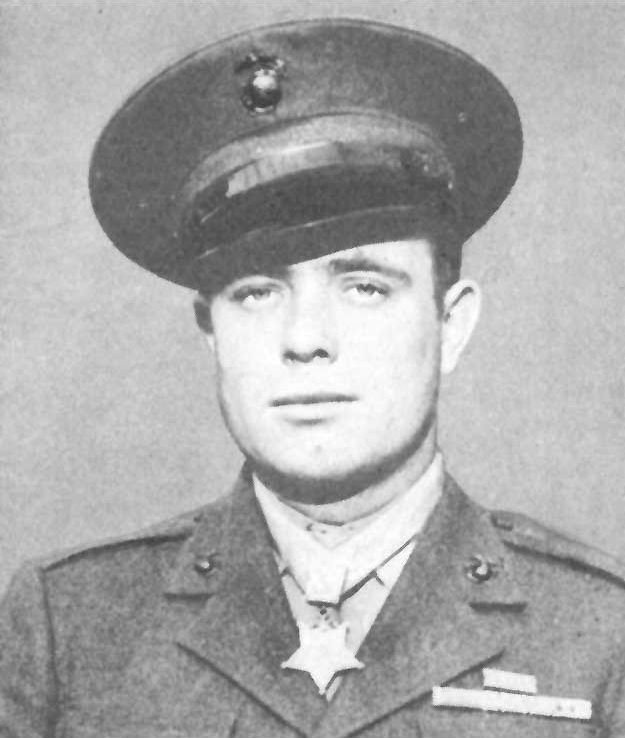

Hershel Woodrow Williams, always known as Woody, was born on 2 October 1923 in Quiet Dell, in Marion County, West Virginia, the youngest of eleven children in a farming family. His father, Lloyd, died of a heart attack when Woody was about eleven, and several of his brothers and sisters died of influenza while he was young.2
He left the farm to work, driving trucks for a construction firm and then a taxi. When Japan attacked Pearl Harbor he was in Montana with the Civilian Conservation Corps, the New Deal programme that put young men to work on public land.2
Too short for the Marines
He wanted to join the Marines, drawn by the dress blue uniforms he had seen worn by Marines from his home town. In 1942 they turned him down: at five feet six inches, he was too short. Early in 1943, as the war’s demand for men grew, the height rule was relaxed, and on 26 May 1943 he enlisted in the Marine Corps Reserve in Charleston, West Virginia.2
After recruit training at San Diego he was trained at Camp Elliott as a demolition man and flamethrower operator. The training covered how the weapon worked; how to use it in battle, he said later, they had to learn for themselves. In January 1944 he joined Company C, 1st Battalion, 21st Marines, in the 3rd Marine Division, on Guadalcanal. That summer he fought in the recapture of Guam.2
Iwo Jima
On 19 February 1945 the Marines landed on Iwo Jima, a small volcanic island some 750 miles south of Tokyo, which the Americans wanted for its airfields. More than twenty thousand Japanese defenders waited in a network of tunnels, caves and concrete pillboxes. Williams’s regiment came ashore on 21 February.1,2
On 23 February his company was stopped by a belt of reinforced concrete pillboxes, mutually supporting and covered by machine guns. American tanks trying to open a path through them were pinned down. The company commander asked for volunteers to deal with the pillboxes.1,2
Pillbox to pillbox
Williams went forward with a seventy-pound flamethrower on his back and four riflemen to cover him. Two of them, Vernon Waters and Charles Fischer, were killed protecting him. He reached the first pillbox, pushed the nozzle of the flamethrower through an opening and burned out the men inside.1,2
Then he went back to the American lines, strapped on a fresh flamethrower, and went forward again. He did it again and again over four hours under heavy fire, using his flamethrower and demolition charges on one position after another. At one point enemy riflemen charged him with fixed bayonets and he turned the flame on them. He saw smoke rising from an air vent of one bunker, climbed up to it and fired the flamethrower in through the vent.1,2
Four hours under fire, a seventy-pound flamethrower, and four riflemen, two of whom did not come back.
Iwo Jima, 23 February 1945
That same day, about a thousand yards away, Marines raised the American flag on the summit of Mount Suribachi. Williams saw it go up. He fought on through the rest of the five-week battle, and on 6 March was wounded in the leg by shell fragments, earning the Purple Heart.2,3
Flamethrower operators were among the most exposed men on the island. Williams himself later said that of more than three hundred on Iwo Jima, fewer than twenty came through.3
The cost of Iwo Jima
The battle for Iwo Jima lasted more than five weeks, until the island was declared secure in late March 1945. It was one of the costliest battles in the history of the Marine Corps. Nearly seven thousand Americans were killed and around twenty thousand wounded. Of the roughly twenty-one thousand Japanese defenders, almost all died; only about two hundred were taken prisoner.
Twenty-seven Medals of Honor were awarded for the fighting on the island, more than for any other single battle of the war. Many of them went to men who, like Williams, had gone forward against pillboxes and caves that could not be taken any other way, and many were awarded after the men had died.
The White House
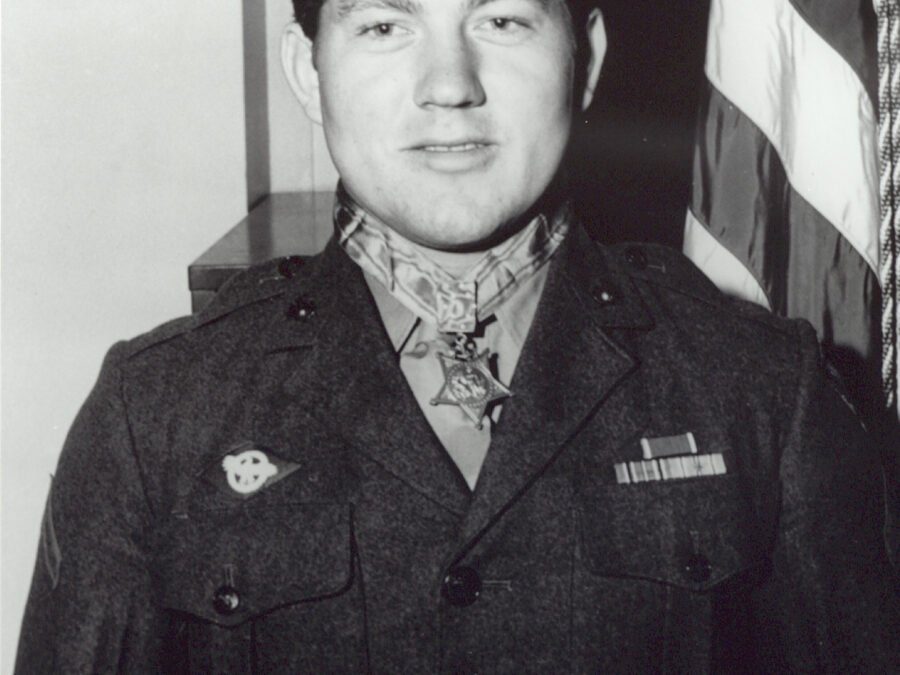
On 5 October 1945 President Harry Truman presented the Medal of Honor to Williams and thirteen other servicemen at the White House. The citation praised his “conspicuous gallantry and intrepidity at the risk of his life above and beyond the call of duty”.1
Thirty-three years at the VA
After the war he stayed in the Marine Corps Reserve on and off until 1969, commanding a reserve company in Huntington and rising to chief warrant officer. For thirty-three years he worked for the Department of Veterans Affairs, helping other veterans with their claims and benefits.2
He struggled for years with what he had seen and done on Iwo Jima, and said that a religious renewal in 1962 finally ended his nightmares. In his later years his foundation, the Hershel Woody Williams Medal of Honor Foundation, set out to build monuments in every state to honour Gold Star families, the families of service members killed in the line of duty.2,3
The last of his war
In March 2020 the Navy commissioned an expeditionary sea base, the USNS Hershel “Woody” Williams, with Williams himself present. He became the last surviving Medal of Honor recipient of the Second World War.2
Woody Williams died on 29 June 2022 at the veterans’ medical centre in Huntington, West Virginia, which already bore his name. He was ninety-eight. On 14 July 2022 his body lay in honour in the Rotunda of the United States Capitol.2,4
Timeline
- 2 October 1923 Born in Quiet Dell, West Virginia.
- 1942 Turned down by the Marines for being too short.
- 26 May 1943 Enlists in the Marine Corps Reserve.
- January 1944 Joins the 21st Marines on Guadalcanal.
- July–August 1944 Fights in the recapture of Guam.
- 21 February 1945 Lands on Iwo Jima.
- 23 February 1945 Four hours with a flamethrower against the pillboxes.
- 6 March 1945 Wounded in the leg.
- 5 October 1945 Receives the Medal of Honor from President Truman.
- 7 March 2020 USNS Hershel “Woody” Williams commissioned.
- 29 June 2022 Dies in Huntington, West Virginia, aged 98.
- 14 July 2022 Lies in honor in the U.S. Capitol.
- Medal of Honor citation for Corporal Hershel W. Williams, U.S. Marine Corps History Division.
- Hershel Woody Williams Congressional Medal of Honor Education Foundation, biography.
- The Washington Post, interview with Hershel Williams for the 75th anniversary of Iwo Jima, February 2020.
- U.S. Congress, proceedings for Williams lying in honor at the Capitol, July 2022.
- The figure of fewer than twenty survivors among some three hundred flamethrower operators on Iwo Jima is Williams’s own and is widely repeated; we have not found a primary source for it.
Found an error, or hold a related record? Tell the research desk.
Share what you know