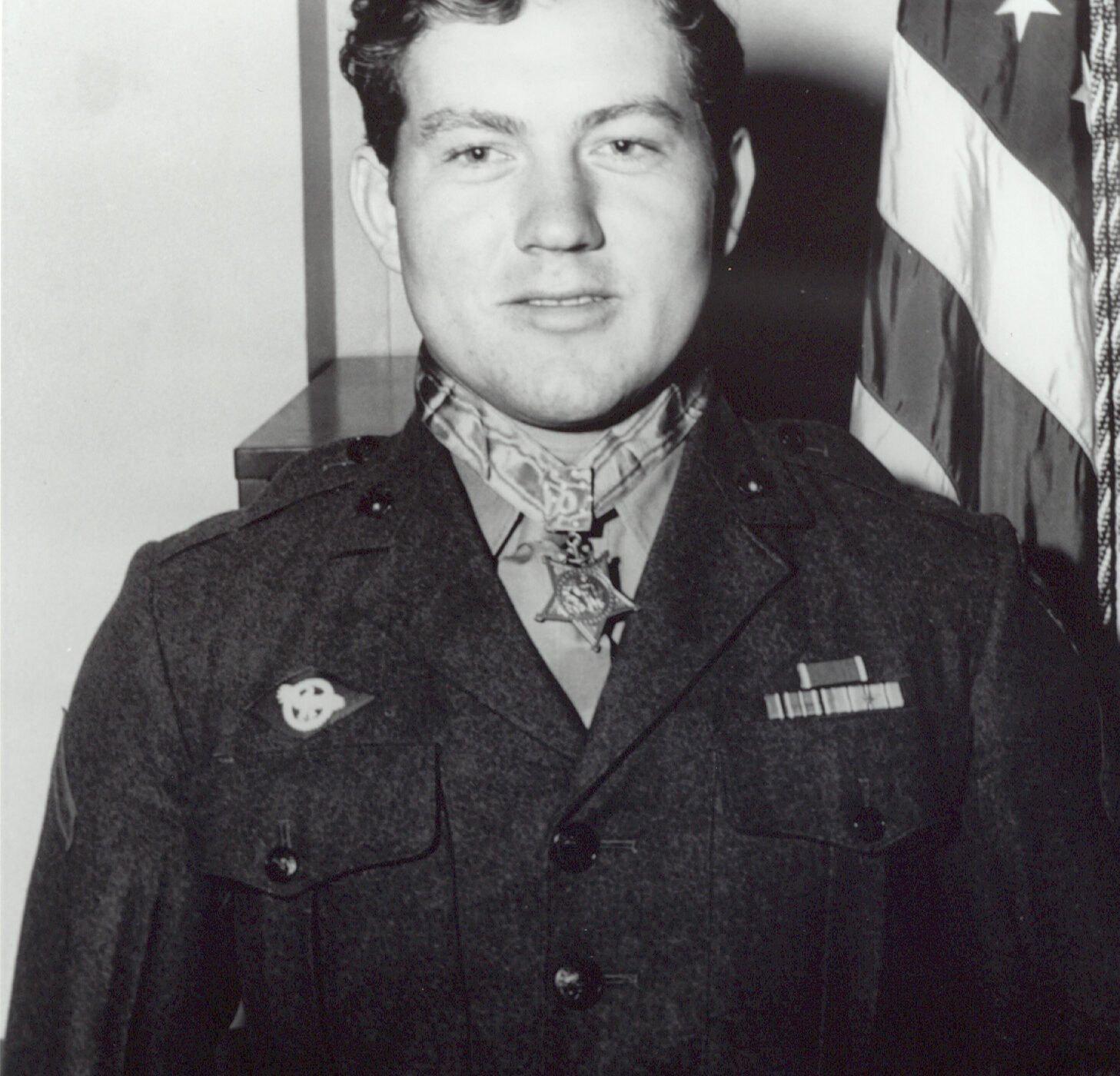

Jacklyn Harold Lucas was born on 14 February 1928 in Plymouth, North Carolina, the son of a tobacco farmer. His father died when Jack was eleven, and his mother sent him to Edwards Military Institute at Salemburg, where the boy thrived. He became a cadet captain and captain of the football team, and threw himself into every sport the school offered, from baseball and boxing to wrestling, riding and shooting.1,2
Fourteen
When Japan attacked Pearl Harbor in December 1941, Jack was thirteen. By the summer of 1942 he had made up his mind to fight. He was big for his age, five feet eight inches tall and about 180 pounds of muscle, and on 8 August 1942 he walked into the Marine Corps recruiting office in Norfolk, Virginia, with a consent form on which he had forged his mother’s signature, claiming to be seventeen. He later admitted to bribing the notary. He was fourteen.2,3
The Marines sent him to boot camp at Parris Island, South Carolina, where he qualified as a sharpshooter, and then trained him as a heavy machine-gunner at Camp Lejeune. In November 1943 he sailed from San Diego for Hawaii. But instead of a combat unit he was put to work at a supply depot at Pearl Harbor, driving a truck. He wanted to fight.2
The stowaway
On 10 January 1945 Lucas walked out of his camp in Hawaii carrying his combat clothes and boots rolled under his arm, and did not come back. He was reported absent without leave. He had stowed away aboard the transport USS Deuel, which was carrying the 1st Battalion, 26th Marines, of the 5th Marine Division towards an island most of its men had never heard of: Iwo Jima.1,2,3
On 8 February, the day before he would have been formally listed as a deserter, he turned himself in to the commander of C Company, Captain Robert Dunlap. Dunlap took him to the battalion commander, who, a few days before a landing, was not about to turn away a volunteer. Lucas was reduced to private as a punishment and made a rifleman in Dunlap’s company. On 14 February 1945 he celebrated his seventeenth birthday at sea.2
Iwo Jima
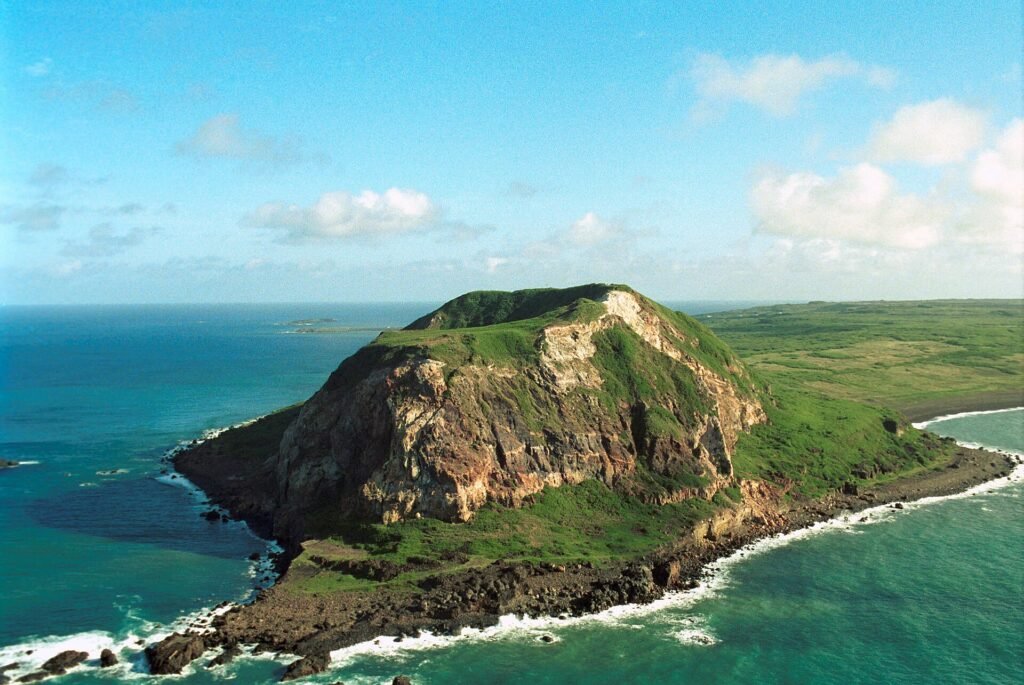
On 19 February 1945 the 5th Marine Division landed on the black volcanic sand of Iwo Jima’s south-eastern beaches. The island was defended by more than 20,000 Japanese soldiers in a maze of tunnels, caves and bunkers, and the Marines came under murderous fire from the moment they stepped ashore. Lucas’s company pushed inland towards the first of the island’s airfields.1,2
On the second day, 20 February, Lucas and three other Marines of a fire team were creeping through a twisting ravine near the airfield when they spotted a Japanese pillbox and dropped into a trench for cover. In a parallel trench only a few yards away were eleven Japanese soldiers. Both sides opened fire. Two Japanese grenades landed in the Marines’ trench, right in front of Lucas’s comrades.1,2
“Grenades!”
Lucas yelled a warning, jumped over one of his friends, and threw himself on the grenades. He jammed one into the soft volcanic ash with his rifle butt and covered it with his body, and reached out and pulled the second one under him too. His citation says he hurled himself upon one grenade and pulled the other under him, absorbing the whole blasting force of the explosion in his own body to shield his companions.1
One grenade exploded. The blast threw him onto his back and tore into his right arm and wrist, his right leg and thigh, and his chest. The second grenade, lying in his hand, never went off. His three friends were unhurt, and they killed the Japanese in the other trench. Seeing Lucas’s body lying torn and bloody in the trench, they believed he was dead and moved on.1,2,3
He was alive, and conscious. Marines from another unit passing by heard him and called corpsmen, who gave him first aid while one of them shot a Japanese soldier who was trying to finish him off. Stretcher-bearers carried him down to the beach, and he was taken aboard a landing ship and then a hospital ship.2,3
Two hundred pieces
Lucas arrived back in San Francisco on 28 March 1945. Over the following months he had twenty-one operations. The surgeons could not get all the metal out: for the rest of his life he carried about two hundred fragments in his body, some as big as a .22 bullet, and he set off airport metal detectors wherever he went. In August 1945 the charge of absence without leave was removed from his record, and in September he was discharged from the Marine Corps because of his wounds.2,3
On 5 October 1945 President Harry Truman presented the Medal of Honor to Jack Lucas and thirteen other Marines and sailors on the South Lawn of the White House. Among them was his company commander, Robert Dunlap, decorated for his own actions on Iwo Jima. Lucas’s mother and brother were there, and so were Admiral Chester Nimitz and the Secretary of the Navy, James Forrestal. Truman is said to have told Lucas that he would rather have the medal than be president. At seventeen, Lucas was the youngest Marine ever to receive it, and the youngest serviceman of the Second World War.1,2,3
A paratrooper who was afraid of heights
After the war Lucas went back to his education and earned a business degree at High Point College in North Carolina. In 1961 he joined the United States Army and trained as a paratrooper with the 82nd Airborne Division, by his own account to conquer his fear of heights. On one training jump both his main and reserve parachutes failed to open properly; he hit the ground and survived again. He volunteered for Vietnam but was not sent, and ended his service as a captain in 1965, training young soldiers at Fort Bragg who would be.2,3
Civilian life was hard. He ran a chain of butcher’s shops in Maryland, but ran into trouble with back taxes. In 1977 police told him that his second wife and his son-in-law were plotting to kill him; they pleaded guilty, and at his request the court was lenient. In the 1980s his mobile home burned down and he spent a period living rough. He told his story in a memoir, Indestructible, published in 2006.2,3
He never lost his love for the Marine Corps. When the keel of the new assault ship USS Iwo Jima was laid, Lucas placed his Medal of Honor citation inside its hull, where it is still sealed. In 2006, at a ceremony at the Marine Barracks in Washington with fifteen other living Marine Medal of Honor recipients, he said that seeing the young Marines there rejuvenated his old heart and made him love the Corps even more.2
USS Jack H. Lucas
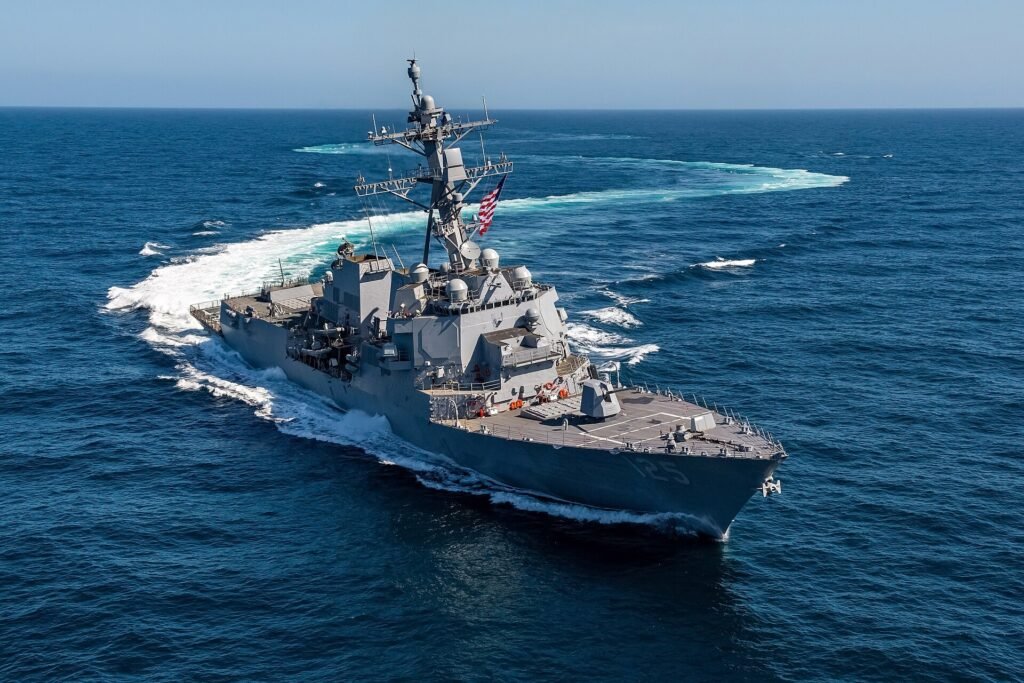
Jack Lucas died of leukaemia in Hattiesburg, Mississippi, on 5 June 2008, with his family around him. He was eighty. In 2016 the Navy announced that a new Arleigh Burke-class guided-missile destroyer would bear his name, and on 7 October 2023 USS Jack H. Lucas (DDG 125), the first of a new generation of the class, was commissioned at Tampa, Florida.2,4
Timeline
- 14 February 1928 Born in Plymouth, North Carolina.
- 8 August 1942 Enlists in the Marine Corps Reserve at fourteen, claiming to be seventeen.
- November 1943 Sent to Hawaii.
- 10 January 1945 Stows away aboard USS Deuel.
- 8 February 1945 Turns himself in and joins C Company, 1/26 Marines.
- 14 February 1945 Turns seventeen at sea.
- 19 February 1945 Lands on Iwo Jima.
- 20 February 1945 Throws himself on two grenades.
- 5 October 1945 Receives the Medal of Honor from President Truman.
- 1961–1965 Serves as an Army paratrooper and officer.
- 5 June 2008 Dies in Hattiesburg, Mississippi.
- 7 October 2023 USS Jack H. Lucas commissioned.
- Medal of Honor citation for Private First Class Jacklyn H. Lucas, for action on 20 February 1945.
- Jack H. Lucas with D. K. Drum, Indestructible: The Unforgettable Memoir of a Marine Hero at the Battle of Iwo Jima (Da Capo, 2006).
- U.S. Marine Corps History Division, biography of Private First Class Jacklyn H. Lucas.
- U.S. Navy, commissioning of USS Jack H. Lucas (DDG 125), Tampa, 7 October 2023.
Found an error, or hold a related record? Tell the research desk.
Share what you know