In the spring of 1942 a long column of Polish soldiers and civilians was travelling through the mountains of northern Persia, now Iran. Most of them had spent the previous two years as prisoners of the Soviet Union, in labour camps, prisons and places of exile scattered from the Arctic to Kazakhstan. Many had watched family members die of hunger, cold and disease. Now they were free, thin and ragged, on the road to Tehran.4
The Anders Army
In September 1939 Poland had been invaded from both sides, by Germany from the west and the Soviet Union from the east. Hundreds of thousands of Poles from the eastern half of the country were deported into the Soviet interior. Then in June 1941 Hitler invaded the Soviet Union, and Stalin suddenly needed allies. He agreed to free the Polish prisoners so that they could form an army under General Władysław Anders, himself just released from the Lubyanka prison in Moscow.4
The men who reached Anders’s recruiting centres were starving and sick. Stalin was unwilling to feed or arm them, and in 1942 it was agreed that the new army would leave for Persia, where the British would equip it. Around 115,000 people crossed the Caspian Sea, soldiers and civilians together, women and children among them. For the civilians it was escape; for the soldiers it was the start of a long road back to the war.4
A cub on the road
On 8 April 1942, on the road from the port of Pahlavi to Tehran, some Polish soldiers met a young Persian boy carrying a sack. In it was a bear cub, a Syrian brown bear, whose mother had been shot by hunters. An eighteen-year-old refugee travelling with the column, Irena Bokiewicz, fell for the cub at once and begged a young officer, Lieutenant Anatol Tarnowiecki, to buy it. Accounts differ about the price; one says a few coins, a bar of chocolate, a penknife and a tin of bully beef.1,2
For three months the cub lived in the Polish refugee camp near Tehran, mostly in Irena’s care. In August 1942 he was given to the soldiers of the 2nd Transport Company, later the 22nd Artillery Supply Company, who drove the trucks that carried ammunition to the guns. They named him Wojtek, a familiar form of the old Polish name Wojciech, which is often said to mean “happy warrior”.1
Condensed milk from a vodka bottle
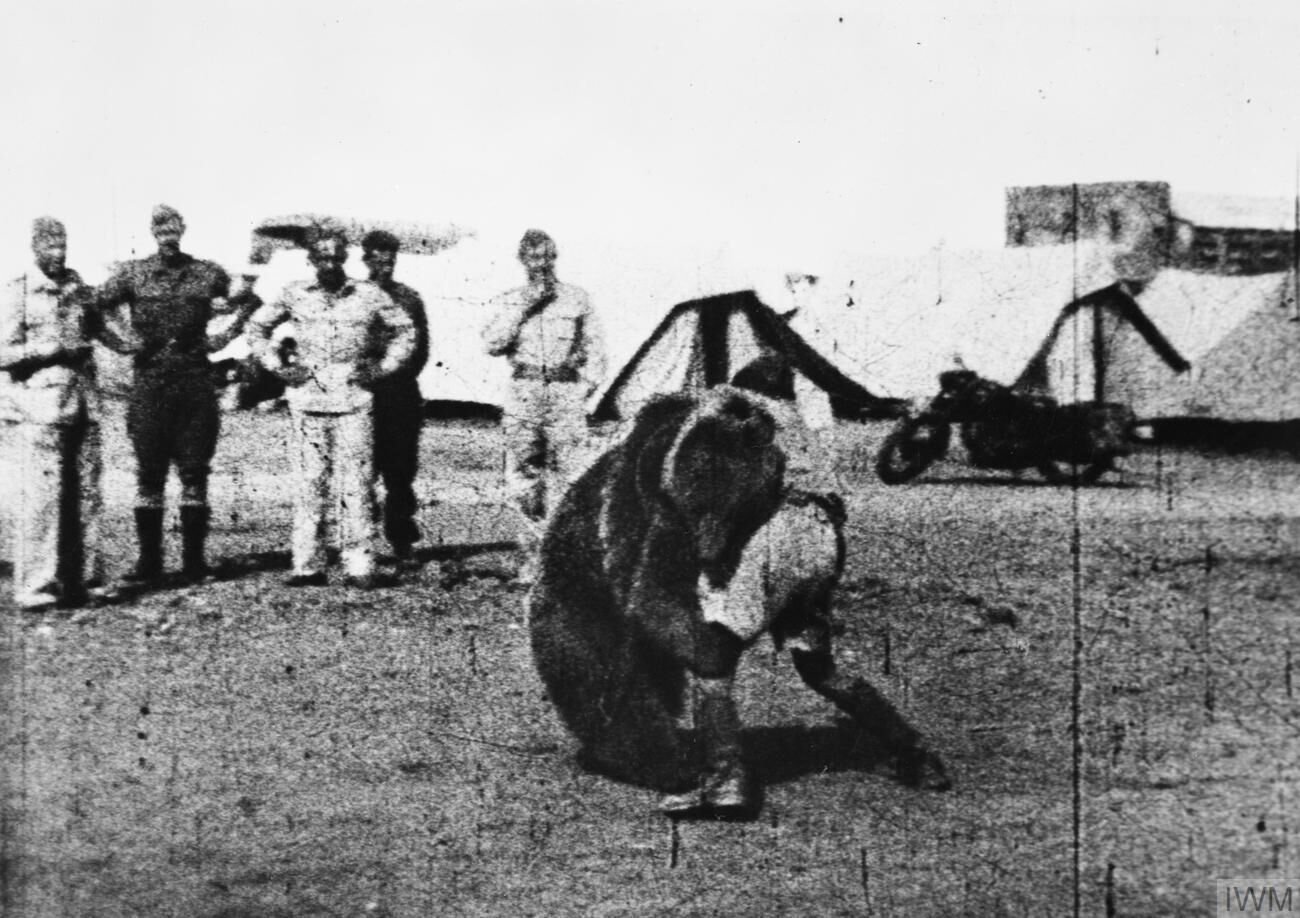
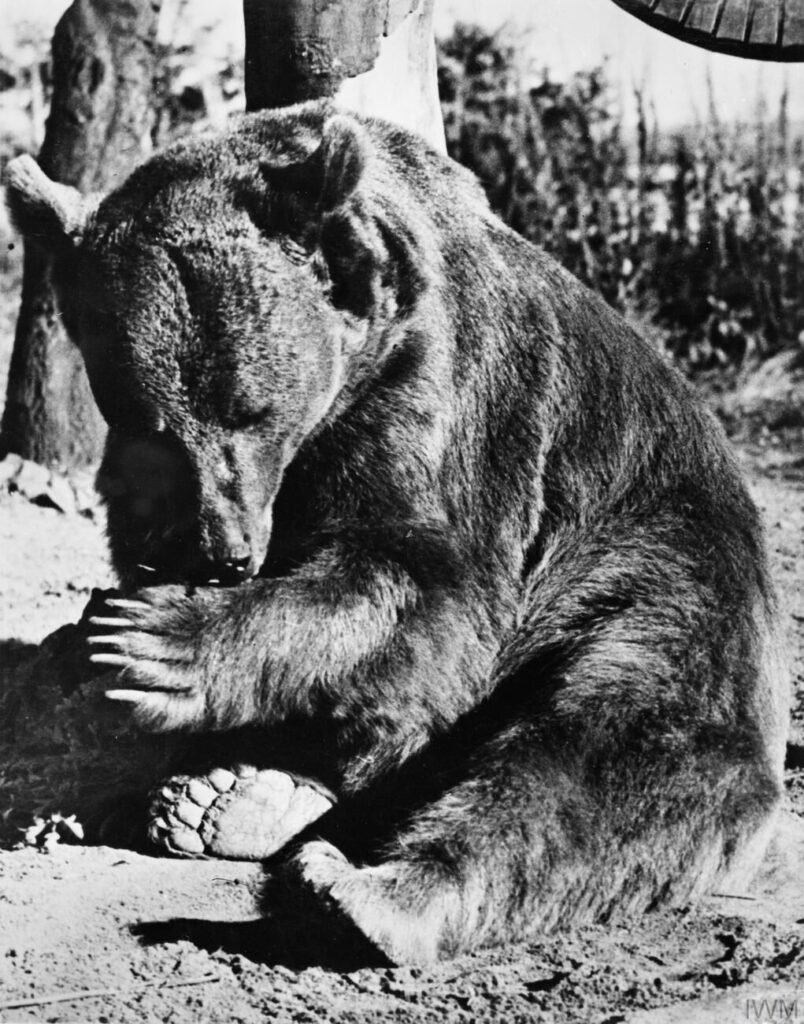
At first the cub could hardly swallow, and the soldiers fed him condensed milk diluted with water from an old vodka bottle. He grew quickly on fruit, marmalade, honey and syrup. He learned to like beer, which became his favourite treat, and to eat lit cigarettes; he drank coffee in the mornings. He wrestled with the men, sometimes several at once, and learned to salute. On cold nights he crept into a soldier’s tent for warmth. When he was frightened, he ran to his favourite soldiers and hid his head.1
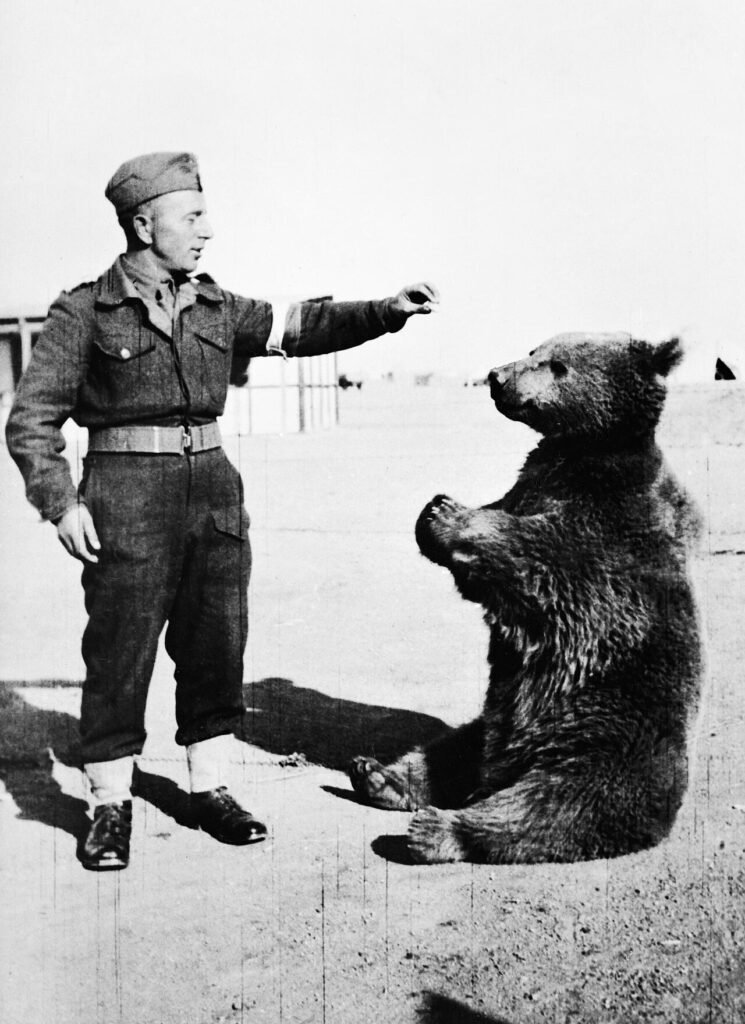
The company moved from Persia to Iraq, then through Syria and Palestine to Egypt, and Wojtek travelled with them in the back of a truck. He became famous far beyond the company. Soldiers of other units came to see him wrestle, and he learned to beg for treats. On one famous occasion in Iraq, the story goes, he wandered into the camp’s bath-house and found an intruder hiding there, whose screams brought the guard running. For men who had lost their homes and families, he was something to laugh at and to love.1
Private Wojtek
In early 1944 the Polish forces, now the 2nd Polish Corps, were ordered to Italy to join the British Eighth Army. The British shipping regulations did not allow pets or mascots on troopships. The 22nd Company solved the problem by enlisting Wojtek as a private soldier, with a name, a rank, a serial number and a paybook, and he sailed with them to Italy. Two soldiers, Henryk Zacharewicz and Lew Worzowski, were assigned to look after him.1
Monte Cassino
The Polish Corps was sent into one of the hardest battles of the war. Since January 1944 the Allies had been trying to break the Gustav Line, the German defences across Italy south of Rome, at its strongest point: the town of Cassino and the mountain above it, crowned by the ancient Benedictine monastery of Monte Cassino. American, British, New Zealand and Indian troops had attacked it three times and failed. In May 1944 the Poles were given the task of taking the mountain itself.2,3
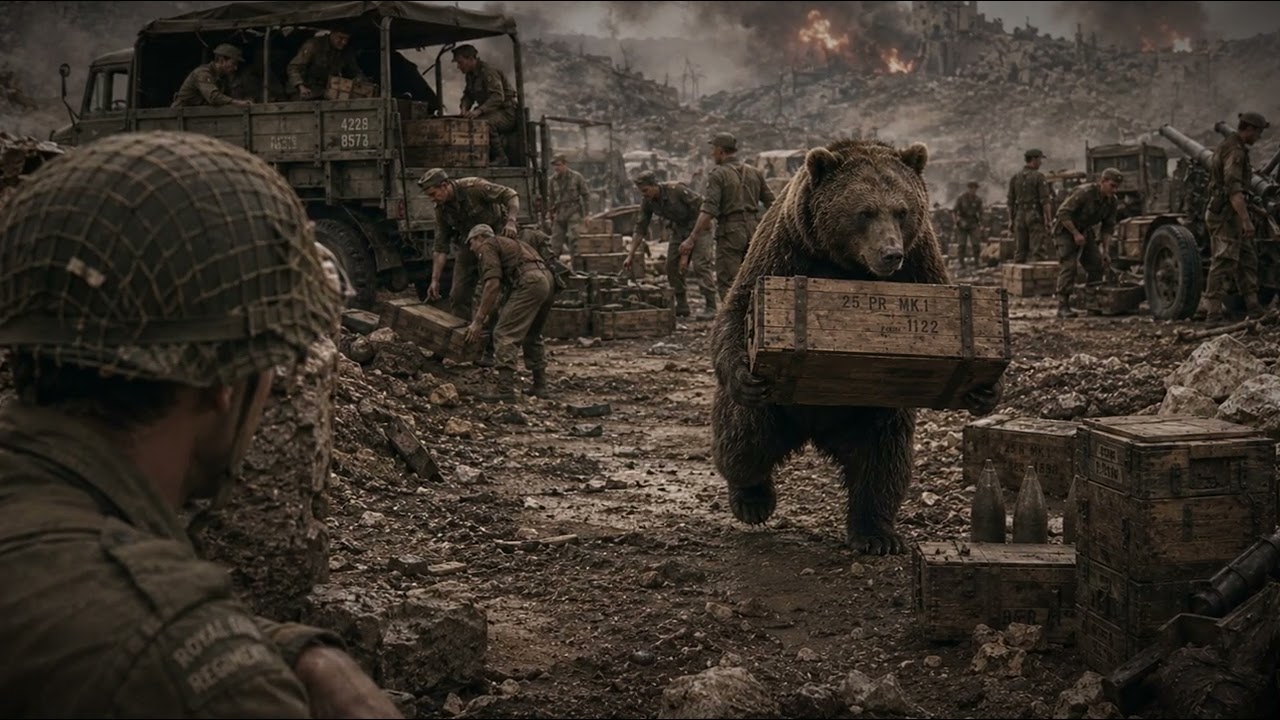
The 22nd Company’s job was to keep the guns supplied, driving ammunition up the mountain roads under shellfire. According to the men of the company, Wojtek watched them unloading the heavy boxes of 25-pounder shells from the lorries and began to copy them. He would take a crate in his arms, carry it to the stack and come back for another, never dropping one. The crates weighed around a hundred pounds. At least one British soldier later described seeing a bear carrying shells near Cassino. The story was never set down in an official report, and it may have grown with the telling. But the company believed it, and so did everyone who knew Wojtek.1,5
On 18 May 1944, after a week of fighting at terrible cost, Polish soldiers raised their flag over the ruins of the monastery. Nearly a thousand of them are buried in the Polish War Cemetery on the slopes below it.3,4
The emblem
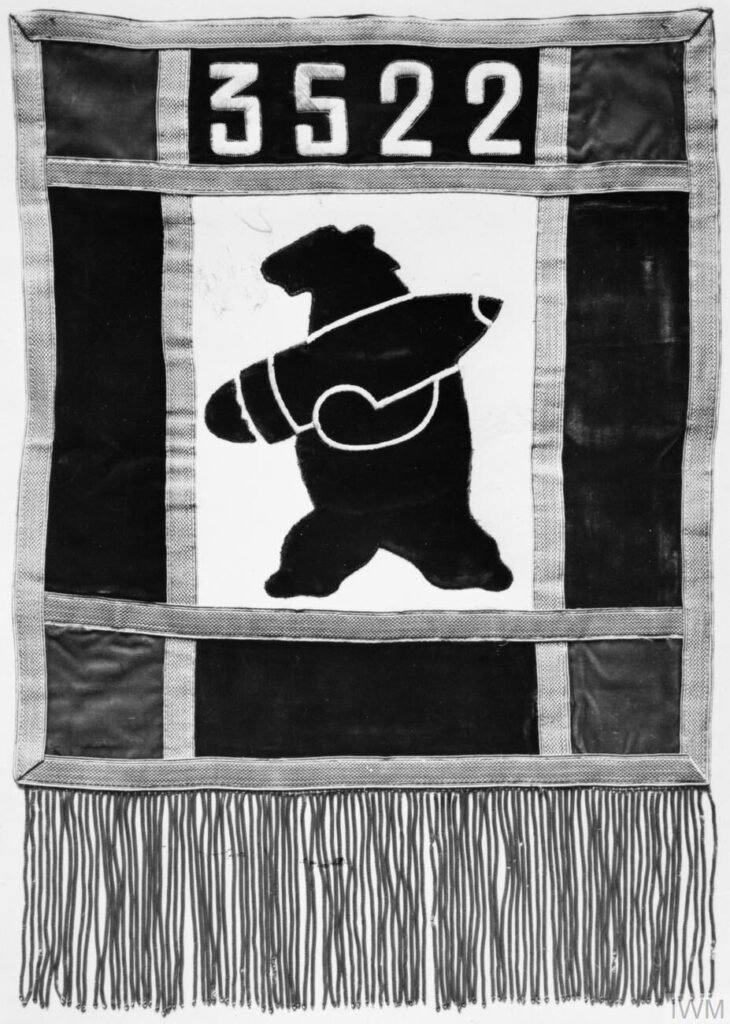
After the battle Wojtek was promoted to corporal. The 22nd Company asked for, and was given, permission to change its badge to a bear carrying an artillery shell, and the men wore it on their sleeves and painted it on their trucks. Visiting generals and statesmen asked to meet him. He went with the company up the length of Italy to the end of the war, to Ancona and Bologna.1,2
A war with no homecoming
For the Poles, the end of the war in Europe in May 1945 brought no victory. At Yalta in February 1945 the Allied leaders had agreed that the Soviet Union would keep eastern Poland, the very region most of Anders’s men came from, and that Poland would fall within the Soviet sphere. Many of the soldiers had no homes to go back to, and many feared, with reason, what would happen to them in a communist Poland if they did.4
In 1946 the 22nd Company was shipped to Scotland with the rest of the Polish forces, to be demobilised through the Polish Resettlement Corps. Wojtek went with them. They were camped at Winfield, a former airfield on Sunwick Farm near the village of Hutton, in Berwickshire. The local people took to the bear at once. He went to dances, rode in the back of lorries through the villages, and swam in the River Tweed. The Polish-Scottish Association made him an honorary member.1
Edinburgh Zoo
When the company was disbanded on 15 November 1947, the men could not take a full-grown bear into civilian life. Wojtek was given to Edinburgh Zoo. Some of his old comrades settled in Scotland and visited him there. When they called to him in Polish he would sit up and wave, and some climbed the fence to wrestle with him as they used to, or threw him cigarettes, to the alarm of the keepers. He became a favourite with Scottish children, and appeared on the BBC children’s programme Blue Peter.1
Wojtek died at the zoo on 2 December 1963, aged about twenty-one. He weighed close to five hundred kilograms and stood more than six feet tall on his hind legs.1
Soldier bear
Today Wojtek is remembered in both his homelands. A bronze statue of him walking beside a Polish soldier stands in West Princes Street Gardens in Edinburgh, unveiled in 2015. Others stand in Jordan Park in Kraków, unveiled on the seventieth anniversary of Monte Cassino in 2014, in the Scottish Borders town of Duns, near the old camp, and since 2019 in Cassino itself. A street in Poznań leading to the city zoo is named Corporal Wojtek Street. A plaque at the Imperial War Museum and a sculpture at the Sikorski Museum in London keep his memory, and that of the soldiers he served with, who so rarely got a statue of their own.1,3
Timeline
- 1939 Poland invaded by Germany and the Soviet Union; mass deportations to the USSR.
- 1941–1942 Polish prisoners released to form the Anders Army.
- 8 April 1942 Soldiers buy a bear cub on the road from Pahlavi to Tehran.
- August 1942 Given to the 2nd Transport Company and named Wojtek.
- Early 1944 Enlisted as a private so he can sail to Italy.
- May 1944 Battle of Monte Cassino; said to have carried shells.
- 18 May 1944 Polish flag raised over the monastery.
- 1946 Arrives in Scotland with his company.
- 15 November 1947 Company disbanded; Wojtek goes to Edinburgh Zoo.
- 2 December 1963 Dies at Edinburgh Zoo.
- 2015 Statue unveiled in Edinburgh.
- Aileen Orr, Wojtek the Bear: Polish War Hero (Birlinn, 2010).
- Imperial War Museums, photographs and records of Wojtek and the 22nd Artillery Supply Company.
- Polish Institute and Sikorski Museum, London, records of the 2nd Polish Corps.
- Norman Davies, Trail of Hope: The Anders Army, an Odyssey Across Three Continents (Osprey, 2015).
- The story of Wojtek carrying shells at Monte Cassino comes from the men of his company and at least one British eyewitness. It was not recorded in official reports at the time, and some historians treat the details with caution.
Found an error, or hold a related record? Tell the research desk.
Share what you know