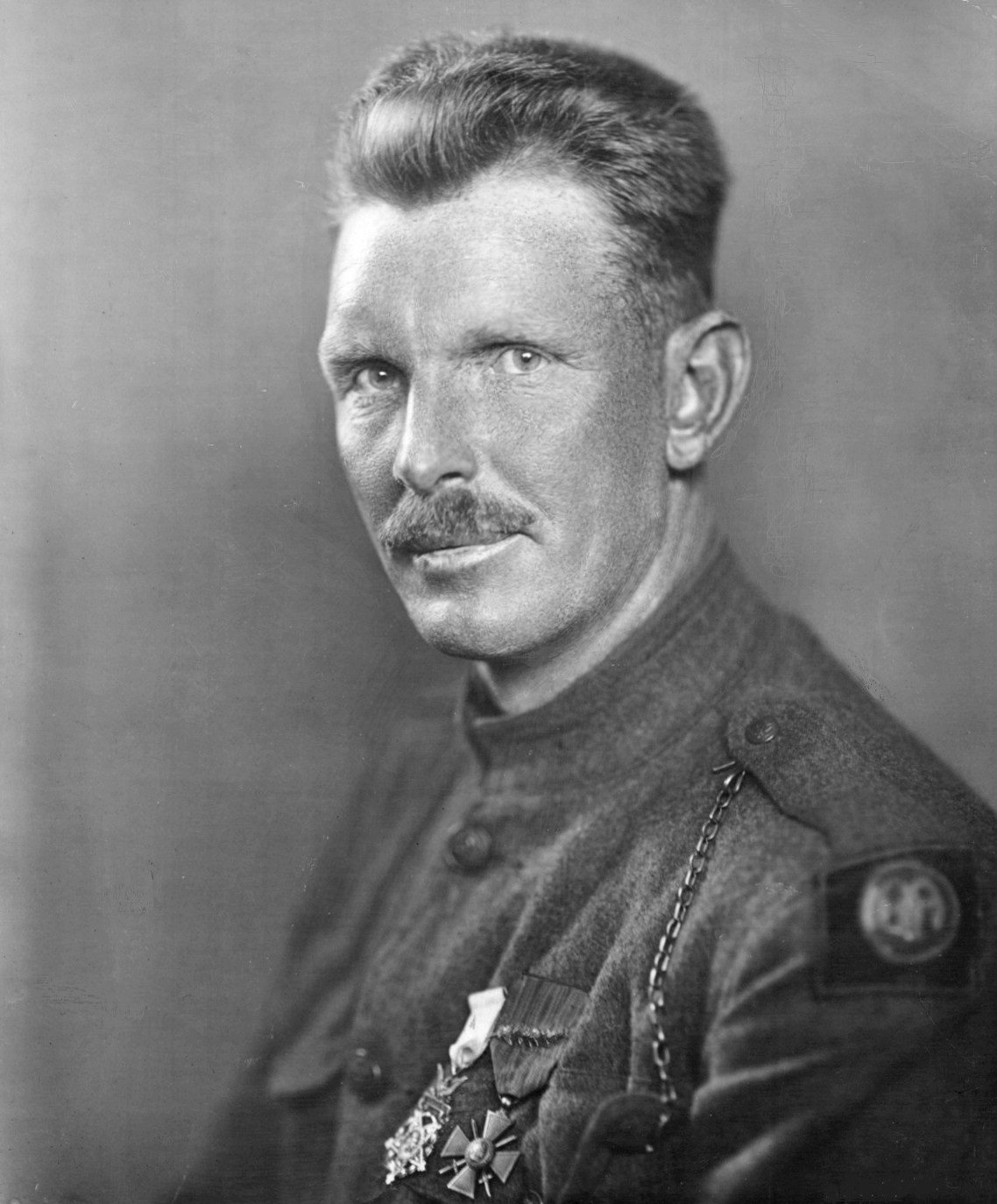
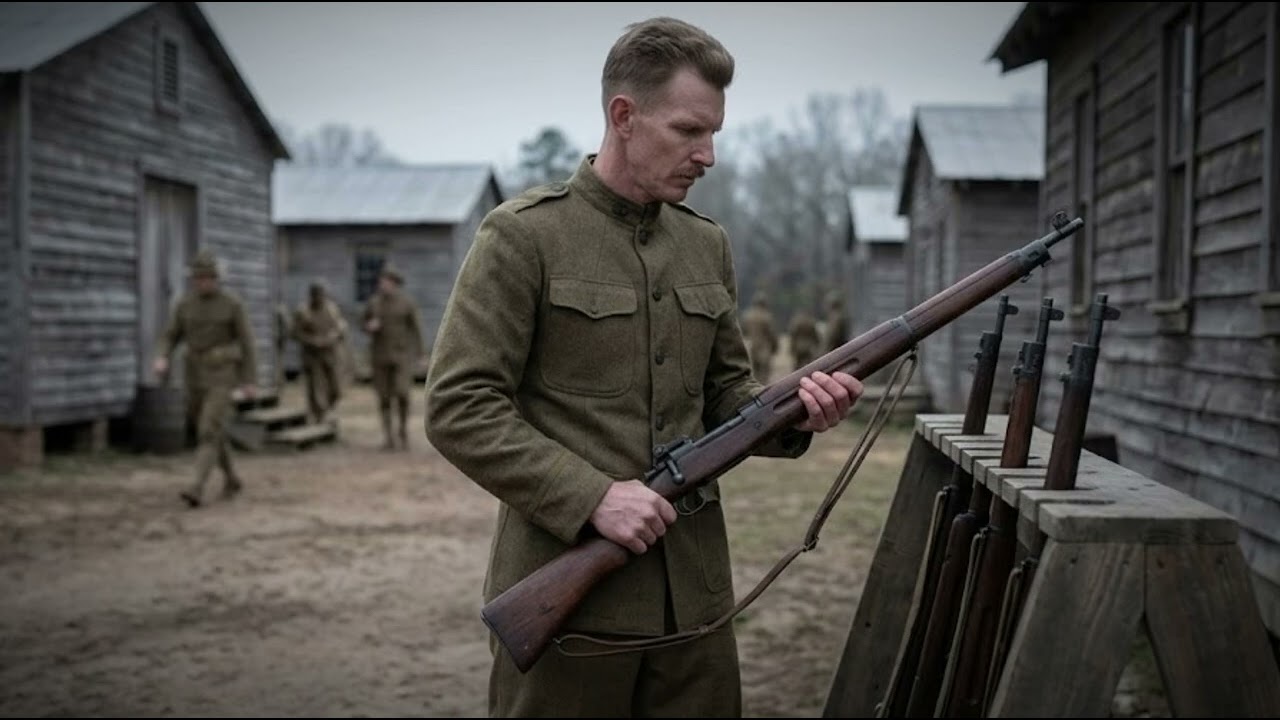
Alvin Cullum York was born on 13 December 1887 in a two-room log cabin at Pall Mall, in Fentress County, in the hills of northern Tennessee. He was the third of eleven children of William York, a blacksmith who also farmed, and his wife, Mary. The York boys went to school for about nine months in all before they were taken out to work the farm and hunt and fish to feed the family. York could barely read or write for much of his life.1,2
When his father died in November 1911, Alvin became the main support of his mother and younger siblings, working on railroad construction and in logging camps. He was already known as a crack shot. He was also known as a heavy drinker and a fighter in the saloons along the Tennessee–Kentucky line, and his mother, a devout woman, despaired of him.2
“Don’t want to fight”
On 1 January 1915, at a revival meeting, York was converted. He joined the Church of Christ in Christian Union, a small Protestant denomination that rejected violence, gave up drink and fighting, and became a regular at church.1,2
Two years later the United States entered the First World War. When York registered for the draft on 5 June 1917, the form asked whether he claimed exemption. He wrote: “Yes. Don’t want to fight.” His claim to be a conscientious objector was turned down, and in November 1917 he was drafted and sent to Camp Gordon, Georgia. He later said that he had never really been a conscientious objector, although his own diary suggests otherwise.1,2
An argument over scripture
York was assigned to Company G of the 328th Infantry Regiment in the 82nd Division. His company commander, Captain Edward Danforth, and his battalion commander, Major George Edward Buxton, took his doubts seriously. They spent long hours with him going through the Bible, quoting passages such as “he that hath no sword, let him sell his garment, and buy one”.1,2
They gave him ten days’ leave to go home and think. He came back convinced that God meant him to fight, and would bring him through. He sailed for France in 1918 and served in the St. Mihiel offensive that September.2
The patrol behind Hill 223
On the morning of 8 October 1918, during the Meuse-Argonne offensive, York’s battalion attacked German positions near Hill 223, north of the village of Châtel-Chéhéry. German machine guns on the high ground stopped the advance. Acting Sergeant Bernard Early was sent with a patrol of seventeen men, York among them, to work round behind the guns and silence them.2,3
The patrol got behind the German line and surprised a group of German soldiers at a headquarters position, who surrendered. Then machine guns on the slope above swung round and opened fire. Six Americans were killed and three wounded, among them Early. Acting Corporal York was the senior man left standing.2
A marksman on the hillside
York had grown up shooting, and he used it. Lying in the open, he fired at each German who raised his head above the gun pits. “There were over thirty of them in continuous action,” he said later, “and all I could do was touch the Germans off just as fast as I could.”1,2
A group of Germans rushed him with bayonets. He shot them with his pistol, starting, by his own account, with the man at the back of the line so that the ones in front would not see the others fall, as he had done when shooting wild turkeys. A German officer, First Lieutenant Paul Vollmer, emptied his own pistol at York without hitting him, and then offered, in English, to surrender the position. York accepted.1,2
York and the seven unwounded men of the patrol marched their prisoners back towards the American lines, collecting more Germans on the way. When he reported to his brigade commander, General Julian Lindsey, the general said: “Well York, I hear you have captured the whole German army.” York replied: “No sir. I got only 132.”2
“I occupied one space in a 50-mile front. I saw so little it hardly seems worthwhile discussing it.”
Alvin York, on his part in the war
How many?
York was promoted to sergeant. He was first awarded the Distinguished Service Cross, which was upgraded to the Medal of Honor after an investigation; General John J. Pershing presented it. France gave him the Croix de Guerre, the Médaille Militaire and the Légion d’honneur, and Italy and Montenegro decorated him too.2,3
The American figures credited him with about twenty-five Germans killed, 132 prisoners and thirty-five machine guns put out of action. In 1929 a German army study went back over the records of the units involved. It found that the Germans had lost around seventy-nine men as prisoners in that sector and questioned some of the other numbers, but it did not question York’s courage. The U.S. Army never changed its account.2
A farm, a school and a film
York was barely known at home until April 1919, when the journalist George Pattullo told his story in The Saturday Evening Post. He came home in May to parades in New York and Washington. He turned down thousands of dollars in offers for stage appearances, endorsements and film rights, and accepted only a farm, bought for him by public subscription. On 7 June 1919 he married Gracie Williams, with the governor of Tennessee officiating. They had ten children.2,4
He spent much of the rest of his life raising money for schools in the mountains where he had grown up with almost no education, and in 1929 opened the York Agricultural Institute in Jamestown, Tennessee. In 1941 Gary Cooper played him in the film Sergeant York, which was the highest-grossing film of the year and won Cooper the Academy Award for Best Actor.2
When the Second World War came, York, then in his fifties, tried to rejoin the Army, and was made an honorary major in the Signal Corps instead, touring training camps and serving on his county draft board. After a series of strokes, he was confined to bed from 1954. Alvin York died at the veterans’ hospital in Nashville on 2 September 1964, aged seventy-six, and was buried at Wolf River Cemetery in Pall Mall.2
Timeline
- 13 December 1887 Born at Pall Mall, Tennessee.
- November 1911 His father dies; he becomes the family’s main support.
- 1 January 1915 Converted at a revival meeting.
- 5 June 1917 Registers for the draft: “Don’t want to fight.”
- November 1917 Drafted and sent to Camp Gordon, Georgia.
- 8 October 1918 The patrol behind Hill 223, near Châtel-Chéhéry.
- 26 April 1919 His story appears in The Saturday Evening Post.
- 22 May 1919 Arrives home at Hoboken.
- 7 June 1919 Marries Gracie Williams.
- December 1929 Opens the York Agricultural Institute.
- 1941 The film Sergeant York is released.
- 2 September 1964 Dies in Nashville, aged 76.
- Tom Skeyhill (ed.), Sergeant York: His Own Life Story and War Diary (Doubleday, Doran, 1928).
- Douglas V. Mastriano, Alvin York: A New Biography of the Hero of the Argonne (University Press of Kentucky, 2014).
- Medal of Honor citation for Corporal Alvin C. York, U.S. Army Center of Military History.
- George Pattullo, “The Second Elder Gives Battle”, The Saturday Evening Post, 26 April 1919.
- The American figures (about 25 Germans killed, 132 prisoners, 35 machine guns) come from York’s account and U.S. Army reports. A German Reichsarchiv study in 1929 put the prisoners lost in that sector nearer 80 and questioned other numbers, while confirming York’s bravery.
Found an error, or hold a related record? Tell the research desk.

Share what you know