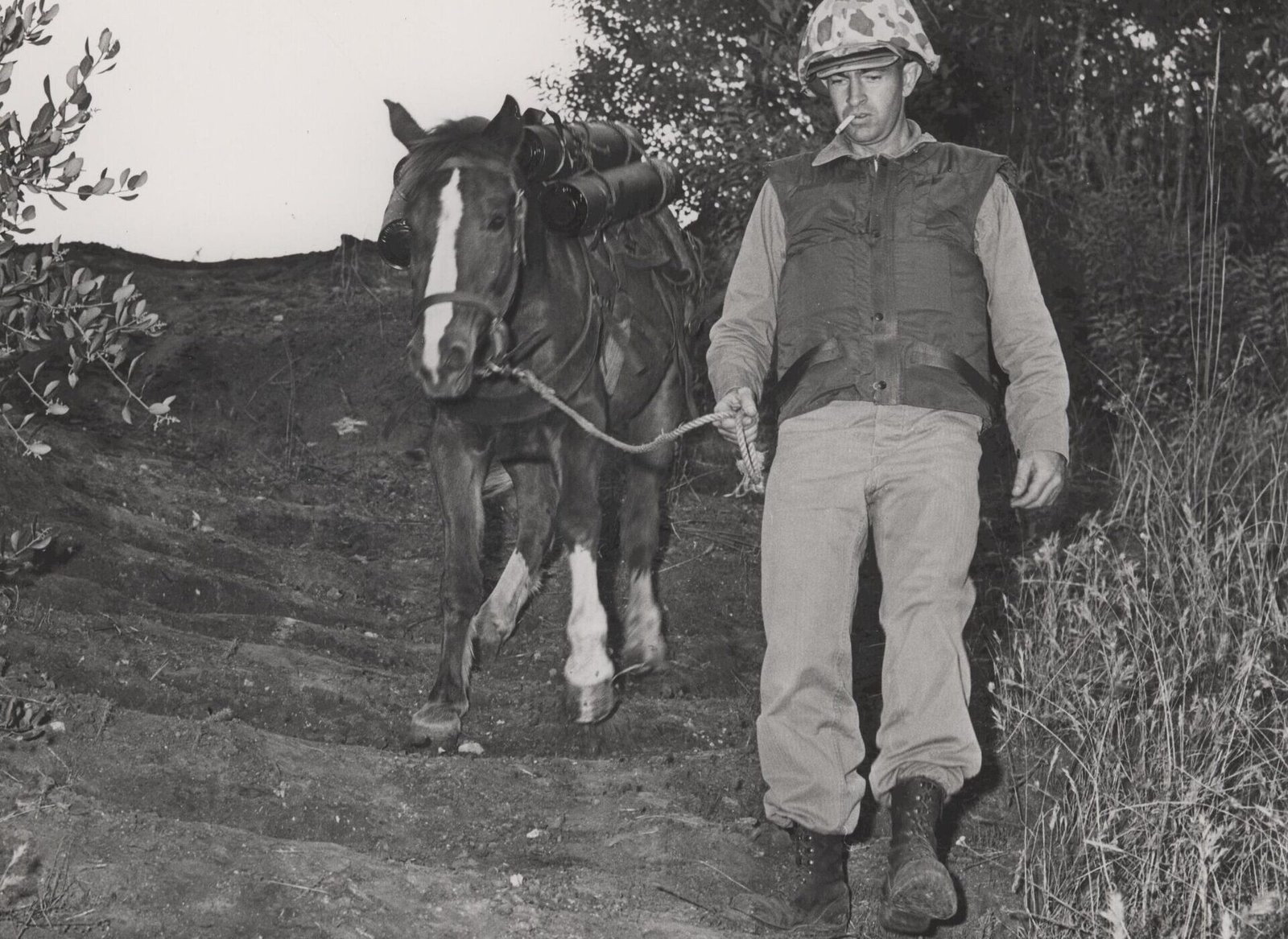

Before she was a Marine, she was a racehorse. The small chestnut mare was foaled in Korea around 1948 and raced at the track in Seoul, where she was known by a Korean name, Ah Chim Hae, meaning “Morning Sun”. Her owner, a young stable boy named Kim Huk Moon, called her Flame. By most accounts he sold her because he needed money to buy an artificial leg for his sister, who had been badly injured by a land mine.1,3
Bought for $250
On 26 October 1952, Lieutenant Eric Pedersen of the 5th Marine Regiment drove to the Seoul racetrack with two of his men, looking for a pack animal. He commanded the Recoilless Rifle Platoon of the regiment’s Anti-Tank Company. The platoon’s 75mm recoilless rifles fired heavy shells of about twenty-four pounds each, and hauling them up the steep Korean hills to the guns was exhausting and dangerous. Pedersen paid $250 for the mare, much of it his own money.1,3
The Marines named her Reckless. The recoilless rifle was known in the ranks as the “reckless rifle”, and the name suited the men who fired it as well as the horse who would carry its shells.1
Hoof camp
Her main trainer was the platoon gunnery sergeant, Joseph Latham, and a private first class named Monroe Coleman looked after her day to day. At what the Marines called “hoof camp” she learned to step over barbed wire and communication lines, to lie down when under fire, and to run for a bunker when someone shouted “incoming”. A pack saddle, sent from California by Pedersen’s wife, let her carry several shells at a time.1,3
She was small, about fourteen hands, and weighed around nine hundred pounds, but she became part of the platoon. She wandered freely around camp and into the men’s tents, and on cold nights slept by the stove in Latham’s tent. She would eat almost anything: scrambled eggs, bacon, buttered toast, chocolate, peanut butter sandwiches and Coca-Cola, and, on one famous occasion, about thirty dollars’ worth of poker chips. The platoon’s Navy corpsman advised limiting her to two bottles of Coke a day.1,3
Learning the way
The first time the recoilless rifle fired near her, she jumped with all four hooves off the ground. By the second shot she only snorted. She learned supply routes after being led along them a few times, and then made the trips on her own, carrying shells up to the gun positions without a handler.1,3
Outpost Vegas, March 1953
In late March 1953 Chinese forces attacked a chain of Marine outposts in front of the main line, named after cities in Nevada: Reno, Carson and Vegas. From 26 to 28 March the fighting for Outpost Vegas swung back and forth under some of the heaviest shelling the Marines had seen in Korea.3,4
Reckless carried ammunition up the slope to the recoilless rifles, and on the way down she carried wounded Marines. On a single day she made fifty-one trips, most of them alone, carrying 386 rounds of recoilless-rifle ammunition, more than nine thousand pounds, and covering over thirty-five miles through the hills. She was wounded twice, by shell fragments above her left eye and in her flank, and kept going.1,3
Fifty-one trips in one day. 386 shells. More than nine thousand pounds. Two wounds.
Reckless at Outpost Vegas, March 1953
She did other work too. Laying out telephone wire, she could do the work of a dozen men on foot. When the 5th Marines moved by sea from Camp Casey to Inchon, she became the first horse in the Marine Corps known to take part in an amphibious landing. She was seasick at first, then got used to it.1,3
The Paddy Derby
Reckless became a celebrity with the Marines long before she was famous at home. During a rest period, her Marines posed her beside a sign challenging Native Dancer, the most famous American racehorse of the day, to a race they called the Paddy Derby: a mile and a half over rice paddies and hills, carrying 192 pounds of ammunition, with no rider. Native Dancer never took up the challenge.1
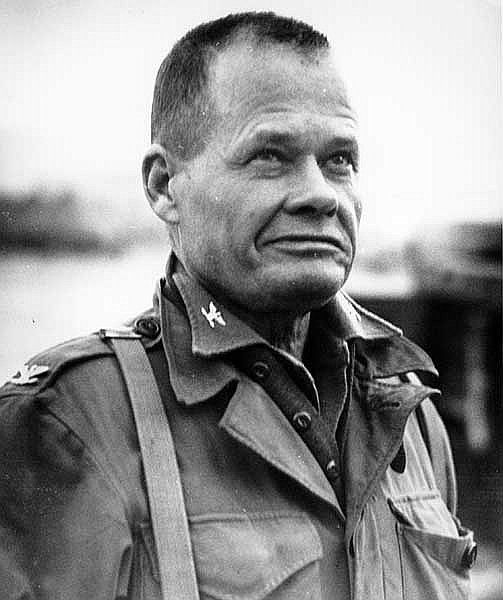
Chesty Puller, the Marine Corps’ most decorated officer, was one of the few Marines allowed to ride her. When she later had a colt, the Marines named him Chesty.1
Corporal, sergeant, staff sergeant
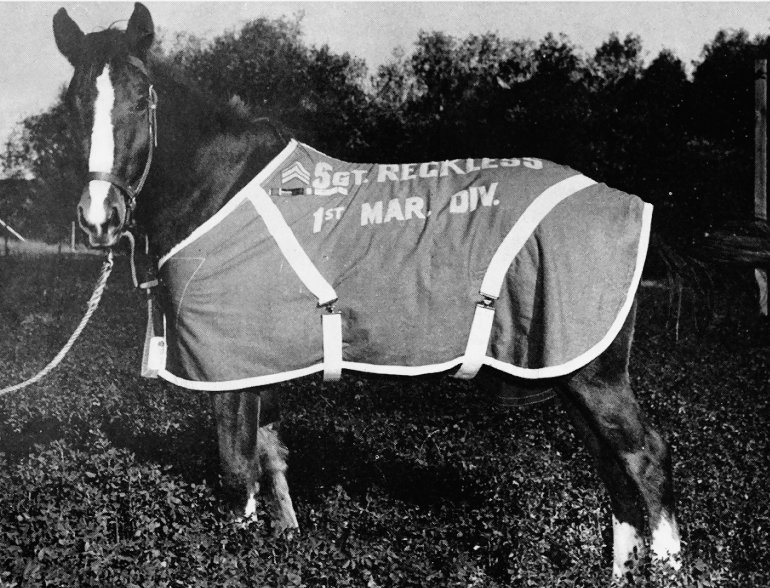
After Vegas the Marines gave her a battlefield promotion to corporal. On 10 April 1954, after the fighting in Korea had ended, General Randolph Pate, commanding the 1st Marine Division, promoted her to sergeant at a formal ceremony and presented her with a red and gold blanket bearing her insignia.1,4
That month Lieutenant Colonel Andrew Geer told her story in The Saturday Evening Post, and Americans began asking for her to be brought home. A shipping executive offered her free passage. She sailed from Yokohama in October 1954 aboard the SS Pacific Transport, rode out a typhoon on the way, and arrived in San Francisco on 10 November 1954, the Marine Corps’ birthday, just in time for the birthday ball, where she ate the cake and the flower arrangements.1,2
Camp Pendleton
She spent the rest of her life at Camp Pendleton in California with the 5th Marines. On 31 August 1959 Pate, by then Commandant of the Marine Corps, promoted her to staff sergeant, with a nineteen-gun salute and a parade of seventeen hundred Marines from her old unit. Her decorations, worn on her blanket, included two Purple Hearts, the Marine Corps Good Conduct Medal and the Presidential Unit Citation.1,4
She retired with full military honours on 10 November 1960, with free quarters and feed for life. She had four foals: Fearless, Dauntless, Chesty, named after the famous Marine general Chesty Puller, and a filly who died young. Staff Sergeant Reckless died on 13 May 1968, after injuring herself in a fall into a barbed-wire fence. She was about twenty years old.1
In 1997 Life magazine named her one of America’s hundred all-time heroes. In 2013 a statue of her was unveiled at the National Museum of the Marine Corps in Virginia, with a lock of her tail hair inside it; others followed at Camp Pendleton and the Kentucky Horse Park. In 2016 she was posthumously awarded the Dickin Medal, the animal equivalent of the Victoria Cross.1,4
Timeline
- c. 1948 Foaled in Korea.
- 26 October 1952 Bought for $250 at the Seoul racetrack by Lieutenant Eric Pedersen.
- 26–28 March 1953 Battle for Outpost Vegas: 51 trips in a single day; wounded twice.
- 1953 Battlefield promotion to corporal.
- 10 April 1954 Promoted to sergeant.
- 17 April 1954 Her story appears in The Saturday Evening Post.
- 10 November 1954 Arrives in San Francisco on the Marine Corps birthday.
- 31 August 1959 Promoted to staff sergeant.
- 10 November 1960 Retires with full military honours.
- 13 May 1968 Dies at Camp Pendleton.
- 2013 Statue unveiled at the National Museum of the Marine Corps.
- 2016 Awarded the Dickin Medal.
- Andrew Geer, Reckless: Pride of the Marines (E. P. Dutton, 1955).
- Andrew Geer, “Reckless, Pride of the Marines”, The Saturday Evening Post, 17 April 1954.
- Robin Hutton, Sgt. Reckless: America’s War Horse (Regnery History, 2014).
- U.S. Marine Corps History Division and National Museum of the Marine Corps, material on Staff Sergeant Reckless.
Found an error, or hold a related record? Tell the research desk.

Share what you know