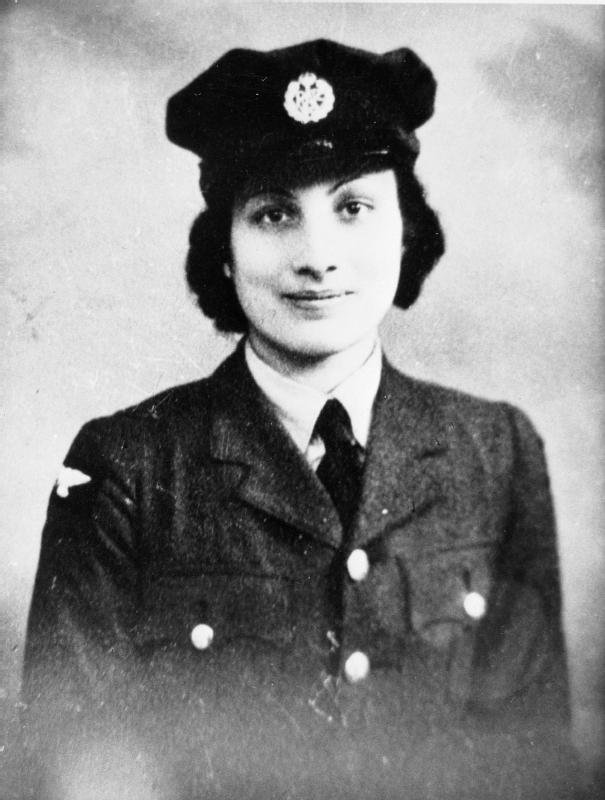

Noor-un-Nisa Inayat Khan was born in Moscow on 1 January 1914, the eldest of four children. Her father, Inayat Khan, was an Indian classical musician and teacher of Sufism, descended from Tipu Sultan, the eighteenth-century ruler of Mysore. Her mother, Pirani Ameena Begum, was born Ora Ray Baker in Albuquerque, New Mexico; the two had met while Inayat Khan was touring the United States.1
The family moved to London in 1914 and lived for a time in Bloomsbury. In 1920 they settled in Suresnes, just outside Paris, in a house called Fazal Manzil that had been given to them by a follower of the Sufi movement. Noor was a quiet, dreamy child. When her father died in 1927 she was thirteen, and with her mother overwhelmed by grief, she took on much of the care of her younger brothers and sister.1
The storyteller
She studied child psychology at the Sorbonne and music at the École Normale de Musique under Nadia Boulanger, playing the harp and piano and composing. She wrote poetry and children’s stories in English and French, contributed to children’s magazines and read her stories on French radio. In 1939 the London publisher George G. Harrap brought out her book Twenty Jataka Tales, retellings of traditional Buddhist stories.1
When Germany invaded France in 1940, the family fled to Bordeaux and took a ship to England, landing at Falmouth on 22 June 1940. Noor and her brother Vilayat had grown up with their father’s pacifist teaching, but both decided that Nazism had to be fought. Vilayat later said that he hoped an Indian might win high distinction in the war, and help build a bridge between the British and Indian peoples.1
From the WAAF to the SOE
In November 1940 Noor joined the Women’s Auxiliary Air Force as an aircraftwoman second class and trained as a wireless operator, the first member of the WAAF to do so. Her fluent French brought her to the attention of the Special Operations Executive, the secret organisation set up to support resistance in occupied Europe, and in early 1943 she was transferred to its French section.1,2
She trained at Wanborough Manor in Surrey, at a wireless school near Aylesbury, and at Beaulieu in Hampshire for security and clandestine work. Not all of her instructors were convinced. One report doubted that she was suited to work in the field; another noted that she said she would not like to do anything two-faced. She was terrified during a mock Gestapo interrogation. The head of the French section, Maurice Buckmaster, wrote “Nonsense” in the margin of the most critical report.1
Before she left, his intelligence officer, Vera Atkins, took her to lunch and told her that it was not too late to turn back. Noor insisted that she wanted to go. Her only worry was her mother, whom she had told she was being posted to Africa. Wireless operators in France in 1943 were not expected to survive long; the usual estimate was about six weeks.1
Madeleine
On the night of 16 to 17 June 1943 she was flown into France by Lysander, together with two other women agents, Diana Rowden and Cecily Lefort. She was the first woman the SOE sent into occupied France as a wireless operator; the women before her had gone as couriers. Her codename was Madeleine, her cover a children’s nurse called Jeanne-Marie Renier, and her radio call sign, Nurse. She was assigned to the Cinema–Phono circuit in Paris, run by Émile Garry, part of the large Prosper network.1,5
Within days of her arrival, starting on 24 June, the Germans began arresting the leaders and members of Prosper in a wave that swept through Paris. London offered to bring her home. She refused, believing she was the last wireless operator still free in the city.1,5
Alone on the air
For about three and a half months she moved between safe houses, carrying her transmitter, changing her appearance, and sending messages for the agents who remained at large. A transmitter that stayed on the air for more than twenty minutes could be traced by German direction-finding vans; she kept moving. The George Cross citation later described her post as the principal and most dangerous one in France.1,5
She refused to abandon what had become the principal and most dangerous post in France, even though she had been given the opportunity to return to England.
George Cross citation, The London Gazette, 5 April 1949
Betrayed
In mid-October 1943 she was betrayed, allegedly by Renée Garry, the sister of her circuit organiser, who was said to have been paid for the information. Renée Garry was tried after the war and acquitted by a single vote. Noor was arrested and taken to the headquarters of the Sicherheitsdienst, the Nazi security service, at 84 Avenue Foch.1
The head of the Sicherheitsdienst in Paris, Hans Kieffer, testified after the war that she gave away not a single piece of information. But against security rules she had kept copies of the messages she had sent, and with those the Germans were able to operate her radio and impersonate her. London did not realise, and agents dropped into France on the strength of those messages were captured on landing.1
On 25 November 1943, during an air raid alert, she escaped across the roof of the building with two other prisoners, the SOE agent John Starr and the resistance leader Léon Faye. They were caught before they got clear. When she refused to sign a promise not to try again, she was sent to Germany.1
Pforzheim and Dachau
For ten months she was held at Pforzheim prison in solitary confinement, classed as a “Nacht und Nebel” prisoner: highly dangerous, to disappear without trace. She was kept in chains at her hands and feet. The prison director testified after the war that she refused to give any information about her work. By scratching on the bottom of her mess bowl she managed to tell another prisoner her name and her mother’s address in London.1
On 12 September 1944 she was moved to Dachau with three other SOE women: Yolande Beekman, Madeleine Damerment and Eliane Plewman. At dawn the next day all four were shot. Most records, including the Commonwealth War Graves Commission, give the date as 13 September 1944; English Heritage gives 11 September. According to a later account, her last word was “Liberté”.1,2,4
Remembered
France awarded her the Croix de Guerre with a silver-gilt star. In 1949 Britain awarded her the George Cross, its highest award for gallantry not in the face of the enemy. She has no known grave; her name is on the Air Forces Memorial at Runnymede.4,5
In 2012 a bronze bust of her was unveiled in Gordon Square, Bloomsbury, by the Princess Royal. In 2014 she appeared on a Royal Mail stamp, and in 2020 she became the first woman of South Asian descent to be honoured with an English Heritage blue plaque, at 4 Taviton Street, the London address she had scratched into her prison bowl.1,2
Timeline
- 1 January 1914 Born in Moscow.
- 1920 Family settles at Suresnes, near Paris.
- 1939 Twenty Jataka Tales published in London.
- 22 June 1940 Reaches England by sea from Bordeaux.
- November 1940 Joins the Women’s Auxiliary Air Force.
- February 1943 Transferred to the SOE’s French section.
- 16–17 June 1943 Flown into France by Lysander.
- 24 June 1943 Mass arrests of the Prosper network begin.
- Mid-October 1943 Betrayed and arrested in Paris.
- 25 November 1943 Escape attempt across the roof of 84 Avenue Foch.
- 27 November 1943 Sent to Pforzheim prison in Germany.
- 13 September 1944 Executed at Dachau.
- 5 April 1949 George Cross gazetted.
- 2012 and 2020 Bust unveiled in Gordon Square; English Heritage blue plaque.
- Shrabani Basu, Spy Princess: The Life of Noor Inayat Khan (Sutton Publishing, 2006).
- English Heritage, blue plaque record for Noor Inayat Khan, 4 Taviton Street, London.
- Imperial War Museums, photograph HU 74868 and caption.
- Commonwealth War Graves Commission, casualty record for Assistant Section Officer N. Inayat-Khan; Air Forces Memorial, Runnymede.
- The London Gazette, 5 April 1949 (George Cross citation).
- The National Archives (Kew), Special Operations Executive personnel files, series HS 9.
Found an error, or hold a related record? Tell the research desk.
Share what you know