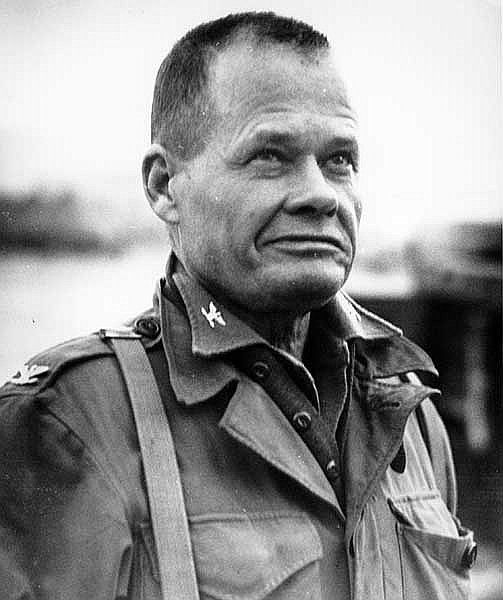

Lewis Burwell Puller was born on 26 June 1898 in West Point, Virginia, a small town where the Pamunkey and Mattaponi rivers meet to form the York. His father died when he was ten. He grew up in the Virginia tidewater, and he wanted to be a soldier.1,2
In August 1918 he enrolled at the Virginia Military Institute, but left in the middle of the year, afraid that the First World War would end before he could fight in it. He enlisted in the Marine Corps, went through boot camp at Parris Island, and was sent to officer training at Quantico. He was commissioned a second lieutenant on 16 June 1919, too late for France. Soon afterwards, as the Marine Corps shrank after the war, he was put on the inactive list and went back to the ranks as a corporal.2,3
Haiti: forty engagements
Puller wanted action, and he found it in Haiti, which the United States had occupied since 1915. He joined the Gendarmerie d’Haïti, the Haitian constabulary led by American Marines, and spent five years fighting the Caco rebels in the mountains. He took part in more than forty engagements: ambushes, night raids and long patrols through the hills. In March 1924 he was commissioned again as a second lieutenant.2,3
Nicaragua: “El Tigre”
In December 1928 he was sent to Nicaragua, where Marines were training and leading the Guardia Nacional against the rebel forces of Augusto Sandino. Leading small patrols of Nicaraguan guardsmen through the jungle, he earned his first Navy Cross for five successive engagements against larger forces between February and August 1930.3
His second Navy Cross came in the autumn of 1932, when his patrol of forty men fought off a force of around a hundred and fifty rebels at Agua Carta. On 26 December 1932, days before the Marines left the country, his men beat off an ambush on a train near El Sauce. The rebels are said to have nicknamed him El Tigre.2,3
China and the Horse Marines
In the 1930s Puller served with the Marine legation guard in Beijing, where he served with the mounted detachment known as the Horse Marines, and at sea aboard the cruiser USS Augusta under Captain Chester Nimitz. From 1940 to 1941 he was with the 4th Marines in Shanghai, watching the Japanese army at close quarters.2,3
Guadalcanal: holding the airfield
Puller landed on Guadalcanal in September 1942 in command of the 1st Battalion, 7th Marines. In late September his battalion was caught in a fight along the Matanikau River; three of his companies were cut off, and Puller went aboard the destroyer USS Monssen and directed its gunfire to cover their escape to the beach.3
On the night of 24 to 25 October 1942 a Japanese regiment attacked Henderson Field, the island’s vital airfield, and hit the line held by Puller’s battalion. For about three hours, in heavy rain, his Marines and an Army battalion sent up to reinforce them held their positions against repeated assaults. They lost about seventy men; the Japanese lost more than fourteen hundred killed. Puller received his third Navy Cross. Among his men that night was Sergeant John Basilone, who earned the Medal of Honor.2,3
“We’ve been looking for the enemy for some time now. We’ve finally found him. We’re surrounded. That simplifies things.”
Words attributed to Puller in Korea, 1950
Cape Gloucester and Peleliu
His fourth Navy Cross came at Cape Gloucester, on New Britain, between December 1943 and January 1944, when as executive officer of the 7th Marines he took over two battalions whose commanders had been hit and led them against fortified Japanese positions. In the summer of 1944 his brother Samuel, executive officer of the 4th Marines, was killed by a sniper on Guam.2,3
By then Puller was a colonel commanding the 1st Marine Regiment. In September 1944 he led it ashore on Peleliu, in one of the bloodiest battles in the history of the Corps. In a little over a week the regiment lost about 1,750 of its roughly 3,000 men. Puller was criticised for continuing frontal attacks against the island’s fortified ridges, and the regiment was eventually withdrawn.2,3
Inchon to Chosin
When the Korean War began he was given command of the 1st Marines again. He led them ashore at Inchon on 15 September 1950 and into the fight for Seoul. In late November, far to the north at the Chosin Reservoir, Chinese armies surrounded the 1st Marine Division in bitter cold.2,3
Puller’s regiment held Koto-ri, a key position on the only road south. From 29 November to 10 December his Marines held the perimeter and then fought their way south with the rest of the division, bringing out their wounded, their dead and their equipment. For those two weeks he received the Army’s Distinguished Service Cross and his fifth Navy Cross, the only Marine ever to receive five.2,3
He was promoted to brigadier general in January 1951, and briefly commanded the 1st Marine Division that spring. He came home in May 1951.3
The legend and the man
Few Marines have been surrounded by as many stories as Puller. He was known for staying close to the front line, for sharing his men’s conditions, and for his impatience with staff officers and paperwork. His men trusted him; some of his superiors found him difficult.
His record was also argued over. At Peleliu, historians have questioned his costly frontal attacks against fortified ridges, and General Roy Geiger, the corps commander, eventually ordered his shattered regiment withdrawn. Puller’s admirers point to his courage and to the results he got; his critics, to the price his men paid. Both are part of his story.2,3
His name lives on in the Marine Corps in many ways. A frigate, USS Lewis B. Puller, was named after him, and the Corps’ English bulldog mascot at its barracks in Washington has for years been named Chesty.3
“Good night, Chesty, wherever you are”
After Korea he commanded the 3rd and then the 2nd Marine Division. A stroke ended his active career, and he retired on 1 November 1955 as a lieutenant general. Along with his five Navy Crosses and the Distinguished Service Cross he held a Silver Star, two Legions of Merit, a Bronze Star, three Air Medals and a Purple Heart: the most decorated Marine in American history.3
His son, Lewis Puller Jr., followed him into the Marines and was terribly wounded in Vietnam; his memoir, Fortunate Son, won the Pulitzer Prize in 1992. Chesty Puller died in Hampton, Virginia, on 11 October 1971, aged seventy-three, and was buried at Christ Church in Middlesex County, Virginia. To this day, recruits at Marine boot camp are said to end the day with the words: “Good night, Chesty, wherever you are.”1,2
Timeline
- 26 June 1898 Born in West Point, Virginia.
- 1918 Leaves the Virginia Military Institute to enlist in the Marines.
- 16 June 1919 Commissioned a second lieutenant; soon returned to the ranks.
- 1919–1924 Fights with the Gendarmerie d’Haïti.
- 1930 First Navy Cross, in Nicaragua.
- 1932 Second Navy Cross, at Agua Carta.
- 24–25 October 1942 Holds the line at Henderson Field, Guadalcanal: third Navy Cross.
- December 1943 – January 1944 Cape Gloucester: fourth Navy Cross.
- September 1944 Leads the 1st Marines at Peleliu.
- 15 September 1950 Lands at Inchon.
- November–December 1950 Chosin Reservoir: Distinguished Service Cross and fifth Navy Cross.
- 1 November 1955 Retires as a lieutenant general.
- 11 October 1971 Dies in Hampton, Virginia.
- Burke Davis, Marine! The Life of Chesty Puller (Little, Brown, 1962).
- Jon T. Hoffman, Chesty: The Story of Lieutenant General Lewis B. Puller, USMC (Random House, 2001).
- U.S. Marine Corps History Division, biography of Lieutenant General Lewis B. Puller, and Navy Cross citations.
- Words attributed to Puller at the Chosin Reservoir are reported in several slightly different versions.
Found an error, or hold a related record? Tell the research desk.

Share what you know