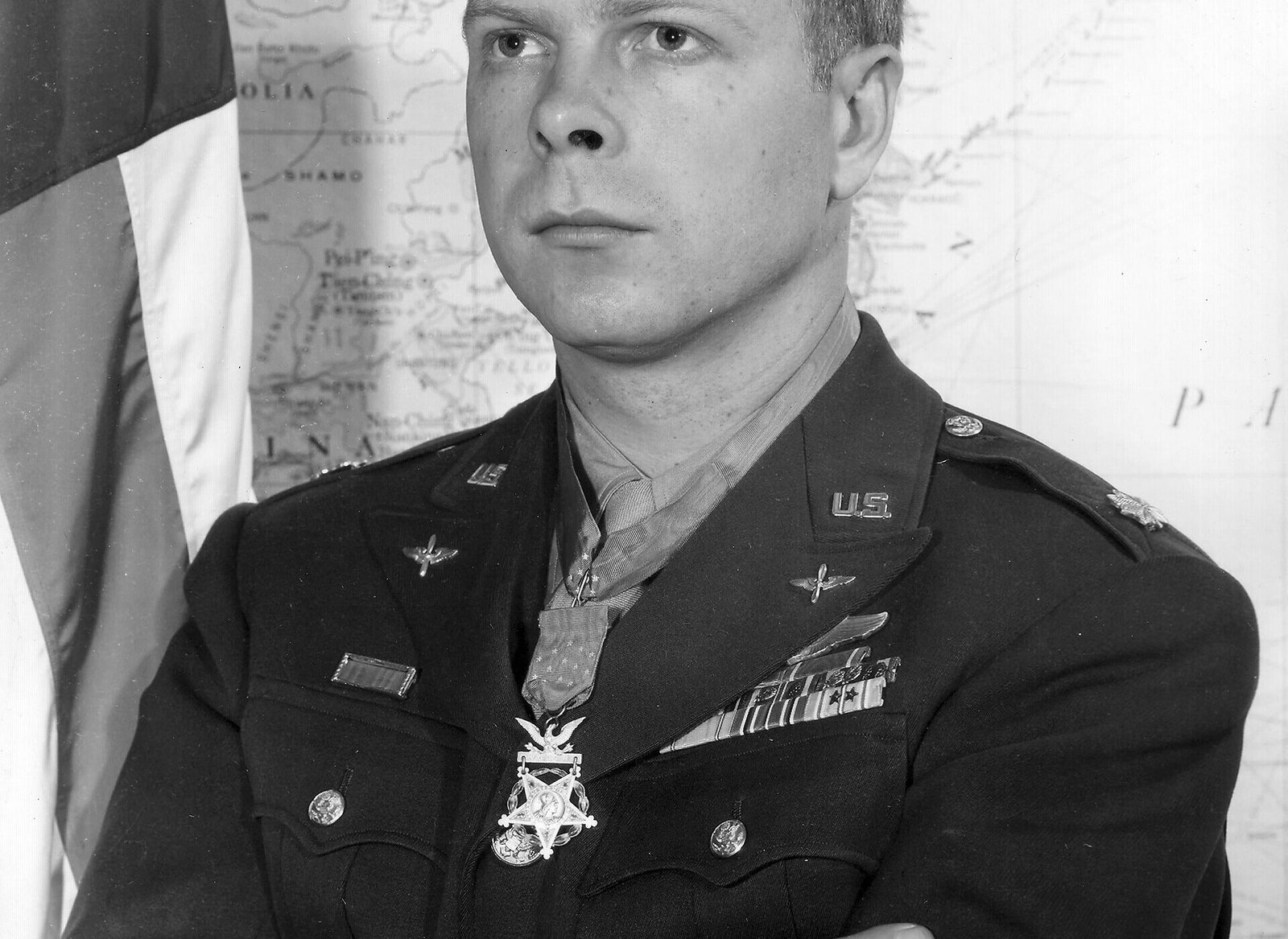
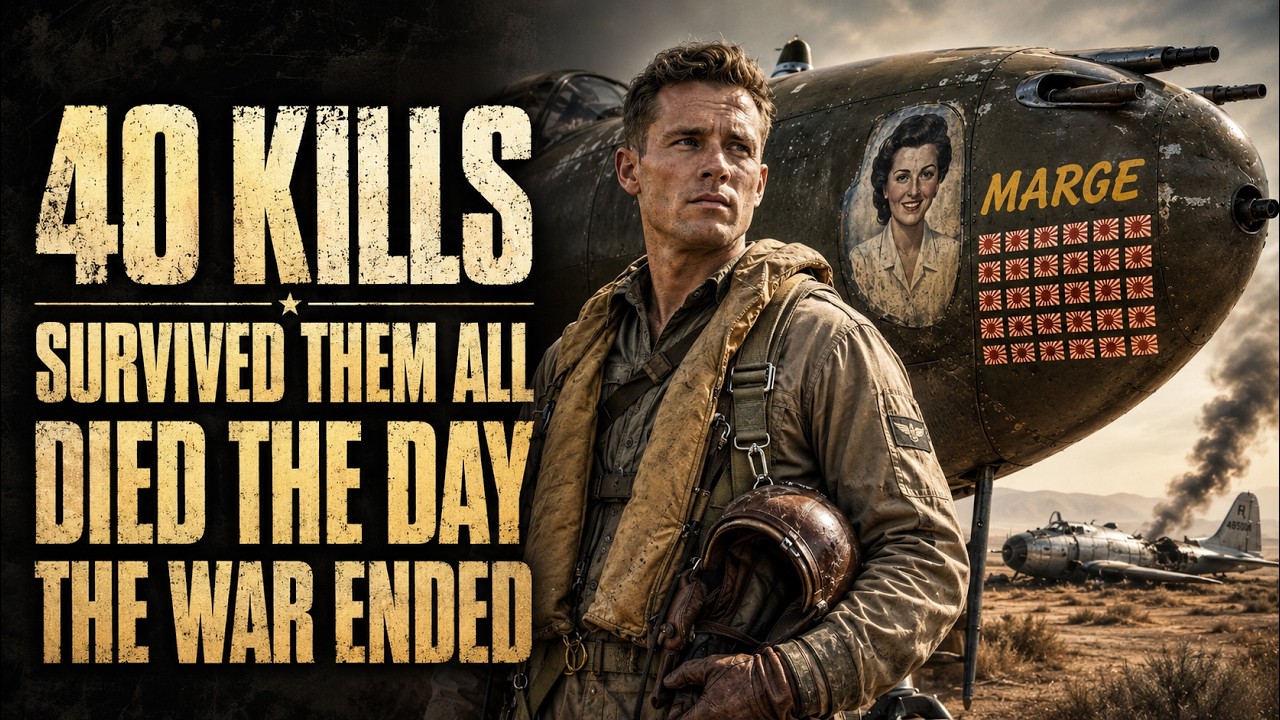
Richard Ira Bong was born in Superior, Wisconsin, on 24 September 1920, the first of nine children of a Swedish immigrant, Carl Bong, and his wife Dora. He grew up on the family farm at Poplar, in the far north-west of the state, where the winters were long and the nearest city was Duluth, across the water. In the summer of 1928 President Calvin Coolidge made his summer White House at Superior, and the mail planes that flew in and out passed over the Bong farm. The boy watched them and built model aeroplanes.3,5
He was an ordinary, cheerful, practical farm boy: he played clarinet in the school band, baseball, basketball and hockey. In 1938 he went to the state teachers college in Superior. There he signed up for the government’s Civilian Pilot Training Program and took private flying lessons. On 29 May 1941 he enlisted as an aviation cadet in the Army Air Corps. One of his instructors was a young officer named Barry Goldwater, later a senator and presidential candidate.3,5
Looping the Golden Gate
Bong won his wings on 19 January 1942 and, after a spell as a gunnery instructor in Arizona, was sent to Hamilton Field near San Francisco to learn to fly the Lockheed P-38 Lightning, a big, fast, twin-engined fighter with a distinctive twin-boom tail. He loved it. On 12 June 1942 he flew very low over the house of a newly married fellow pilot in San Anselmo, on the same day that other P-38 pilots looped the Golden Gate Bridge. He was accused of looping the bridge, flying down Market Street in San Francisco at rooftop height and blowing the washing off a woman’s line in Oakland.2,3
He was hauled in front of the commander of the Fourth Air Force, General George Kenney. Kenney gave him a dressing down and then told him that if he did not want to fly down Market Street, Kenney would not want him in his air force; but he was not to do it again. Kenney later wrote that the Air Force needed kids like that. Bong, who always denied flying under the bridge, was grounded while his group left for England without him. It was the best thing that could have happened to him. Kenney went to command the air forces in the South-West Pacific, and he did not forget the young pilot.2
New Guinea
By the end of 1942 Bong was in Australia and then New Guinea, flying with the 9th Fighter Squadron, the Flying Knights, of the 49th Fighter Group. The war in New Guinea was fought over some of the worst country on earth, jungle and mountain and swamp, from primitive airstrips around Port Moresby. On 27 December 1942 Bong shot down his first two Japanese aircraft, a Zero and an Oscar, over Buna, and won the Silver Star.3,5
He was not a natural marksman, and he knew it. He thought his deflection shooting was poor, so he made up for it by getting as close as he possibly could before firing. Sometimes he flew through the wreckage of the aircraft he had just destroyed; once he collided with his target. On 26 July 1943 he shot down four Japanese fighters over Lae and was awarded the Distinguished Service Cross.3,5
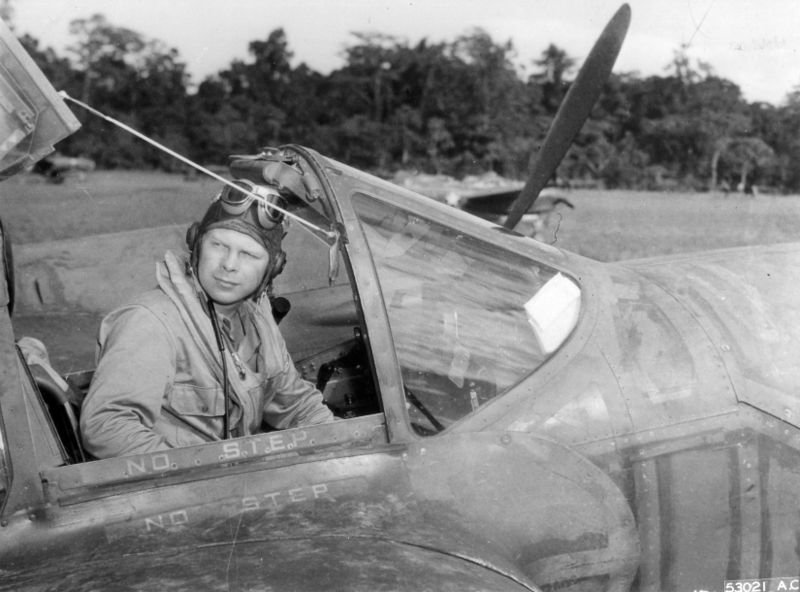
Marge
Home on leave in late 1943, Bong met a student named Marjorie Vattendahl at a homecoming event at his old college in Superior. When he went back to the Pacific in January 1944, he named his P-38 Marge and had her photograph painted on the nose. That aircraft was lost in March 1944, flown by another pilot who bailed out safely; in 2024 researchers announced that they had found its wreckage in the New Guinea jungle.3,5
Twenty-seven
The American record for enemy aircraft shot down was held by Eddie Rickenbacker, with twenty-six in the First World War. Pappy Boyington had equalled it in January 1944, and then gone missing over Rabaul. On 12 April 1944 Bong shot down his twenty-sixth and twenty-seventh, and the record was his. Kenney promoted him to major on the spot and sent him home to meet General Hap Arnold, the chief of the Army Air Forces, and to tour the country selling war bonds.2,3
An instructor who kept fighting
He came back to the Pacific in September 1944 as an advanced gunnery instructor on the staff of V Fighter Command, with permission to fly combat missions but orders not to go looking for fights. He went looking anyway. Between 10 October and 15 November 1944, flying over Balikpapan in Borneo and over Leyte in the Philippines, he shot down eight more Japanese aircraft. His Medal of Honor citation noted drily that, though he was neither required nor expected to fight, he had flown repeated combat missions “voluntarily and at his own urgent request”.1
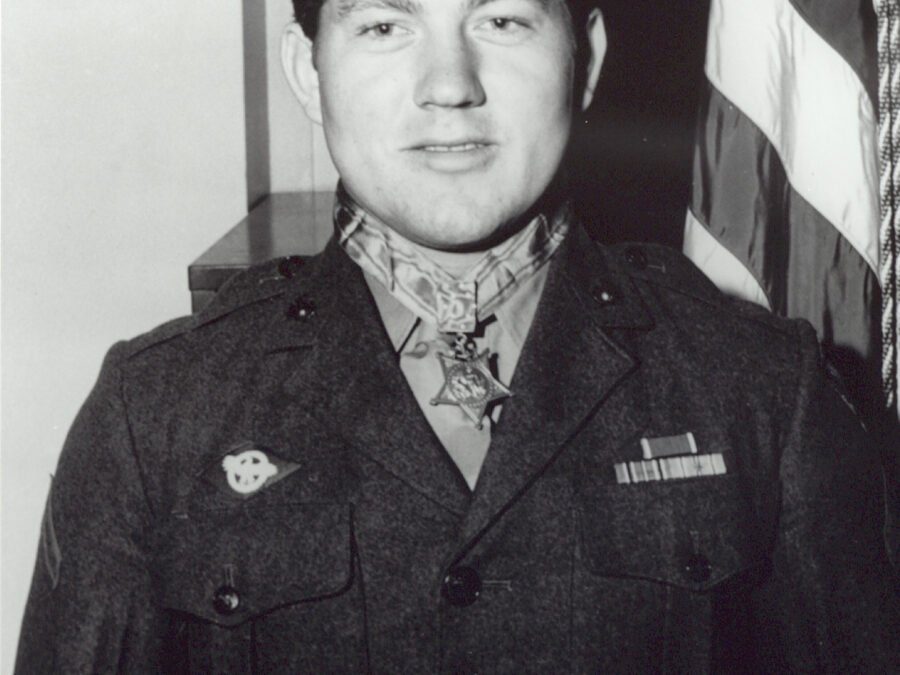
General Douglas MacArthur presented the medal to him in December 1944 at Tacloban airfield on Leyte. By 17 December his total stood at forty, the highest of any American pilot in any war. All forty were scored in the P-38. He was only twenty-four.1,2
Sent home
Kenney had seen too many aces killed. In January 1945 he ordered Bong home for good. America’s ace of aces married Marge Vattendahl in Superior on 10 February 1945, in a wedding that made the national newspapers, and went on another round of bond tours and public appearances.2,3
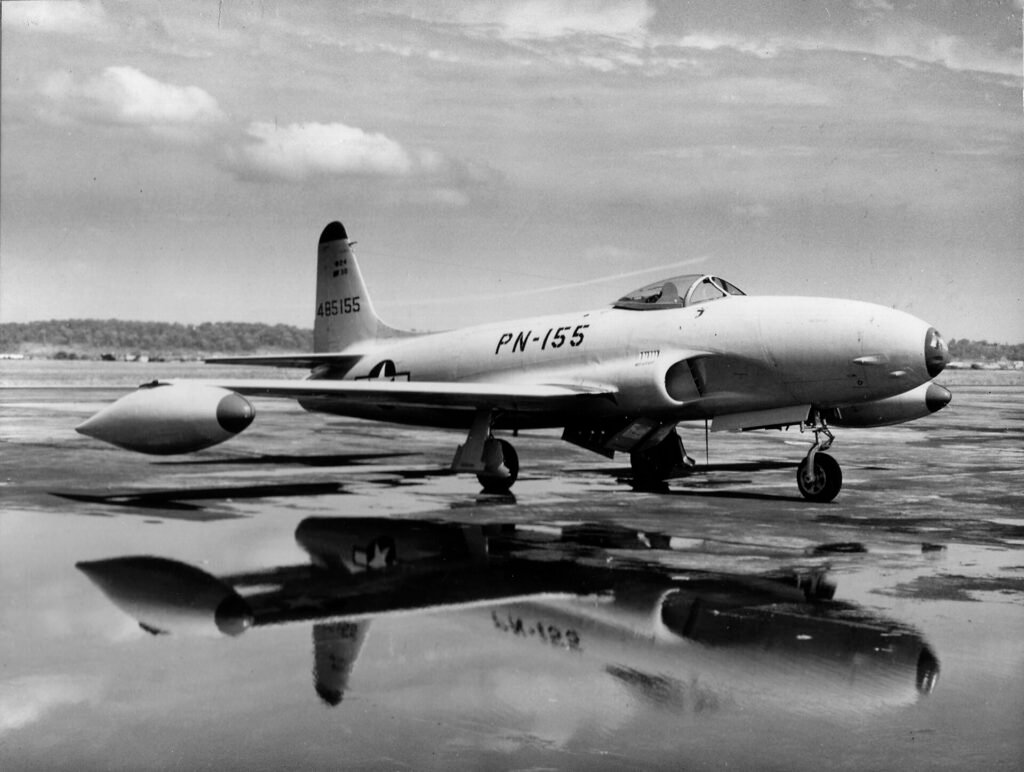
He wanted to keep flying, and he was assigned as a test pilot at the Lockheed plant in Burbank, California, to fly the new P-80 Shooting Star, America’s first operational jet fighter. Jet aircraft were new and dangerous, and test flying was among the most lethal jobs in aviation.3,4
6 August 1945
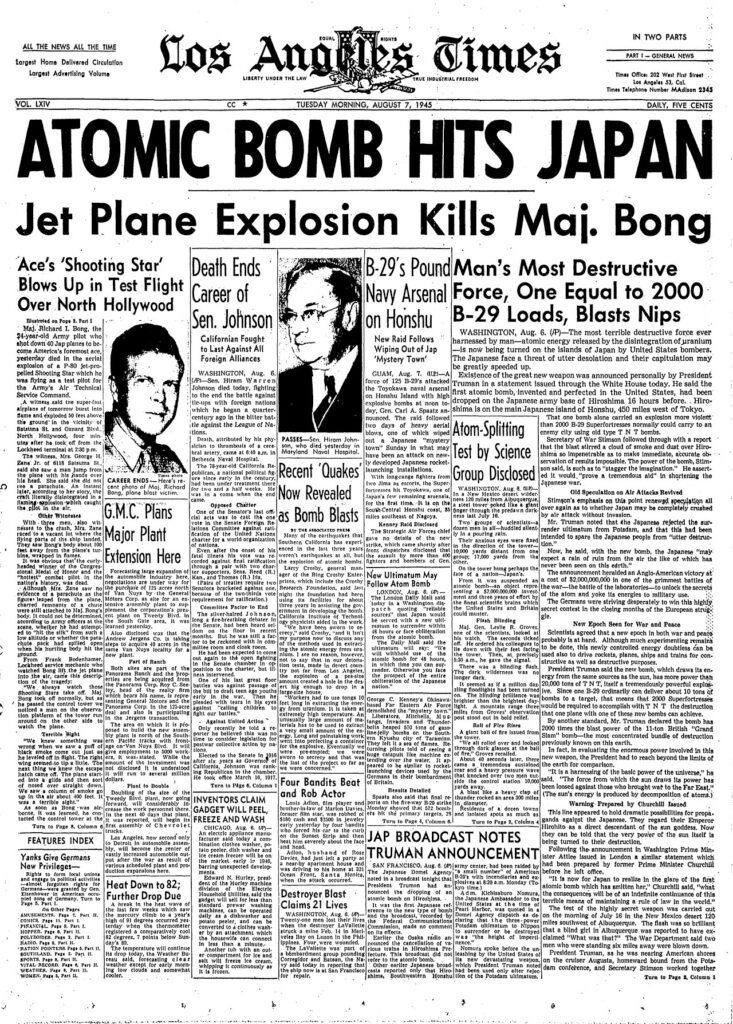
On 6 August 1945 Bong took off from the Lockheed air terminal in Burbank on the acceptance flight of a new P-80A. It was his twelfth flight in the jet; he had just over four hours on the type. Just after take-off the main fuel pump failed. The P-80 had an auxiliary pump for exactly that emergency, added after an earlier fatal crash, but it had to be switched on by hand, and Bong did not switch it on. At low altitude, with the engine dying, he jumped. Witnesses said the aircraft exploded as he left it. He was too low for his parachute to open. The jet came down in a field in North Hollywood.4
A fellow test pilot later said that Bong had told him he had forgotten to turn on the auxiliary pump on an earlier flight. His brother Carl, who later studied the investigation reports, doubted that he would have made the same mistake twice so soon. Whatever the cause, he was dead at twenty-four.4
That same day an American B-29 dropped the first atomic bomb on Hiroshima. The next morning the two stories shared the front pages of newspapers across the country.4
Remembered in Wisconsin
Dick Bong is buried in the cemetery at Poplar, the farming village where he grew up. A bridge between Duluth and Superior, the airport at Superior and a state recreation area in Kenosha County, on land that was to have been an air base in his name, all carry it. So does the street leading to the National Museum of the United States Air Force in Dayton, Ohio. In Superior, the Richard I. Bong Veterans Historical Center keeps a P-38 Lightning restored in the markings of Marge.5
No American fighter pilot has ever matched his forty victories, and in the age of missiles and jets it is unlikely that anyone ever will.
Timeline
- 24 September 1920 Born in Superior, Wisconsin.
- 29 May 1941 Enlists as an aviation cadet.
- 19 January 1942 Wins his wings.
- 12 June 1942 Grounded after low flying around San Francisco.
- 27 December 1942 First two victories, over Buna, New Guinea.
- 26 July 1943 Four victories over Lae; Distinguished Service Cross.
- 12 April 1944 Passes Rickenbacker’s record with his 27th victory.
- 10 October – 15 November 1944 Eight victories over Borneo and Leyte.
- December 1944 Receives the Medal of Honor from General MacArthur; reaches forty victories.
- 10 February 1945 Marries Marjorie Vattendahl.
- 6 August 1945 Killed testing a P-80 jet in North Hollywood.
- Medal of Honor citation for Major Richard I. Bong, General Orders No. 90, 8 December 1944.
- General George C. Kenney, Dick Bong: Ace of Aces (Duell, Sloan and Pearce, 1960).
- Carl Bong and Mike O’Connor, Ace of Aces: The Dick Bong Story (Champlin Museum Press, 1985).
- Carl Bong, Dear Mom, So We Have a War (1991), including the reports of the crash investigation.
- Richard I. Bong Veterans Historical Center, Superior, Wisconsin.
- Forty is the number of victories credited to Bong by the Army Air Forces. As with every ace, post-war study of Japanese records suggests that some claims cannot be matched to known losses.
Found an error, or hold a related record? Tell the research desk.
Share what you know