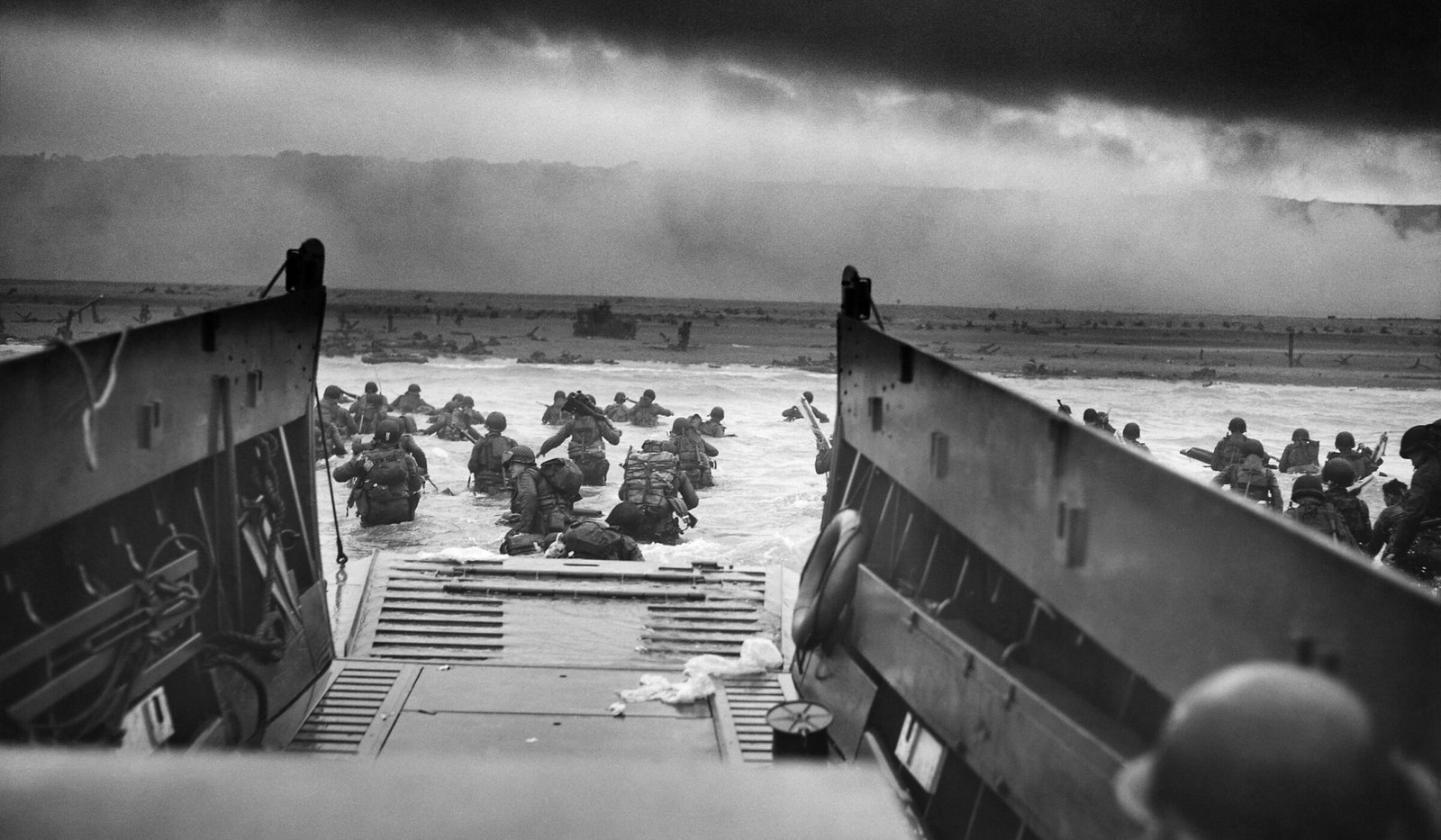
Waverly Bernard Woodson Jr. was born on 3 August 1922 at 1235 North 58th Street in Philadelphia. His father was a mail carrier. Woodson went to Overbrook High School and then to Lincoln University, in Oxford, Pennsylvania, as a pre-medical student. He wanted to be a doctor. He was in his second year there when the United States entered the Second World War.6
On 15 December 1942 he enlisted, together with his younger brother Eugene. He scored highly on the Army’s aptitude tests and was sent to officer candidate school for anti-aircraft artillery, one of only two African Americans in the programme. Then he was told that the unit he was meant to join would not take a Black officer. The Army retrained him as a combat medic instead.1,2
The only Black combat unit on D-Day
Woodson was posted to the 320th Barrage Balloon Battalion, which trained at Camp Tyson, near Paris, Tennessee. The battalion’s job was unusual. Its men flew large tethered balloons above landing beaches and anchorages; the steel cables that held them made it dangerous for enemy aircraft to come in low and strafe the troops below. In the segregated Army of 1944, the 320th was an all-Black unit, and on 6 June 1944 it would be the only African American combat unit to land in Normandy on D-Day.1,2
By then Woodson was a corporal. On the morning of the invasion he was aboard a tank landing craft, LCT 856, in the third wave heading for Omaha Beach, the most heavily defended of the five landing areas.1
Wounded before the sand
The craft never had a clean run in. It struck a naval mine, lost power and began to drift towards the beach under fire. Then a German shell, from one of the 88mm guns covering the shore, hit it. Woodson was wounded by shrapnel in the groin, the inner thigh and the back before he had set foot in France.1,2
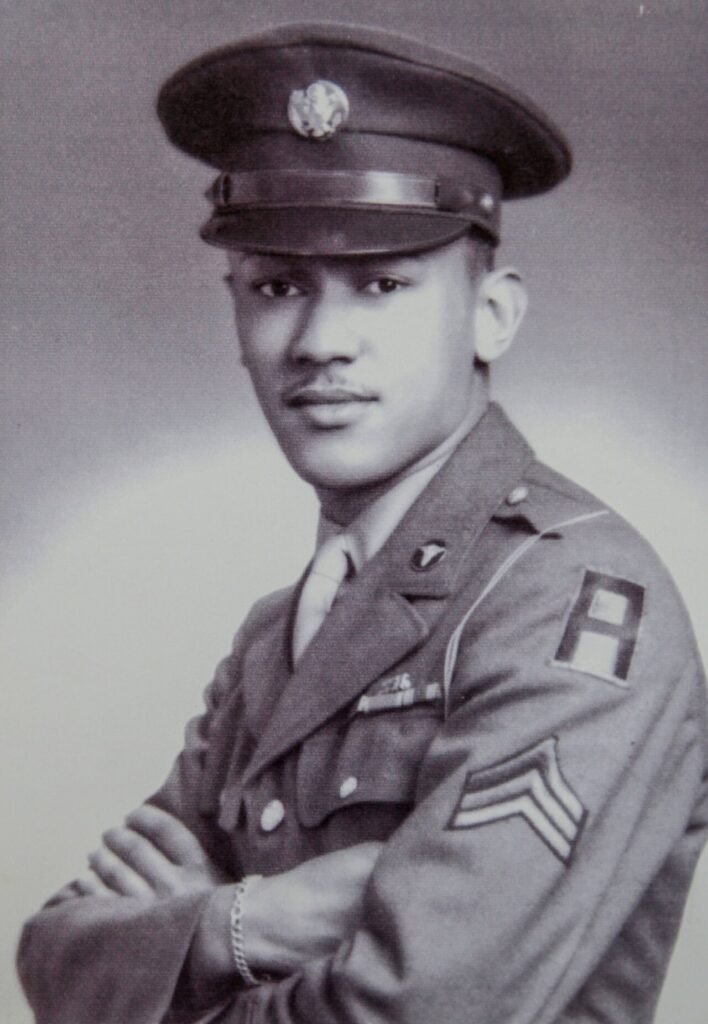
He got ashore anyway. After his own wounds were dressed, he set up a field dressing station under a rocky embankment close to a German strongpoint the Americans knew as WN61, and began to treat the men around him. Omaha Beach that morning was covered with the wounded and the dying, and the fire from the bluffs above did not stop.1
Thirty hours at the aid station
Woodson worked from about ten o’clock on the morning of 6 June until about four in the afternoon of 7 June: some thirty hours without relief, most of it under artillery and small-arms fire. He removed bullets, set broken limbs, dressed wounds, packed them with sulfa powder and gave plasma. At one point he amputated a man’s foot.1,2
When he was finally relieved, he still was not finished. Three British soldiers had gone under the water while leaving their landing craft. Woodson gave them artificial respiration, and brought all three round.1,2
He is credited with treating as many as two hundred men, Black and white, over those two days. His wounds put him on a hospital ship for three days. At the end of them he asked to be sent back to the beach.1
“Covered themselves in glory.”
Stars and Stripes, on the medics of Omaha Beach, 1944
The medal that never came
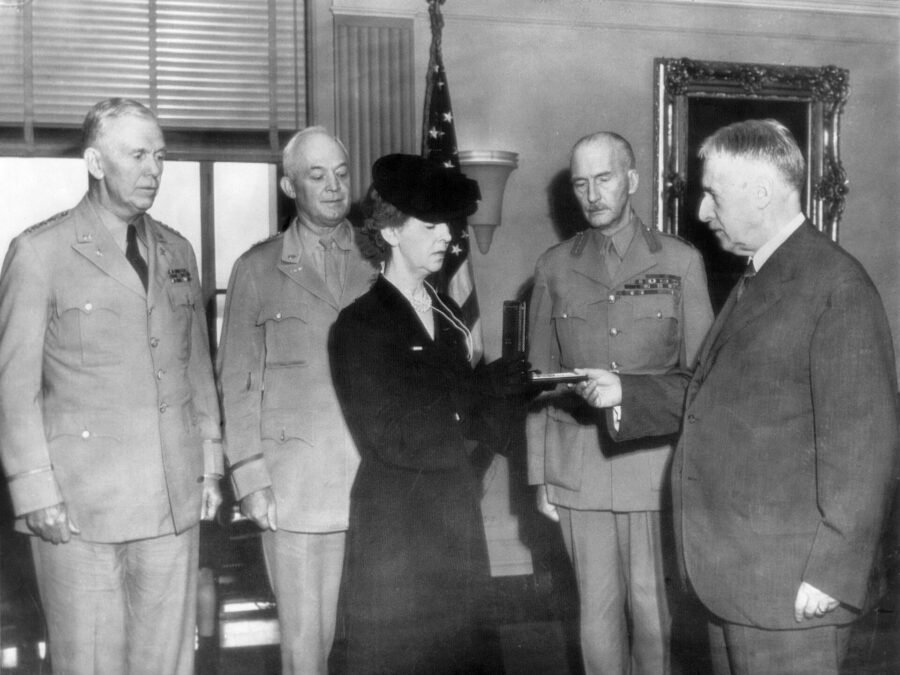
His actions did not go unnoticed at the time. His commanding officer recommended him for the Distinguished Service Cross, the Army’s second-highest award for valour. Staff officers working for Lieutenant General John C. H. Lee went further and concluded that what he had done deserved the Medal of Honor. At the War Department, a special assistant named Philleo Nash proposed that President Franklin D. Roosevelt present an award to Woodson in person, as a public signal to Black Americans that their service counted.2,3
None of that happened. Woodson received the Purple Heart for his wounds. A Bronze Star was approved in 1945, but it was never presented; by then his battalion had been sent home, retrained at Camp Stewart, Georgia, and shipped to Hawaii to prepare for the invasion of Japan, which never came.2
The Black press noticed. The Philadelphia Tribune wrote that the feeling was widespread among Black Americans that, had Woodson been white, he would have received the highest honour. Seven Black soldiers of the Second World War were eventually given the Medal of Honor, but not until 1997, more than fifty years later. Woodson was not among them.2
Part of the reason his case stalled for so long lies in a fire. In 1973 a blaze at the National Personnel Records Center in St. Louis destroyed around eighty per cent of the Army’s personnel records for soldiers discharged between 1912 and 1960. Much of the paperwork that might have supported a review of his case went with them.3
A life in the laboratory
After the war Woodson went back to Lincoln University and graduated in 1950 with a degree in biology. He still wanted to be a doctor, but he could not find a medical school that would admit a Black student.1,6
When the Korean War began he was recalled to the Army. He was first assigned to train combat medics at Fort Benning, Georgia, and was then moved, because of his race, to Walter Reed Army Medical Center, where he became the sergeant in charge of the morgue and performed autopsies. He was promoted to staff sergeant and left the Army in 1952.1
That same year he married Joann Katharyne Snowden. They had two daughters and a son. Woodson worked in the bacteriology department of the National Naval Medical Center in Bethesda, Maryland, and from 1959 in the clinical pathology department of the National Institutes of Health, where he supervised the staffing of operating theatres and assisted with post-operative care for open-heart surgery patients. He retired in 1980.1
In 1994 the French government invited him back to Normandy for the fiftieth anniversary of the landings and presented him with a commemorative medallion. Waverly Woodson died on 12 August 2005, aged eighty-three, and was buried with military honours at Arlington National Cemetery.1
Eighty years late
The campaign to recognise him did not die with him. His papers went to Lincoln University. The journalist Linda Hervieux told his story in her 2015 book Forgotten. In September 2020 Senator Chris Van Hollen of Maryland introduced a bill to authorise the Medal of Honor for him, and in 2021 the commanding general of First Army, Lieutenant General Thomas S. James Jr., wrote in support. Joann Woodson said that if the medal were ever awarded, she would give it to the National Museum of African American History and Culture.2,4,5
Recognition came in stages. On 11 October 2023, at a ceremony at Arlington, the Army formally presented his long-approved Bronze Star and a Combat Medical Badge to his family. On 3 June 2024, three days before the eightieth anniversary of D-Day, a Distinguished Service Cross awarded to him posthumously was laid on the sand of Omaha Beach during a ceremony there. In September 2024 it was handed to his widow, then ninety-five, in Washington.4,5
Other honours have followed: an Army health clinic at Rock Island Arsenal in Illinois bears his name, and in 2024 Philadelphia renamed the corner of 58th Street and Girard Avenue, near the house where he was born, Sgt. Waverly B. Woodson Way. The Medal of Honor that his officers thought he had earned in 1944 has still not been awarded.
Timeline
- 3 August 1922 Born in Philadelphia.
- 15 December 1942 Enlists in the Army with his younger brother, Eugene.
- 6 June 1944 Lands on Omaha Beach with the 320th Barrage Balloon Battalion; wounded before reaching the shore.
- 6–7 June 1944 Treats as many as 200 men over about thirty hours at his aid station.
- 1945 Bronze Star approved, but never presented.
- 1950 Graduates from Lincoln University; recalled for the Korean War.
- 1952 Leaves the Army and marries Joann Snowden.
- 1959–1980 Works in clinical pathology at the National Institutes of Health.
- 12 August 2005 Dies, aged 83; buried at Arlington.
- 11 October 2023 Bronze Star and Combat Medical Badge formally presented to his family.
- 3 June 2024 Distinguished Service Cross awarded posthumously and laid on Omaha Beach.
- National Park Service, “Waverly Bernard Woodson, Jr.”, nps.gov.
- Linda Hervieux, Forgotten: The Untold Story of D-Day’s Black Heroes, at Home and at War (HarperCollins, 2015).
- Jesse Greenspan, “A Black medic saved hundreds on D-Day. Was he deprived of a Medal of Honor?”, History.com, 4 June 2019.
- Associated Press, report on the Distinguished Service Cross ceremony at Omaha Beach, 3 June 2024.
- The Washington Post, “He saved 200 lives on D-Day, and was finally honored for his heroism”, 24 September 2024.
- Lincoln University, Langston Hughes Memorial Library: Waverly B. Woodson Jr. papers.
Found an error, or hold a related record? Tell the research desk.
Share what you know