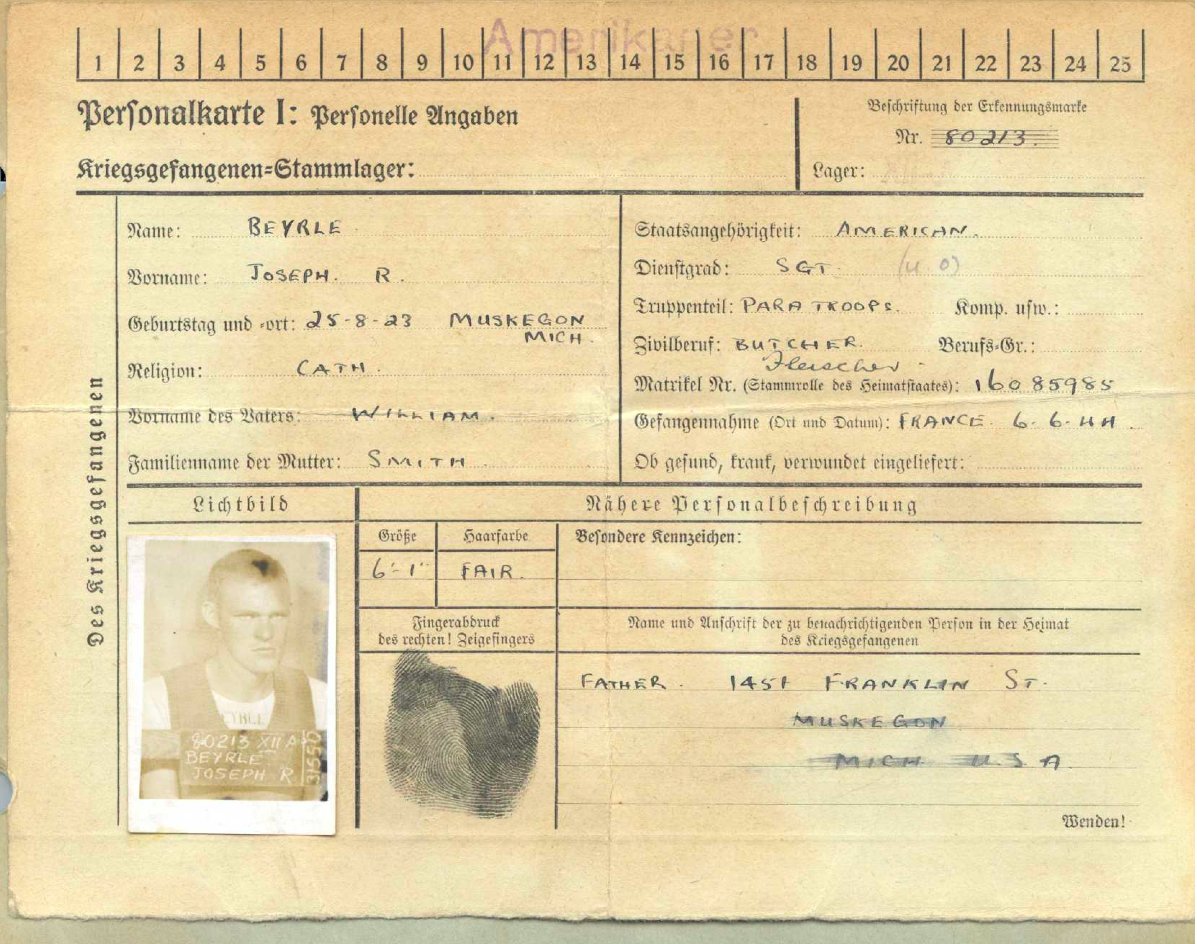
Joseph Robert Beyrle was born in Muskegon, Michigan, on 25 August 1923, the fifth of seven children of a factory worker whose family had come from Germany. When he was six the Great Depression began. His father lost his job, the family was evicted and moved in with his grandmother, and some of Joe’s earliest memories were of standing in the queue for government food with his father. His two elder brothers left school to join the Civilian Conservation Corps and sent their pay home so the family could stay together.1
He grew up fast and strong and became a fine track athlete in high school. He was offered a scholarship to Notre Dame. After Pearl Harbor he turned it down and joined the Army.1
Currahee
Beyrle volunteered for the paratroopers and trained at Camp Toccoa in Georgia, where the recruits of the new 506th Parachute Infantry Regiment ran up and down Currahee Mountain until they could do it in their sleep. The regiment, part of the 101st Airborne Division, the Screaming Eagles, was later made famous by the book and television series Band of Brothers. Beyrle trained as a radio operator and demolitions man and went with the regiment to England, where it was based around Ramsbury in Wiltshire.1
According to his own account, in April and May 1944 he parachuted into occupied France twice on secret missions to deliver gold to the French Resistance, coming back each time.1,5
D-Day
On the night of 5–6 June 1944 the 101st Airborne flew over the Normandy coast to land behind Utah Beach. Beyrle’s C-47 transport came under heavy anti-aircraft fire, and he jumped at only about 360 feet, barely enough for a parachute to open. He landed on the roof of the church in the village of Saint-Côme-du-Mont, slid off, and found himself alone. Separated from his unit, he went about his job anyway, blowing up an electrical substation, and carried on sabotage for a few days before he was captured by German soldiers.1
His dog tags ended up on the body of a dead German soldier who had apparently taken them. When the body was found in American uniform with Beyrle’s tags, the War Department listed him as killed in action on 10 June 1944. In September his parents in Muskegon received the telegram. A requiem mass was held for him, and his obituary appeared in the local paper.1,2
Seven prisons
Beyrle was very much alive. Over the next seven months he was held in seven different German prisons and camps. He was marched through the streets of Paris with other prisoners while crowds jeered and threw rotten food. He spent a week crammed with eighty men into a railway wagon, which was strafed by Allied aircraft on the way.1
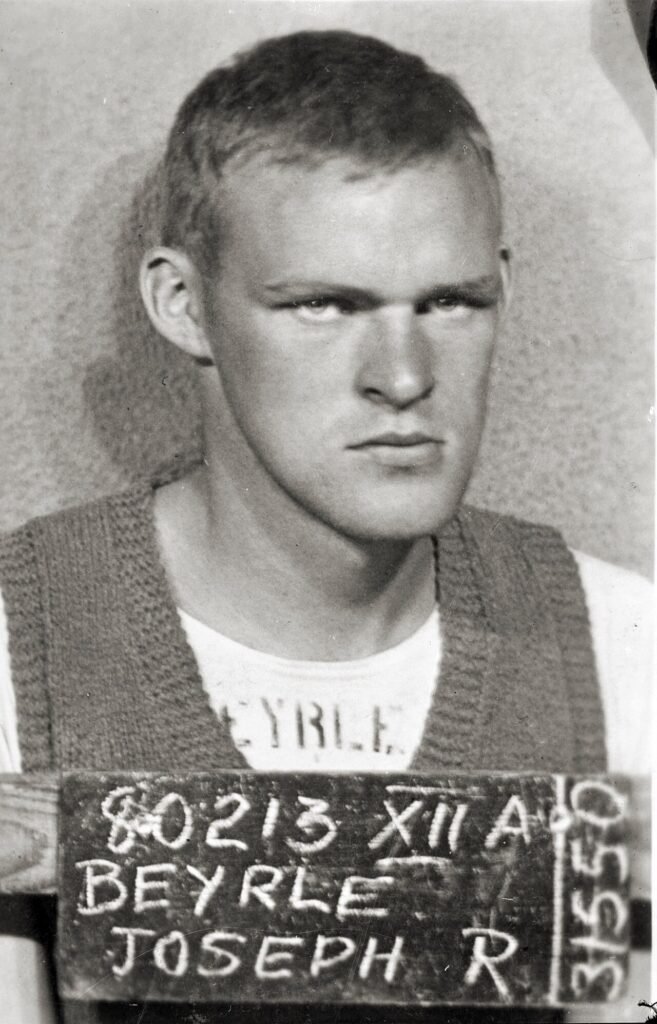
He escaped twice. The second time he and his companions set out to reach Poland and the advancing Red Army, but boarded a train that took them to Berlin by mistake. A German civilian turned them over to the Gestapo, who beat and tortured them and prepared to shoot them as American spies who had parachuted into Berlin. They were saved when German military officials intervened, insisting that the Gestapo had no authority over prisoners of war.1
“Amerikansky tovarishch!”
Finally Beyrle was sent to Stalag III-C at Alt Drewitz, east of the Oder river, in what is now western Poland. In early January 1945, with the Soviet front drawing near, he and other prisoners escaped again. He headed east towards the sound of the guns. In the middle of January he came upon a Soviet tank unit. He walked towards the tanks with his hands raised, holding up a packet of Lucky Strike cigarettes, and shouting one of the few Russian phrases he knew: “Amerikansky tovarishch!” American comrade!1
The Soviet soldiers took him to their battalion commander. The officer was a woman, Captain Aleksandra Samusenko, one of very few women to command a tank battalion in the war. Beyrle persuaded her to let him fight with her unit. For about a month he rode with the Soviet tanks, part of the 1st Guards Tank Army, as they pushed west towards Berlin. His demolitions skills were useful. Among the places the battalion helped to liberate was his own former prison camp, Stalag III-C.1
Zhukov
In the first week of February 1945 Beyrle was badly wounded in the leg in an attack by German dive bombers. He was taken to a Soviet field hospital at Landsberg an der Warthe, now Gorzów Wielkopolski in Poland. By his account, one day Marshal Georgy Zhukov, the most famous Soviet commander of the war, came through the hospital and, curious about the only foreigner on the ward, stopped to hear his story through an interpreter. Zhukov gave him papers to help him get back to the Americans.1,5
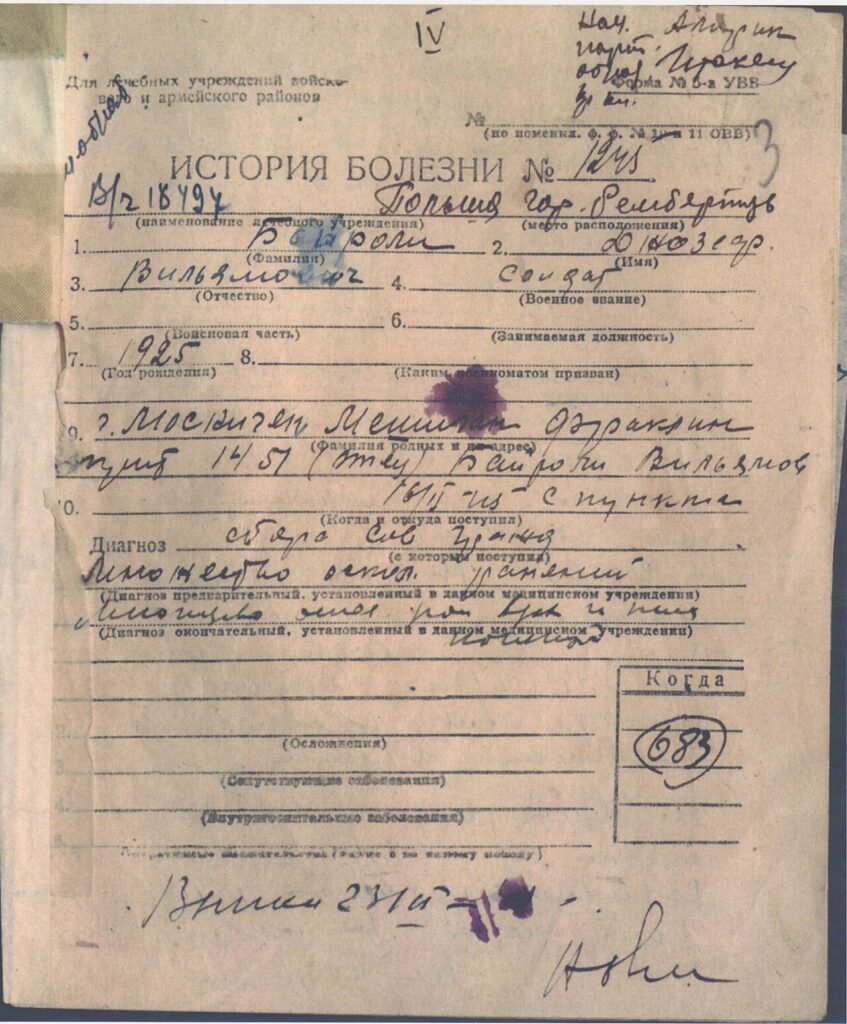
Beyrle joined a Soviet convoy heading east and in February 1945 reached the American embassy in Moscow. There he discovered that officially he was dead. The embassy officials were suspicious of a man claiming to be an American paratrooper who had come out of the Red Army, and kept him under Marine guard in the Metropol Hotel until his fingerprints proved who he was.1
A wedding in the funeral church
Joe Beyrle came home to Michigan on 21 April 1945, and celebrated the end of the war in Europe two weeks later in Chicago. In 1946 he married JoAnne Hollowell in the same church, and before the same priest, that had held his funeral mass two years before. He worked for the Brunswick Corporation for twenty-eight years and retired as a shipping supervisor. He and JoAnne had a daughter and two sons.1
In 1994, marking the fiftieth anniversary of D-Day, he was honoured in the Rose Garden of the White House by both President Bill Clinton and President Boris Yeltsin of Russia, the only man known to have fought for both countries in that war.1,4
Two nations
Joe Beyrle died in his sleep on 12 December 2004, aged eighty-one, while visiting Toccoa, where he had trained as a paratrooper more than sixty years before. He was buried with full military honours at Arlington National Cemetery in April 2005.1,3
His elder son, Joe, served with the 101st Airborne in Vietnam. His younger son, John, became a diplomat and from 2008 to 2012 served as the United States Ambassador to Russia, where he told his father’s story to a new generation of Russians. An exhibition about Joe Beyrle toured Russia in 2010 and the United States in 2011 and 2012. In Saint-Côme-du-Mont a plaque on the church he landed on remembers him, and in 2024 the street beside it was renamed Rue Joseph Beyrle.1,4
Timeline
- 25 August 1923 Born in Muskegon, Michigan.
- 1942 Joins the Army; trains as a paratrooper at Toccoa.
- 6 June 1944 Jumps into Normandy; lands at Saint-Côme-du-Mont.
- June 1944 Captured; listed as killed in action on 10 June.
- June 1944 – January 1945 Held in seven German prisons; escapes twice.
- January 1945 Escapes from Stalag III-C and joins a Soviet tank battalion.
- February 1945 Wounded; treated in a Soviet hospital; reaches Moscow.
- 21 April 1945 Home in Michigan.
- 1994 Honoured by Presidents Clinton and Yeltsin at the White House.
- 12 December 2004 Dies in Toccoa, Georgia.
- Thomas H. Taylor, The Simple Sounds of Freedom: The True Story of the Only Soldier to Fight for Both America and the Soviet Union in World War II (Random House, 2002); paperback as Behind Hitler’s Lines (Ballantine, 2004).
- Joseph R. Beyrle, German prisoner-of-war records, War Department telegram of September 1944 and Soviet medical records, held by the Beyrle family.
- Arlington National Cemetery, burial record of Joseph R. Beyrle, Section 1.
- U.S. Embassy Moscow and the National WWII Museum, exhibition “Joseph Beyrle: A Hero of Two Nations” (2010–2012).
- Some episodes, including his missions into France before D-Day and his meeting with Marshal Zhukov, are known mainly from Beyrle’s own account.
Found an error, or hold a related record? Tell the research desk.

Share what you know