
Joseph Medicine Crow was born on 27 October 1913 on the Crow Indian Reservation near Lodge Grass, Montana. His Crow name was High Bird. He was born into a world that still remembered the old life on the Plains. His grandfather, Medicine Crow, was a celebrated war chief who had earned that rank at the age of twenty-two. His step-grandfather, White Man Runs Him, had been one of the six Crow scouts who guided George Armstrong Custer to the Little Bighorn in June 1876, and had watched the start of the battle from a hill above the river.1,4
As a boy, Joe listened to the old men tell their stories. From White Man Runs Him he heard an eyewitness account of Custer’s last battle. From his grandfather’s generation he learned what it meant to be a Crow warrior. The Crow, whose own name is Apsáalooke, had fought the Lakota and Cheyenne for generations and often sided with the United States against them. White Man Runs Him and the other Crow scouts had warned Custer that the Lakota and Cheyenne camp on the Little Bighorn was far bigger than he believed. Custer attacked anyway. The scouts were released before the final fight, and so survived to tell what they had seen; for the rest of his long life White Man Runs Him was sought out by historians trying to understand what had happened that day. They measured a man’s courage by the deeds he performed in battle, and they were strict about it.1
Four deeds
To become a war chief, a Crow warrior had to perform four particular deeds. He had to touch a living enemy, a deed called counting coup, which was held to be braver than killing because it meant coming within arm’s reach. He had to take an enemy’s weapon from him. He had to lead a successful war party. And he had to capture an enemy’s horse. By the twentieth century there were no more wars on the Plains in which to do such things. Joe grew up assuming the old path to chieftainship was closed.1
A scholar first
His family expected him to learn the white man’s world as well. From 1929 he studied at Bacone College, a school for Native Americans in Muskogee, Oklahoma, and then took a degree in sociology and psychology at Linfield College in Oregon in 1938. In 1939 he became the first member of the Crow tribe to earn a master’s degree, in anthropology, from the University of Southern California. His thesis on how contact with European culture had changed Crow economic, social and religious life is still respected. By 1941 he had finished the coursework for a doctorate. Then America went to war.1
He taught for a year at the Chemawa Indian School in Oregon, and in 1942 went to work in the naval shipyards at Bremerton, Washington. In 1943 he joined the Army.1
Forty-four thousand
He was far from alone. Some 44,000 Native Americans served in the United States armed forces in the Second World War, out of a total Native population of fewer than 400,000, a higher proportion than any other group in the country. Many reservations sent almost every fit young man they had. Navajo, Comanche, Meskwaki and other code talkers turned their languages into codes the enemy never broke. Ira Hayes, a Pima from Arizona, helped raise the flag on Iwo Jima. In Arizona and New Mexico, Native Americans who went to war were not even allowed to vote in state elections when they came home.1,2
Red paint and an eagle feather
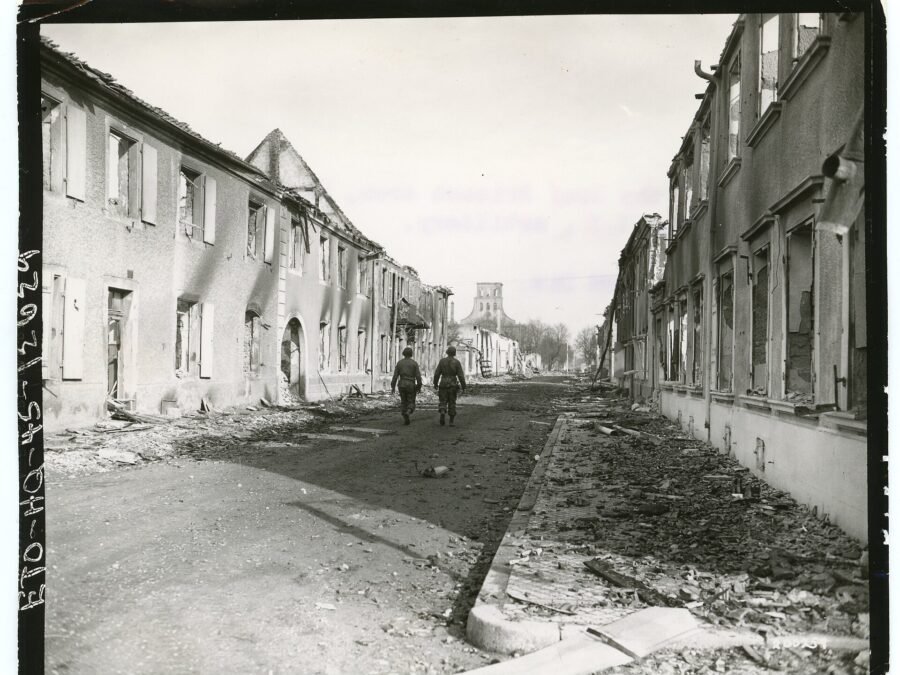
Medicine Crow was assigned to the 103rd Infantry Division, the “Cactus” division, as a scout, and went with it to France in the autumn of 1944. The division fought through the Vosges mountains and Alsace in the bitter winter of 1944–45, against the German fortifications of the Siegfried Line, and in the spring into southern Germany.1,2
Whenever he went into battle, Medicine Crow followed the customs of his people. Under his uniform he painted two red stripes on his arms, his war paint. Under his helmet he carried a sacred eagle feather, painted yellow, given to him by a medicine man of the Sun Dance. He believed they protected him.1,2
Leading a war party
The first of the four deeds came in the fighting in France. His commanding officer sent him to lead a party of seven soldiers across open ground under German fire to fetch explosives. They made it there and back without losing a man. It was, Medicine Crow reckoned, a successful war party under his leadership.1
Counting coup
The deeds that followed came in Germany, in the confused fighting of 1945. As he told it, he was running through a village and turned a corner straight into a young German soldier. He knocked the rifle out of the German’s hands, and the two men grappled on the ground. Medicine Crow had the German by the throat, and could have killed him. The German cried out “Mama”. Medicine Crow let him go.1,2
In that single encounter he had touched a living enemy and taken his weapon. Two of the four deeds were done. In his people’s eyes, sparing the man took nothing away from the deed; counting coup had always been about courage, not killing.1
Fifty horses
The last deed came near the end of the war. His unit was close to a farm where a detachment of SS officers had camped for the night, with their horses corralled nearby. They were fine horses, and Medicine Crow was a horseman from a people of horsemen. In the dark he crept up to the corral, picked a good horse, a sorrel with a white blaze, mounted it and drove the rest of the herd out into the countryside, about fifty horses in all. As he rode away, he sang a Crow honour song.1,2
He had done the four deeds. When he went home to Montana after the war and told the elders, they agreed: Joseph Medicine Crow was a war chief, the first in the tribe for generations. He would be the last. No other Crow, and as far as anyone knows no other Plains warrior, has completed the four deeds since.1
Keeper of memories
After the war Medicine Crow returned to the Crow reservation. In 1948 he was appointed the tribe’s official historian and anthropologist, a post he held for the rest of his life. He worked for the Bureau of Indian Affairs from 1951. He never finished his doctorate, but became the keeper of his people’s memory, collecting stories, songs and photographs in an archive that filled his house and garage.1
He was, above all, the Crow authority on the Battle of the Little Bighorn. He helped found the museum at the battlefield in 1953, spoke there for decades, and wrote the script used for the re-enactment of the battle at Hardin every summer from 1965. He was a founder of Little Big Horn College and of the Buffalo Bill Historical Center in Cody, Wyoming. He wrote books on Crow history, law and customs, and a book for children. In 1999 he addressed the United Nations.1
“A good man”
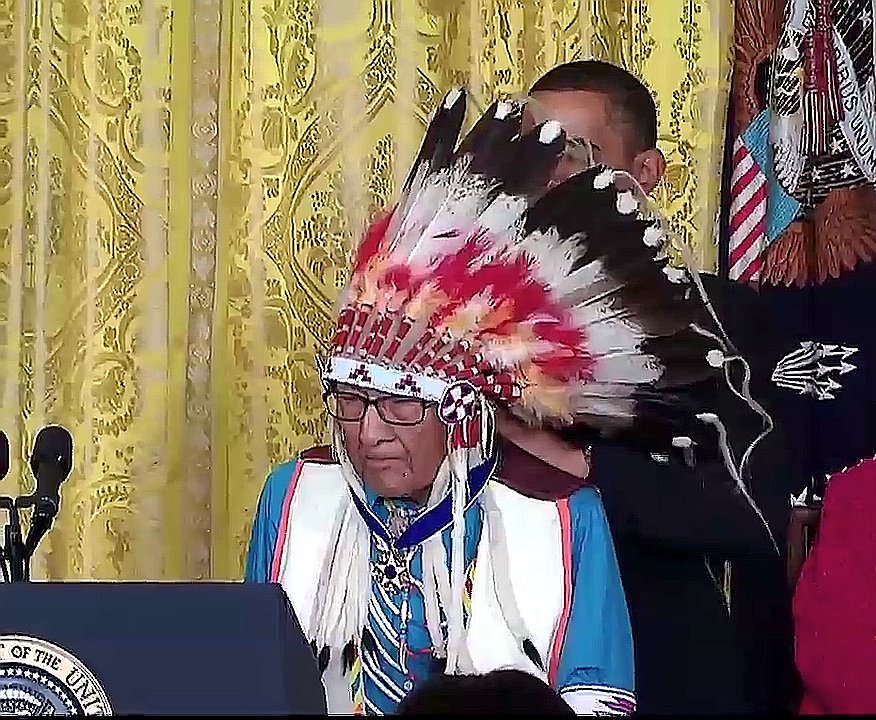
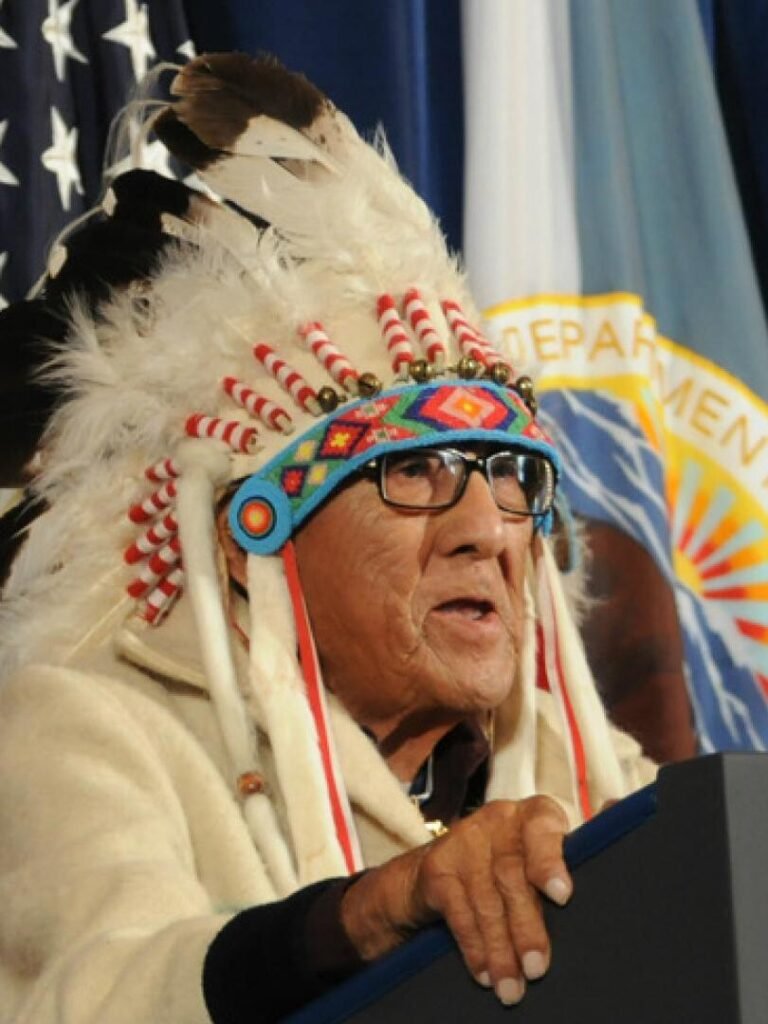
Recognition for his war service came very late. On 25 June 2008, the anniversary of the Little Bighorn, he was presented with the Bronze Star for his service in the Army, and with the French Légion d’honneur. On 12 August 2009 President Barack Obama awarded him the Presidential Medal of Freedom, the highest civilian honour of the United States. At the ceremony the President called him, in the Crow language, bacheitche: a good man.1,3
Two years earlier he had appeared in Ken Burns’s documentary series The War, telling the story of the German soldier and the horses. Burns said he had wanted to tell Medicine Crow’s story for twenty years.2
Joe Medicine Crow went on writing and lecturing to the end. He died in hospice care in Billings, Montana, on 3 April 2016, aged 102. That year Billings opened Medicine Crow Middle School in his honour. In 2018 Congress named the Veterans Affairs clinic in Billings after him, and in 2022 the University of Southern California named its International Center for Public Affairs after its first Crow graduate.1
Timeline
- 27 October 1913 Born near Lodge Grass on the Crow Reservation, Montana.
- 1939 First Crow to earn a master’s degree, at the University of Southern California.
- 1943 Joins the U.S. Army; assigned to the 103rd Infantry Division as a scout.
- Autumn 1944 Arrives in France.
- 1944–1945 Completes the four deeds of a Crow war chief.
- 1948 Appointed Crow tribal historian.
- 1953 Helps found the museum at the Little Bighorn battlefield.
- 25 June 2008 Receives the Bronze Star and the Légion d’honneur.
- 12 August 2009 Awarded the Presidential Medal of Freedom.
- 3 April 2016 Dies in Billings, Montana, aged 102.
- Joseph Medicine Crow with Herman J. Viola, Counting Coup: Becoming a Crow Chief on the Reservation and Beyond (National Geographic, 2006).
- Ken Burns and Lynn Novick, The War (PBS, 2007), interviews with Joseph Medicine Crow.
- The White House, Presidential Medal of Freedom ceremony, 12 August 2009.
- National Park Service, Little Bighorn Battlefield National Monument, on the Crow scouts of 1876.
- Medicine Crow’s war deeds are known from his own accounts, told many times over sixty years and accepted by the Crow Nation, which recognised him as a war chief.
Found an error, or hold a related record? Tell the research desk.
Share what you know