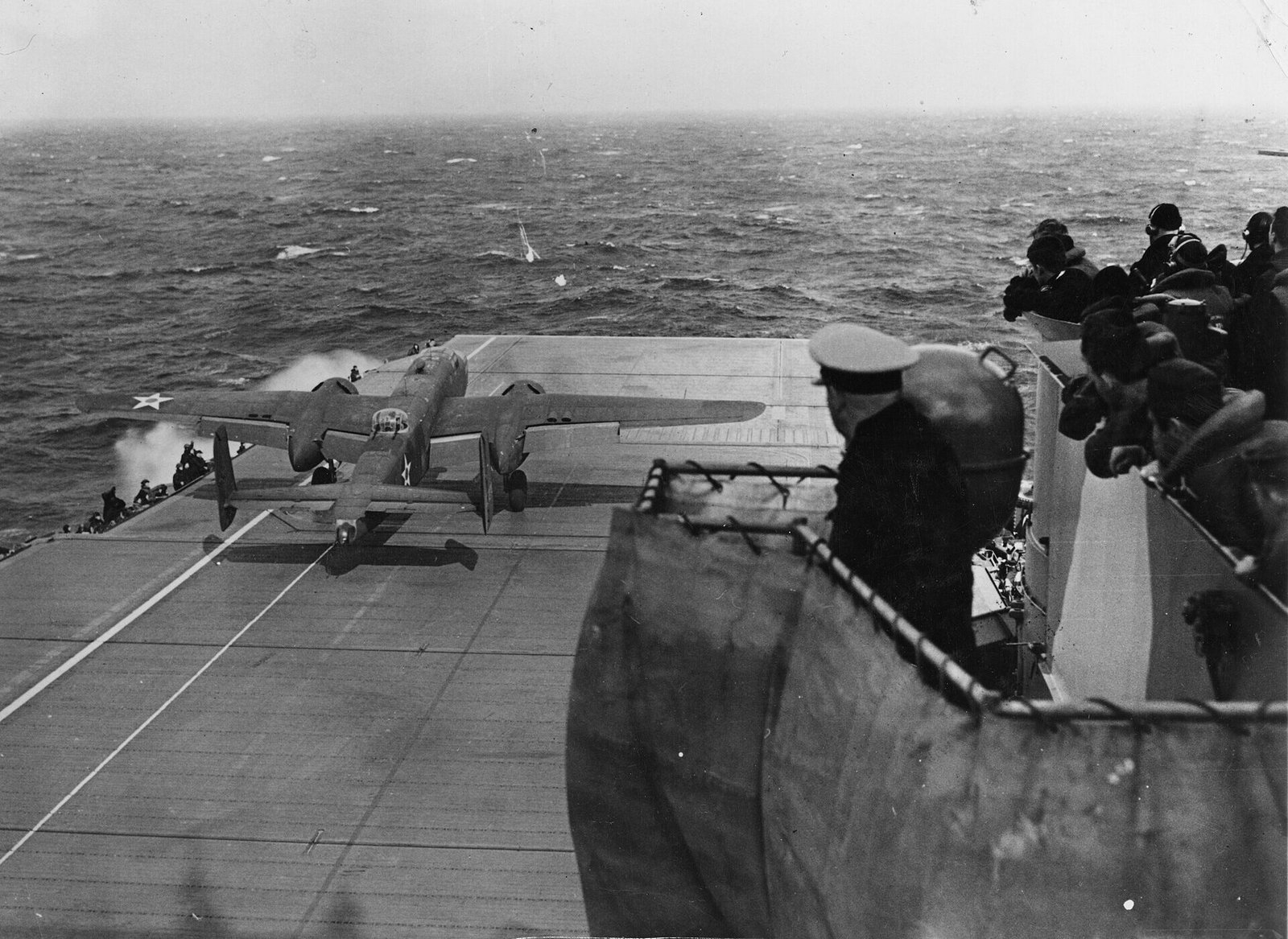
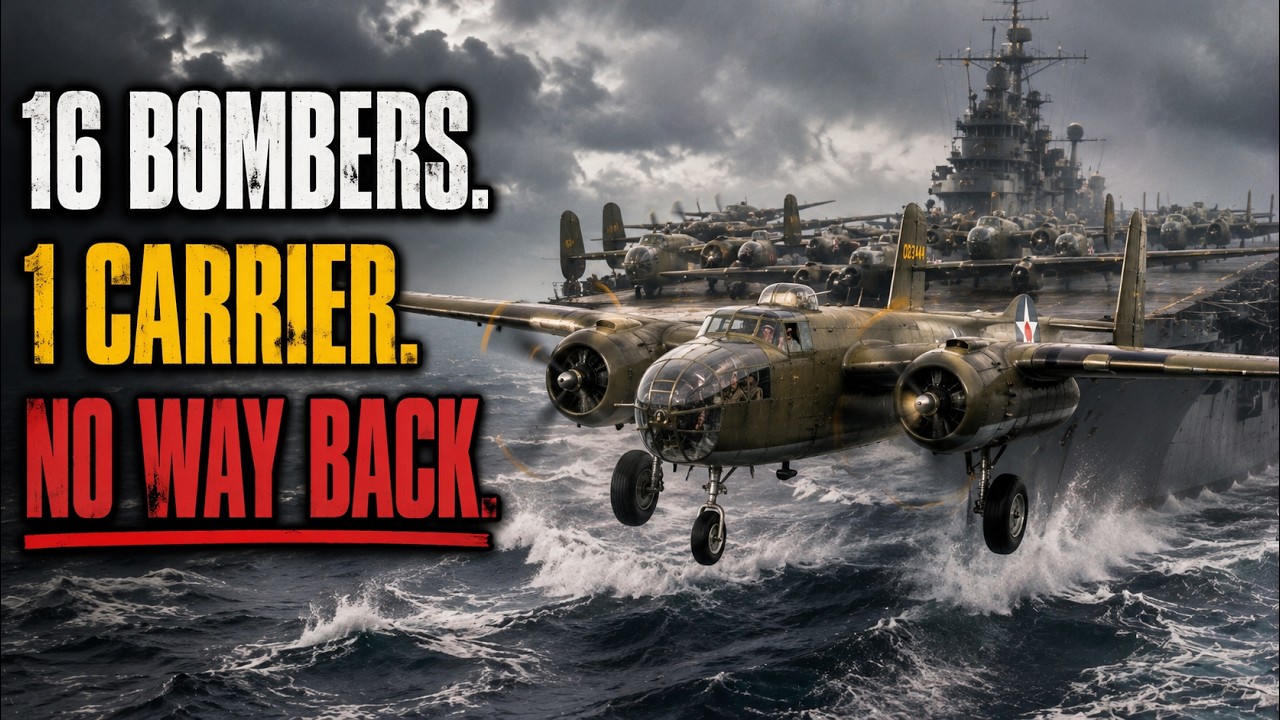
On 18 April 1942 an American aircraft carrier ploughed through a grey, heaving sea about 650 miles east of Japan. On her flight deck, packed nose to tail, sat sixteen twin-engined Army bombers, far too big to land on a ship. None of their pilots had ever taken off from a carrier. They had fuel for Japan and, with luck, for China beyond it, but not to come back. At the controls of the first bomber, with 467 feet of deck in front of him, sat the most famous pilot in America.1,3
A boxer from Nome
James Harold Doolittle was born in Alameda, California, on 14 December 1896, and spent his boyhood in Nome, Alaska, where his father worked as a carpenter in the gold rush. He was small, and learned to fight to survive in a rough frontier town; for a time he boxed as an amateur. The family moved to Los Angeles, where in 1910 he saw his first aeroplane at an air meet at Dominguez Field.1
He went to the University of California at Berkeley to study mining, but in October 1917, with America at war, he took leave to join the Army as a flying cadet. To his frustration he spent the First World War in the United States as a flying and gunnery instructor. He stayed in the Army Air Service afterwards and became one of the most celebrated airmen of the age between the wars.1
The pilot who was also a scientist
In September 1922 Doolittle flew a de Havilland DH-4 from Florida to San Diego in 21 hours and 19 minutes, with one stop, the first crossing of the continent within a single day. He believed pilots and engineers ought to understand each other, and set out to be both. The Army sent him to the Massachusetts Institute of Technology, where he took a master’s degree in a year and, in June 1925, the first doctorate in aeronautical engineering awarded in the United States.1
That same year he won the Schneider Trophy seaplane race. In 1927 he flew the first outside loop, a manoeuvre many pilots believed would pull an aircraft apart. His most lasting achievement came on 24 September 1929, at Mitchel Field on Long Island, when he took off, flew a set course and landed with his cockpit covered by a hood, flying on instruments alone. He had helped to develop the artificial horizon and the directional gyroscope that made it possible. Blind flying, as it was called, made all-weather flying practical, and every airliner that lands in fog today owes something to it.1
In 1930 he left the regular Army for a job with Shell Oil, staying on as a reserve officer. He persuaded Shell to produce 100-octane aviation fuel before any aircraft needed it, a gamble some colleagues called Doolittle’s million-dollar blunder; by the time war came, the fuel gave American and British fighters a decisive edge. He won the Bendix Trophy in 1931 and the Thompson Trophy in 1932, and then retired from air racing, remarking that he had yet to hear of anyone in that line of work dying of old age.1
An idea from a naval officer
Recalled to active duty in 1940, Doolittle was working on aircraft production when the Japanese attacked Pearl Harbor. President Roosevelt wanted Japan struck back, and soon, to lift a shocked American public and to shake Japan’s confidence in its own invulnerability. In January 1942 a Navy officer, Captain Francis Low, suggested that Army bombers could be launched from a carrier. The Navy’s aircraft did not have the range to hit Japan and return; carriers could not approach close enough without being found.3,4
Doolittle was given the job of making it work. He chose the new North American B-25B Mitchell, a medium bomber small enough, just, to take off from a carrier deck. Twenty-four of them were modified to carry nearly twice their normal fuel. Their bottom gun turrets were removed to save weight, and broomsticks painted black were fitted in the tail to look like guns. The expensive, secret Norden bombsight was replaced with a simple aiming device, made for about twenty cents, because at the low level they would bomb from, it worked better and would not matter if it fell into Japanese hands.2,3
The crews were volunteers from the 17th Bombardment Group, told only that the mission was extremely hazardous. At Eglin Field in Florida, in March 1942, a Navy flight instructor, Lieutenant Henry Miller, taught them to take off in a few hundred feet, over lines painted on the runway to mark out a carrier deck. Doolittle, who had planned the raid, talked his way into leading it.2,3
Hornet
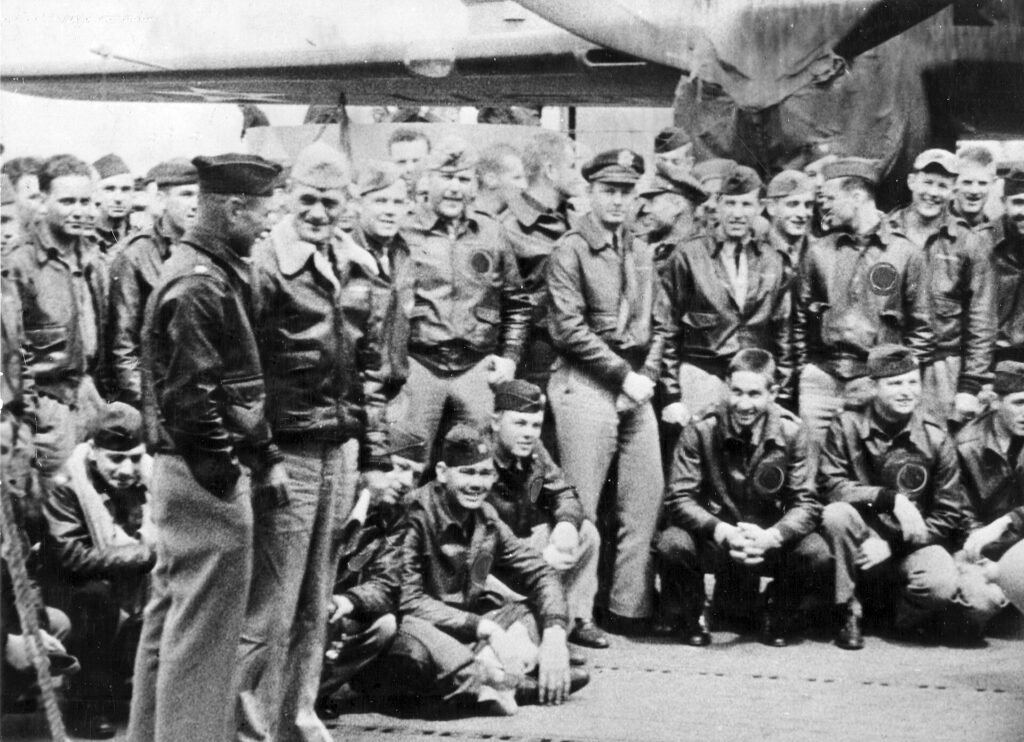
On 1 April 1942 sixteen bombers were hoisted onto the brand-new carrier USS Hornet at Alameda, across the bay from where Doolittle had been born. Hornet sailed under the Golden Gate the next day with the bombers in plain sight and was joined north of Hawaii by Vice Admiral William Halsey with the carrier Enterprise, whose fighters would protect the force, since Hornet’s own aircraft were stowed below. Only once they were at sea were the crews told their target: Tokyo.3
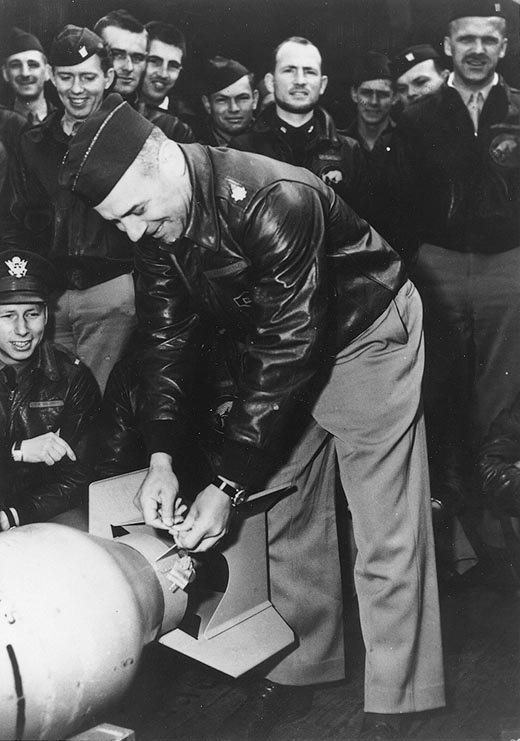
Each bomber carried four 500-pound bombs, three high-explosive and one a cluster of incendiaries. Some had Japanese friendship medals, awarded to Americans before the war, wired to them to be returned to their senders. The plan was to launch late in the afternoon about 400 miles from Japan, bomb after dark, and reach airfields in unoccupied China at first light, where Chinese forces would guide them in and refuel them for the flight inland.3
Launch
At 7.38 on the morning of 18 April, still some 650 nautical miles from Japan, the task force was spotted by a Japanese picket boat, which radioed a warning before the cruiser Nashville sank it. Doolittle and Hornet’s captain, Marc Mitscher, decided to launch at once, ten hours early and about 170 miles farther out than planned. Everyone knew what that meant. The bombers would reach Japan in daylight, and they would reach China, if at all, in darkness with nearly empty tanks.3,4
Doolittle went first, into a strong wind with green water breaking over the bow. Watching sailors saw his heavily loaded bomber drop towards the sea as it left the deck and then claw its way up. All sixteen got off safely between 8.20 and 9.19. They crossed the ocean at wave-top height, singly or in small groups, and began to reach Japan about noon.3
Over Japan
They climbed to about 1,500 feet and bombed military and industrial targets in Tokyo, Yokohama, Yokosuka, Nagoya, Kobe and Osaka. Some met anti-aircraft fire and a few Japanese fighters; none was shot down. It happened that the Japanese capital had held an air-raid drill that very morning, and at first some people thought the real bombers were part of it. The damage was small. About fifty people were killed and some four hundred injured, many of them civilians.3,6
Fifteen of the bombers then turned south-west across the East China Sea. One, flown by Captain Edward York, was burning fuel so fast that it could never reach China, and he headed for the Soviet Union instead. He landed near Vladivostok, where the Soviets, who were not at war with Japan, interned the crew; in 1943 they were allowed to “escape” into Iran.3
The others flew on into gathering night and worsening weather. A tailwind that nobody had forecast carried them farther than their fuel should have allowed. But the signal that was supposed to alert the Chinese airfields was never sent, and they reached the coast of China in darkness and rain, after about thirteen hours in the air, with no lights to guide them in. The crews bailed out over the mountains or crash-landed on beaches and in paddy fields. Doolittle parachuted into a rice paddy near Quzhou and landed, to his relief, in a heap of manure, which saved an ankle he had injured years before.1,3
“A failure”
At daybreak Doolittle found the wreck of his bomber scattered across a mountainside. He sat down beside it, he later wrote, feeling lower than ever before in his life. Every aircraft had been lost, and as far as he knew the damage to Japan had been slight. He told his crew chief, Paul Leonard, that he expected to be court-martialled and would spend the rest of the war in prison at Leavenworth. Leonard told him he was wrong: they would make him a general, and give him the Medal of Honor, and build him a new plane.1
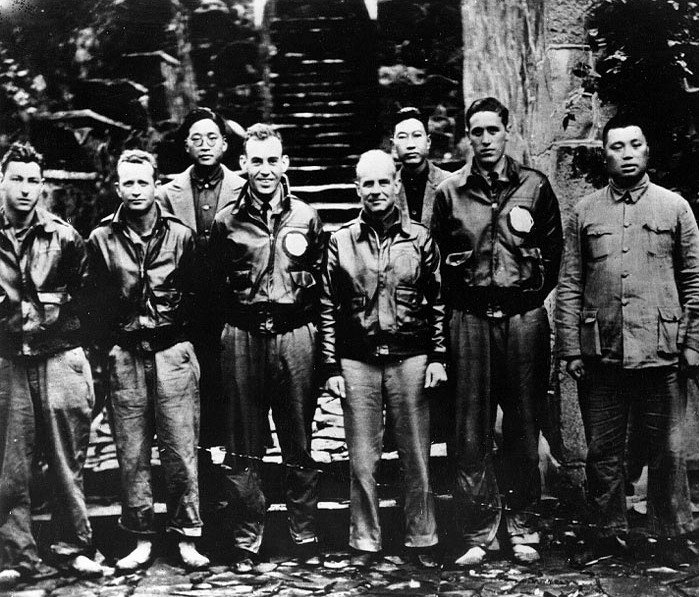
Chinese soldiers, guerrillas and villagers led the Americans to safety, sheltering them from the Japanese troops hunting them, sometimes carrying the injured for miles. Of the eighty men who flew on the raid, sixty-nine got home. Three died in the bail-outs and crash landings. Eight were captured by the Japanese; three of them were executed after a show trial and a fourth died of starvation and disease in captivity. The four others survived more than three years in Japanese prisons. One of them, Jacob DeShazer, returned to Japan after the war as a missionary.3,4
The Chinese people paid the heaviest price. To destroy the airfields and punish those who had helped the Americans, the Japanese army launched a campaign through Zhejiang and Jiangxi provinces that devastated some 20,000 square miles. Villages that had sheltered airmen were burned. Chinese estimates put the dead in the tens of thousands.3,6
Shangri-La
At home the raid had exactly the effect Roosevelt had wanted. After months of defeats, Americans had hit back at the heart of Japan. Asked where the bombers had come from, the President smiled and said: Shangri-La, the hidden mountain kingdom of a popular novel. In Japan the effect was deeper. The Imperial Navy’s commander, Admiral Isoroku Yamamoto, pressed ahead with his plan to seize Midway and draw out the American carriers. In June 1942, at the Battle of Midway, the Japanese lost four carriers in a single day.3,4
Doolittle was promoted straight from lieutenant colonel to brigadier general, skipping the rank of colonel. Back in Washington, Roosevelt presented him with the Medal of Honor at the White House. The citation praised his “conspicuous leadership above and beyond the call of duty”, in leading a raid made “with the apparent certainty of being forced to land in enemy territory or to perish at sea”. Doolittle said he accepted it on behalf of all his men, and insisted every one of them be promoted and decorated.1,5
Commanding the Mighty Eighth
He went on to command the Twelfth Air Force in North Africa and the Fifteenth in Italy, and in January 1944 took over the Eighth Air Force in England, the largest bomber force the United States ever sent to war. His most important decision there changed the air war. American fighters had been ordered to stay close to the bombers they escorted. Doolittle let them go hunting instead, to chase German fighters wherever they could find them, in the air and on the ground. The bomber crews worried that they had been abandoned; within months the Luftwaffe’s fighter force had been ground down, clearing the way for D-Day.1
Eighty goblets
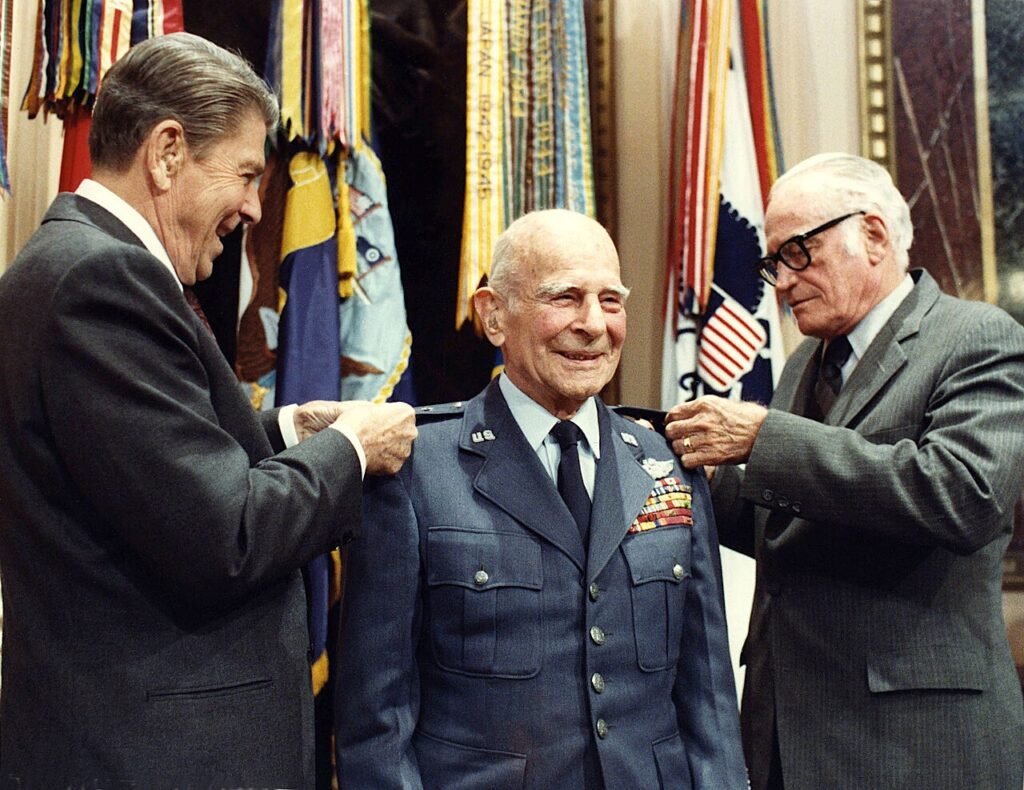
Doolittle left active duty in 1946 and returned to Shell, and later chaired the national committee for aeronautics that became NASA. In 1985 President Ronald Reagan and Senator Barry Goldwater pinned on him the fourth star of a full general, and in 1989 President George H. W. Bush awarded him the Presidential Medal of Freedom. He had married Josephine Daniels in 1917; they were together until her death in 1988. He died at Pebble Beach, California, on 27 September 1993, aged ninety-six, and was buried beside her at Arlington National Cemetery.1
His raiders held a reunion almost every year after the war. The city of Tucson gave them a case of eighty silver goblets, one for each man, engraved with their names. At every reunion the survivors turned the goblets of those who had died upside down. In November 2013 the last three able to attend drank a final toast together. The last of the raiders, Richard Cole, who had flown as Doolittle’s co-pilot, died in 2019, aged 103.2,3
Timeline
- 14 December 1896 Born in Alameda, California.
- March 1918 Commissioned as an Army pilot.
- 4 September 1922 First coast-to-coast flight in under a day.
- June 1925 Awarded the first American doctorate in aeronautics, at MIT; wins the Schneider Trophy.
- 24 September 1929 First flight made entirely on instruments.
- 1 April 1942 Sixteen B-25s loaded aboard USS Hornet.
- 18 April 1942 The raid on Japan; Doolittle bails out over China.
- 1942 Presented with the Medal of Honor by President Roosevelt.
- June 1942 Battle of Midway.
- January 1944 Takes command of the Eighth Air Force.
- 1985 Promoted to full general.
- 27 September 1993 Dies at Pebble Beach, California.
- James H. Doolittle with Carroll V. Glines, I Could Never Be So Lucky Again (Bantam, 1991).
- Carroll V. Glines, The Doolittle Raid: America’s Daring First Strike Against Japan (Orion, 1988).
- Naval History and Heritage Command, “Doolittle Raid”, history.navy.mil
- U.S. Army, “From Shangri-La to Tokyo: The Doolittle Raid, April 18, 1942”, army.mil
- Medal of Honor citation for Brigadier General James H. Doolittle, 1942.
- Japanese casualty figures for the raid (about 50 killed and some 400 injured) and Chinese estimates for the reprisal campaign (tens of thousands of civilians killed) come from post-war studies and vary between sources.
Found an error, or hold a related record? Tell the research desk.
Share what you know