

Simo Häyhä: The “White Death” — 542 Kills in 100 Days
December 1939. The Kollaa front, Finland. Forty degrees below zero. Buried inside a snowdrift, a small man in white lies perfectly still. He has been there since before dawn — motionless for hours in...

December 1939. The Kollaa front, Finland. Forty degrees below zero.
Table Of Content
Buried inside a snowdrift, a small man in white lies perfectly still. He has been there since before dawn — motionless for hours in cold that freezes exposed skin in minutes.
There is snow packed hard in front of his rifle, so the muzzle blast won’t kick up a telltale white cloud. There is snow packed in his mouth, so the vapor of his own breath won’t rise from the drift and betray him.
He does not use a scope. A scope means glass, and glass catches sunlight; a scope fogs in the cold and forces a shooter to raise his head those few fatal centimeters. He uses plain iron sights, the way he learned hunting in these forests as a boy.
Somewhere out in the white silence, Soviet soldiers are moving.
He exhales, slow. He squeezes.
By the time the Red Army finally stopped him — 98 days later — this quiet Finnish farmer would be credited with over 500 kills, the deadliest sniper in the history of warfare. The Soviets gave him a name that traveled through their ranks like a ghost story: Belaya Smert.
The White Death.
They sent counter-snipers to hunt him. He killed them. They dedicated artillery barrages to a single man. They missed.
He stood five foot three. Before the war, almost no one outside his village knew his name. His name was Simo Häyhä — and this is his full story.
The Quiet Farmer
Simo Häyhä was born on December 17, 1905, in the farming village of Kiiskinen in Rautjärvi, Karelia — so close to the Russian border you could almost see the next century’s trouble from the fields. He was the seventh of eight children in a family of farmers and hunters.
His childhood was work: crops in summer, hunting in winter. Like Audie Murphy a world away in Texas, Häyhä learned to shoot not for sport but for the table — and in the Finnish forest, game doesn’t wait while you fumble a second shot. He learned patience, stillness, distance-judging by eye, and how to disappear into terrain. He didn’t know it yet, but Karelia was training him for the most lethal winter of the twentieth century.
At seventeen he joined the local Civil Guard, Finland’s volunteer defense corps, and the farm boy turned out to be a phenomenon on the shooting range. His small house filled up with marksmanship trophies. Asked, decades later, how he became such a shooter, Häyhä gave an answer that has since become legend for its Finnish bluntness:
“Practice.”
He did his military service in the 1920s, went home, and returned to his fields. He was thirty-four years old, an unmarried farmer with a shelf of trophies and no enemies in the world.
Then, on November 30, 1939, the Soviet Union invaded Finland.
One Hundred Days of the White Death
The Winter War was, on paper, an absurdity. The Soviet Union threw roughly three-quarters of a million men, thousands of tanks, and thousands of aircraft at a nation of under four million people. Stalin’s generals expected the whole affair to take about two weeks. Soviet troops were reportedly warned not to accidentally cross into Sweden.
Finland had other plans — and one of the places those plans held was a frozen stretch of front along the Kollaa River, where Häyhä’s unit, the 6th Company of Infantry Regiment 34, faced Soviet divisions that outnumbered the defenders many times over. “Kollaa holds” — Kollaa kestää — became a national rallying cry. And on that front, in snow and darkness and cold that dropped past −40°, Simo Häyhä went to work.
His equipment was almost insultingly humble: a Finnish M/28-30 rifle — a variant of the same Mosin-Nagant the Soviets themselves carried — with no scope at all. His method was the accumulated cunning of a lifetime of hunting:
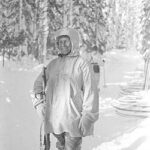
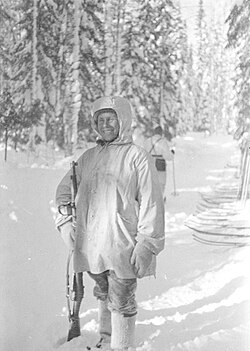
He went out alone before dawn and lay in position all day, sometimes never firing, in cold that killed careless men. He wore head-to-toe white. He built his hides into snowdrifts and packed the snow ahead of his muzzle into ice so a shot wouldn’t stir the surface. He kept snow in his mouth against the breath-vapor. He was small, patient, and utterly still — a man erased from the landscape.
The results defied belief. His kills mounted at a rate the war had never seen — on his single best day, an officially recorded 25. Soviet units on the Kollaa front learned that crossing certain stretches of open ground meant dying without ever hearing where the shot came from. The legend of the White Death spread on both sides of the line.
The Red Army took the extraordinary step of hunting one man as if he were a military objective. Counter-snipers were sent for him; Häyhä killed them. Artillery strikes were called down on his suspected positions; one barrage close enough to shred the back of his coat still failed to touch him. Through it all he kept going out, day after day, for ninety-eight days.
His confirmed sniper-rifle tally is most often given as around 505, with wartime counts running as high as 542 — and that figure doesn’t include the enemy soldiers he killed in close-quarters fighting with a Suomi submachine gun, which by some counts pushes his total toward 700. Even by the most conservative accounting, no sniper in history has ever matched him. And every one of those kills came in roughly 100 days, in near-total winter darkness, with iron sights.
But the Soviets, in the end, had one advantage: there were always more of them.
The Bullet That Couldn’t Finish the Job
On March 6, 1940, in close fighting on the Kollaa front, a Red Army soldier’s explosive bullet struck Simo Häyhä in the lower left jaw.
The wound was catastrophic — the round tore away much of the left side of his face. The men who found him said, bluntly, that half his head was gone; he was placed among the dead. Then someone noticed a leg twitch.
Häyhä was hauled back, unconscious, through the last desperate week of the war. He woke from his coma on March 13, 1940 — the very day the Moscow Peace Treaty took effect and the guns of the Winter War fell silent. Finland had lost territory, including Häyhä’s own Karelian home region, but it had kept its independence — at a cost to the Red Army of hundreds of thousands of casualties. A Soviet general is said to have summed up the campaign in one bitter line: the ground gained was just enough land to bury their dead.
For Häyhä, a different war now began: 26 surgeries to rebuild his shattered jaw, with bone grafted from his own hip. His face bore the damage for the rest of his life — the White Death’s signature, written on the man himself. He tried to return to service when war with the Soviets resumed in 1941; his wounds made it impossible.
So the deadliest sniper who ever lived went home and became, of all things, a moose hunter and dog breeder.
He farmed. He hunted — famously well; Finland’s President Urho Kekkonen joined his hunting parties. He never married, never sought fame, never gave the war stories people wanted. When an interviewer finally asked the old man whether he felt remorse for the hundreds of lives he had taken, Häyhä’s answer was as spare and level as everything else about him:
“I only did what I was told to do, as well as I could.”
Simo Häyhä died on April 1, 2002, in a veterans’ nursing home in Hamina, Finland. He was 96 years old — a man the Red Army could not kill, outliving the Soviet Union itself by more than a decade.
Why History Should Never Forget Him
Simo Hayha’s name should be as famous as any soldier of the Second World War era — the numbers alone guarantee it. Yet outside Finland he remains a curiosity, half-remembered from internet lists, his story rarely told in full. Partly it’s because the Winter War itself is a forgotten war, overshadowed within months by the cataclysm that swallowed Europe. Partly it’s because Häyhä wanted it that way: he gave few interviews, wrote no memoir for the public, and treated his war the way he treated his shooting — as work, done well, and finished.
But his story endures because it is the Winter War in miniature: a small, quiet, unglamorous man against a giant — asking no glory, giving no ground.
One farmer. One rifle with no scope. One hundred days.
And a nation that is still free.
🎬 Watch our documentary on Simo Häyhä: [EMBED: YouTube long-form video — Simo Häyhä / The White Death]
📚 Further Reading
If you want to go deeper into Simo Häyhä’s story and the Winter War, these are the books we recommend:
- The White Sniper: Simo Häyhä by Tapio Saarelainen — the definitive biography, written by a Finnish Army sniper expert who interviewed Häyhä dozens of times over the last years of his life. [Amazon affiliate link]
- A Frozen Hell: The Russo-Finnish Winter War of 1939–1940 by William R. Trotter — the classic English-language history of the war that made the White Death. [Amazon affiliate link]
- The Hundred Day Winter War by Gordon F. Sander — a vivid narrative of Finland’s stand, from Helsinki under bombs to the frozen fronts. [Amazon affiliate link]
As an Amazon Associate, The Forgotten Front earns from qualifying purchases. It costs you nothing and helps us keep telling these stories.

No Comment! Be the first one.