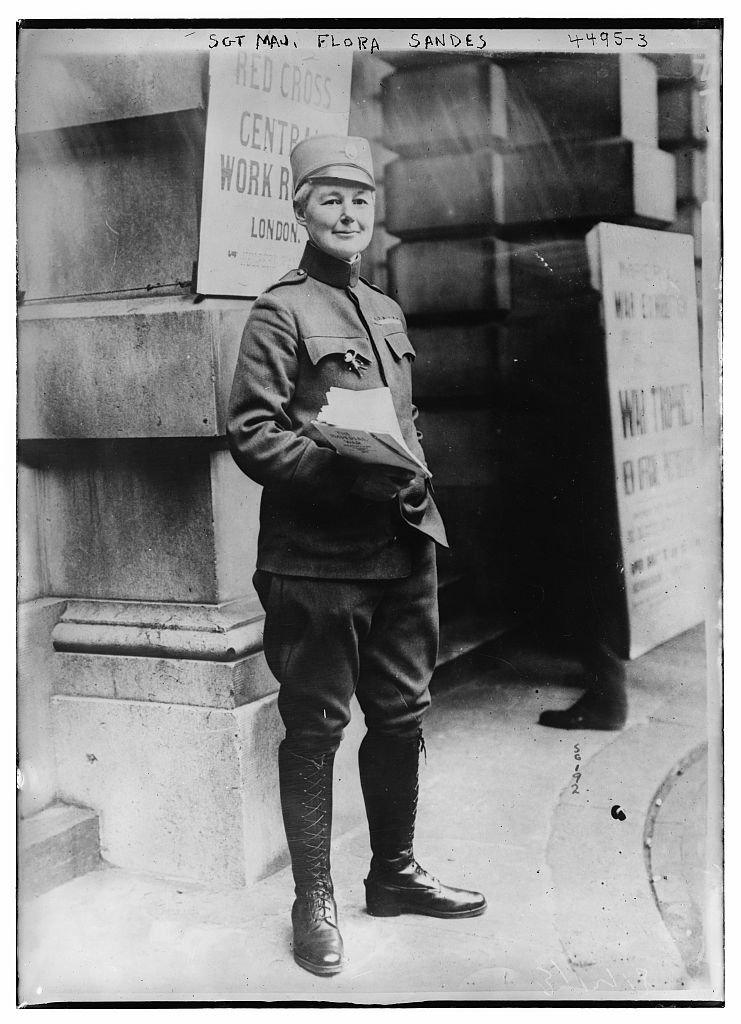
Flora Sandes was born on 22 January 1876 at Nether Poppleton, near York, the youngest daughter of an Irish family. Her father, Samuel Dickson Sandes, had been a rector in County Cork before moving to England. When she was nine the family moved to Marlesford in Suffolk, and later to a house near Croydon, in Surrey.3
She was educated by governesses and grew up loving riding and shooting. She said later that she had often wished she had been born a boy. As a young woman she worked as a secretary, but spent her free time training for emergencies: from 1907 to 1910 she belonged to the First Aid Nursing Yeomanry, an organisation of mounted women volunteers who learned first aid, horsemanship, signalling and drill.3
Too unqualified to nurse
When war broke out in August 1914, Sandes, then thirty-eight, applied to serve as a nurse and was turned down because she lacked formal nursing qualifications. She found another way. On 12 August 1914 she left England with a St John Ambulance unit of thirty-six women organised by the American nurse Mabel Grouitch, bound for Serbia.3
Serbia had been invaded by Austria-Hungary and was short of almost everything, including doctors and nurses. The unit went to Kragujevac, the Serbian army’s headquarters, where Sandes worked with the Serbian Red Cross. In the winter of 1914 and 1915 a typhus epidemic swept through the country and killed tens of thousands of soldiers and civilians. Afterwards she attached herself to the ambulance unit of the Serbian army’s 2nd Infantry Regiment.1,3
Serbia’s war
Serbia’s place in the First World War is often forgotten outside the Balkans. The war began there, with Austria-Hungary’s declaration of war on Serbia in July 1914, after the assassination of Archduke Franz Ferdinand in Sarajevo. Through the autumn of 1914 the Serbian army threw back two Austro-Hungarian invasions, at a terrible cost in men.1,3
Disease then did what the enemy had not. The typhus epidemic of 1915 swept through the army, the hospitals and the towns, and killed doctors and nurses along with their patients, including many of the foreign volunteers who had come to help. By the end of the war Serbia had lost a larger share of its population than almost any other country that fought in it.3
The retreat through Albania
In the autumn of 1915 Serbia was invaded again, from three sides at once, by the armies of Germany, Austria-Hungary and Bulgaria. The Serbian army, with the king, the government and thousands of civilians, began a long retreat over the mountains of Albania in winter, towards the Adriatic coast. Tens of thousands died of cold, hunger and disease on the way.1,3
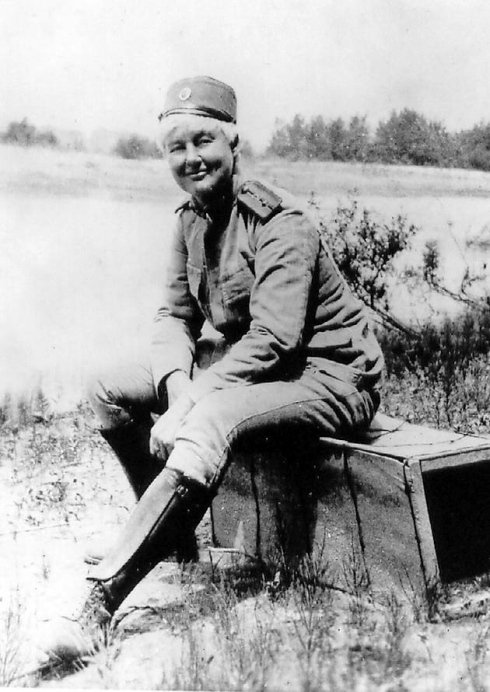
Sandes had pushed to be posted close to the front and was with the regiment’s ambulance at the Babuna Pass when the retreat began. As the ambulance staff around her were killed, captured or scattered, there was no longer a nursing unit to work in. She stayed with the regiment, and its commander, General Miloš Vasić, enrolled her as a private soldier. She took off her Red Cross badge and put on the regiment’s insignia. She was, as far as is known, the only British woman to serve officially as a soldier in the First World War.1,3
The Salonika front
The survivors of the Serbian army were evacuated by the Allies to the Greek island of Corfu, fed, re-equipped and sent back into the line on the Salonika front in Macedonia. Sandes went with them, and was quickly promoted to corporal.1,3
In 1916 the Serbian army went on the offensive towards Bitola, known then by its Turkish name, Monastir. In November, in hand-to-hand fighting on the approaches to the town, Sandes was badly wounded by a grenade. She was carried from the field and spent months recovering.1,3
She went to Serbia to nurse, took off the Red Cross armband during the retreat, and finished the war an officer.
Flora Sandes, 1914–1919
The Karađorđe Star
For her service she was awarded the Order of the Star of Karađorđe, Serbia’s highest military decoration, and promoted to sergeant major. While recovering she turned her letters home into a book, An English Woman-Sergeant in the Serbian Army, published in London in 1916, and raised money for Serbian soldiers. Unable to go back into the front line, she ran a hospital for the rest of the war.1,3
In June 1919 the Serbian parliament passed a special act that made her the first woman to be commissioned as an officer in the Serbian army. She stayed in the army, in what became the Kingdom of Serbs, Croats and Slovenes, until she was demobilised in October 1922, and later held the rank of captain. In 1920 the sculptor Alice Meredith Williams made a model of her in action, which is now in the Imperial War Museum.3,5
Belgrade
In May 1927 she married Yuri Yudenitch, a Russian émigré who had been an officer in the White Army during the Russian Civil War. They settled in Belgrade, where among other ventures she is said to have driven the city’s first taxicab. That year she published a second memoir, The Autobiography of a Woman Soldier, and she lectured in Britain, Australia, New Zealand, France, Canada and the United States, wearing her Serbian uniform on stage.2,3
When Germany invaded Yugoslavia in April 1941, Sandes and her husband were called up again, but the invasion was over before they could serve. Both were briefly interned by the Germans and then released on parole. Yudenitch fell ill and died that September.3
Home to Suffolk
After the Second World War Sandes returned to England and settled near Wickham Market, in Suffolk, not far from where she had spent her childhood. Flora Sandes died at the East Suffolk and Ipswich Hospital on 24 November 1956, aged eighty, and her ashes were scattered in the garden of remembrance at Ipswich Crematorium.3
A memorial plaque to her hangs in St Andrew’s Church at Marlesford. In 2009 the city of Belgrade named a street after her.
Timeline
- 22 January 1876 Born at Nether Poppleton, Yorkshire.
- 1907–1910 Trains with the First Aid Nursing Yeomanry.
- 12 August 1914 Leaves for Serbia with Mabel Grouitch’s St John Ambulance unit.
- 1915 Enrolled as a private in the 2nd Infantry Regiment during the retreat through Albania.
- November 1916 Badly wounded by a grenade near Bitola; awarded the Star of Karađorđe.
- 1916 An English Woman-Sergeant in the Serbian Army published.
- June 1919 Commissioned as an officer by act of the Serbian parliament.
- October 1922 Demobilised.
- May 1927 Marries Yuri Yudenitch; settles in Belgrade.
- 1941 Briefly interned by the Germans; her husband dies that September.
- 24 November 1956 Dies in Ipswich, aged 80.
- 2009 Belgrade names a street after her.
- Flora Sandes, An English Woman-Sergeant in the Serbian Army (Hodder & Stoughton, 1916).
- Flora Sandes, The Autobiography of a Woman Soldier (H. F. & G. Witherby, 1927).
- Louise Miller, A Fine Brother: The Life of Captain Flora Sandes (Alma Books, 2012).
- Library of Congress, Bain News Service photograph of Sgt. Maj. Flora Sandes.
- Imperial War Museums, model of Flora Sandes by Alice Meredith Williams, 1920.
Found an error, or hold a related record? Tell the research desk.



Share what you know