Carlos Norman Hathcock II was born in Little Rock, Arkansas, on 20 May 1942. His parents separated when he was small, and he grew up mostly with his grandmother in the farming town of Wynne. The family was poor, and by the time he was ten he was hunting in the woods with a .22 rifle to put food on the table. He also played at war there, with a dog for company and an old German Mauser his father had brought home from the Second World War, stalking imaginary Japanese soldiers through the trees.1
All he wanted to be was a Marine. On his seventeenth birthday, 20 May 1959, he enlisted. On 10 November 1962, the Marine Corps’ birthday, he married Josephine Broughton, known as Jo. Their son, Carlos III, would one day follow him into the Corps.1
The Wimbledon Cup
The Marine Corps soon discovered that the boy from Arkansas could shoot. Hathcock became one of the best competitive marksmen in the service. In 1965, at the national matches at Camp Perry, Ohio, he won the Wimbledon Cup, the most prestigious prize in American long-range shooting, fired at a thousand yards.1
In 1966 he went to Vietnam, at first as a military policeman. The Marine Corps had let sniping wither after Korea, and one officer had spent years trying to bring it back. Captain Edward James Land, a Marine since the age of seventeen and himself a competitive shooter, had founded the Corps’ first modern sniper course in 1961. In 1966 he set up a scout sniper school for the 1st Marine Division on Hill 55, and went looking for Marines who had already proved themselves on the range. The name of the man who had just won the Wimbledon Cup was not hard to find. Land had Hathcock transferred to his sniper platoon.1,7
Land did more than recruit him. He often went out on missions with his snipers, and he and Hathcock became close friends. The two men would later rebuild Marine Corps sniping together after the war.1,7
Hill 55
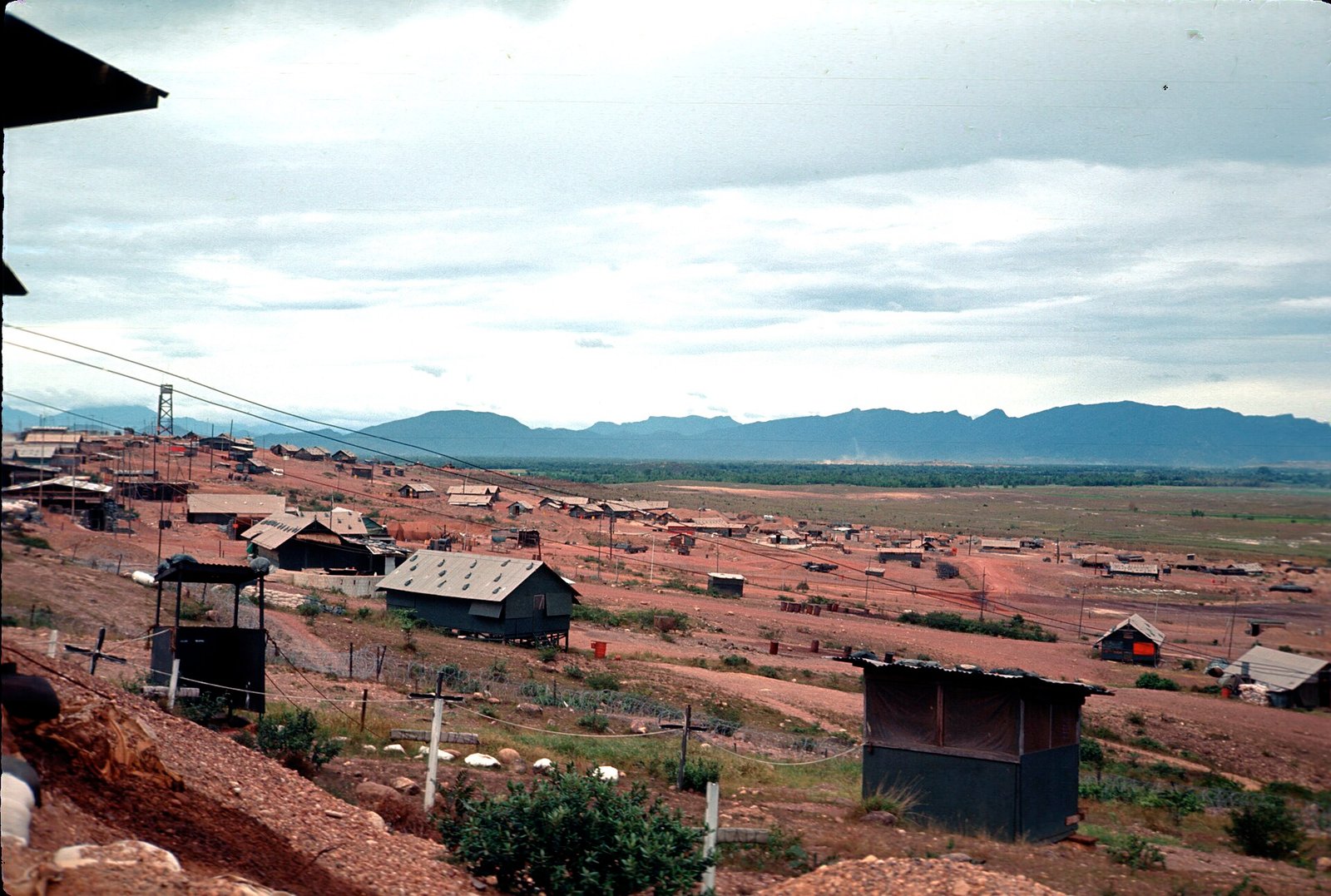
Hathcock worked out of Hill 55, a Marine firebase south-west of Da Nang, above country of rice paddies, villages, tree lines and low hills held or contested by the Viet Cong and the North Vietnamese army. He usually went out with a single spotter, and his standard rifle was a Winchester Model 70 chambered for .30-06, fitted with an eight-power Unertl scope. His creed, as he later described it, was to “get in the bubble”: a state of complete concentration on his rifle, then on the ground around him, where every breeze and every moving leaf meant something, and finally on his target.1,2
He wore a white feather in the band of his bush hat. It was a kind of dare. The Vietnamese called him Lông Trắng, White Feather. The North Vietnamese put a price on his head; the figure usually given is $30,000, when bounties on American snipers normally ran to one or two thousand dollars. When a team of snipers was sent to hunt him, other Marines around Hill 55 began wearing white feathers themselves to confuse them.1,2,8
By the end of the war Hathcock was credited with 93 confirmed kills. The number was deliberately conservative. In Vietnam a kill counted only if it was witnessed by the sniper’s spotter and by a third person, usually an officer. Snipers often worked far from any officer, deep in enemy country, and Hathcock himself believed the real number was several times higher.1
Two men and a rifle
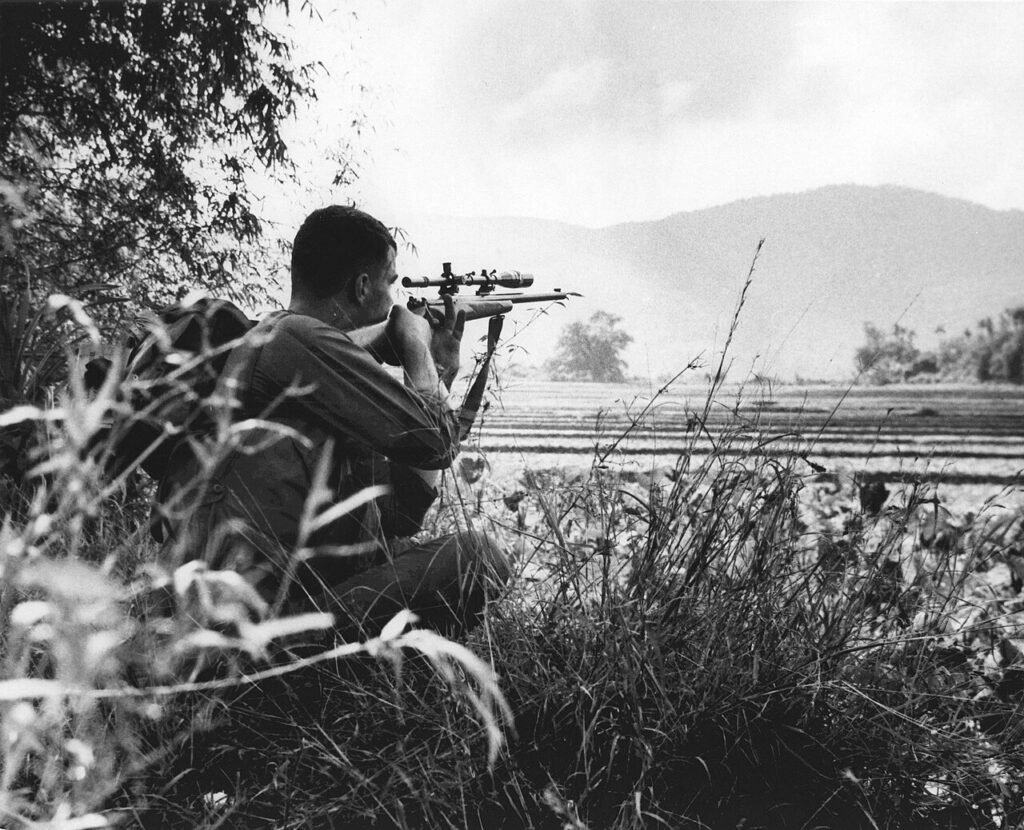
A Marine sniper team in Vietnam was two men: the shooter and his spotter. The spotter carried a powerful spotting scope, read the wind from the way grass and smoke moved, judged the range, watched where each shot struck, and guarded the shooter, whose eye was glued to a narrow field of view. The two took turns and knew each other’s habits completely. They moved slowly, often at night, and might lie still for hours or days in one hide, watching a trail, a paddy dyke or a village. A sniper team’s value was not only the men it killed but the fear it created: enemy units that knew a sniper was working an area moved more cautiously, travelled less by day and exposed themselves less to the rest of the Marines.1,7
Hathcock was patient to an extraordinary degree, and he was a hunter by upbringing. He read the ground the way he had read the Arkansas woods as a boy: where a man would walk, where he would stop to rest, where the light would catch him.1
Five days in Elephant Valley
One of the actions his biographers describe best took place in a valley of rice paddies the Marines called Elephant Valley. Hathcock and his spotter, John Burke, came upon a company of North Vietnamese soldiers, green troops with officers who did not know what they were facing, crossing open ground. From the tree line the two Marines pinned them down in the paddies. Every time a soldier moved, Hathcock fired. For five days they kept the company trapped, until the survivors were finished off by artillery the snipers called in. Most of the company, by these accounts, never left the valley.1,8
A shot through the scope
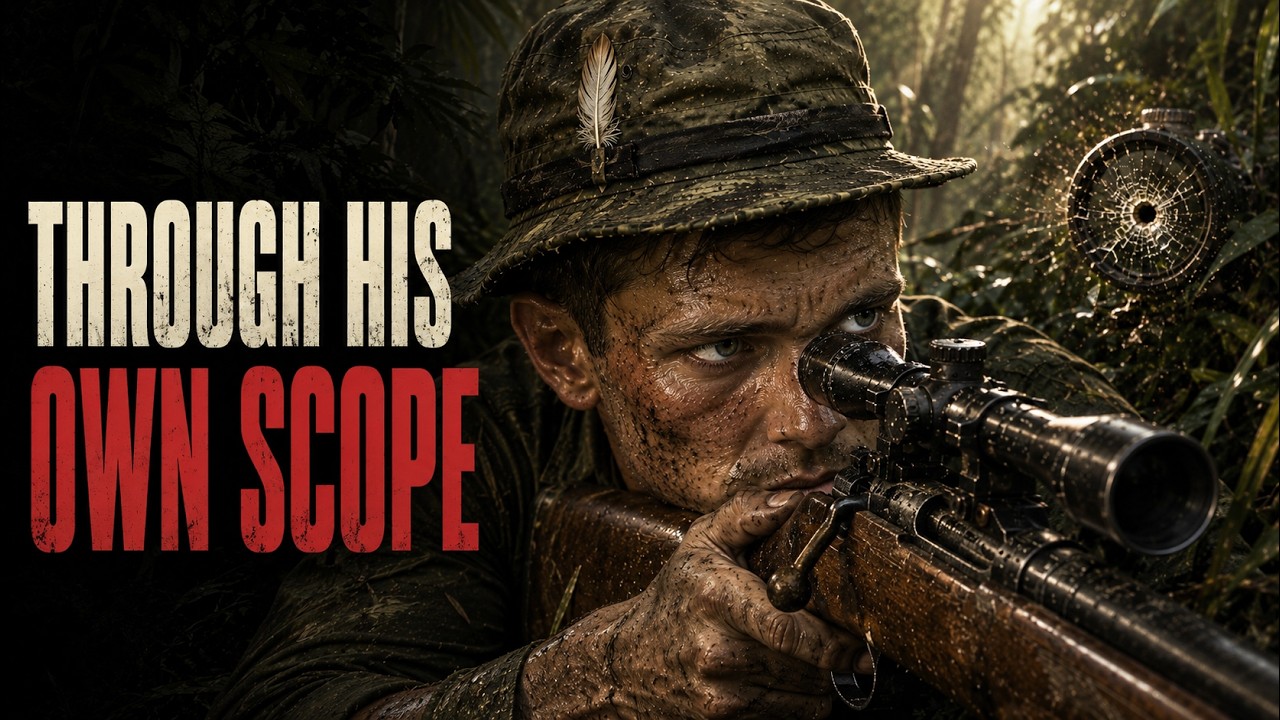
The most famous story about Hathcock is a duel. An enemy sniper, remembered by the Marines as the Cobra, had been killing Marines around Hill 55 and was believed to have been sent to kill Hathcock himself. Hathcock and his spotter, John Burke, went after him. They stalked him for hours through the jungle. Then Hathcock saw a glint of sunlight on glass in the undergrowth, fired at it, and hit the enemy sniper through his own telescopic sight. The Cobra, Hathcock realised afterwards, must have had him in his sights at the same moment. He said later he had simply got there first.1,2
The story is known only from Hathcock’s account. The captured rifle, which he hoped to take home, disappeared from the armoury. Television tests have argued both ways about whether a bullet could pass through such a scope, and the latest suggest that, with the simpler optics of the time, it could.6
Hathcock also told of killing a Viet Cong woman he called Apache, said to have tortured captured Marines to death within earshot of their comrades. Some historians have doubted whether such a person existed, and the story should be read as his account.6
Four days in the grass
In 1967, near the end of his first tour, Hathcock volunteered for a mission he was told nothing about until he had accepted it: to kill a North Vietnamese general at his headquarters. It was the only time, he said, that he took the feather out of his hat. For four days and three nights he crawled some 1,500 yards across open fields, inch by inch, dressed in grass and vegetation. A patrol almost stepped on him. A bamboo viper slid past his face and he did not move. When the officer came out of his camp, at a range of about 700 yards, Hathcock fired once, hit him in the chest, and crawled back out through the troops searching for him.1,2
That same year he made a shot that stood as the record for thirty-five years. Using a .50-calibre M2 Browning machine gun, fitted with a telescopic sight on a bracket made by Seabee metalworkers and fired single shot, he killed a Viet Cong guerrilla at about 2,500 yards, almost a mile and a half. It remained the longest recorded sniper kill until 2002. His use of the heavy machine gun helped persuade the military that the .50-calibre round could be a sniper’s weapon.1
The mine on Highway 1
Hathcock went home in 1967, but he missed the Corps in Vietnam, and in 1969 he went back to command a platoon of snipers with the 7th Marines. On 16 September 1969 he was riding on top of an LVTP-5 amphibious tractor on Highway 1, north of Landing Zone Baldy, when it struck an anti-tank mine. The explosion sprayed the Marines on top with burning petrol and set the vehicle on fire.4
Burned on his face, body, arms and legs, over something like forty per cent of his body and some of it to the third degree, Hathcock pulled Marines off the burning tractor and got them to cover. Then, as his Silver Star citation records, he ran back through the flames and the exploding ammunition to make sure no one had been left behind. Seven Marines were saved. Only when someone pushed him into water did he realise how badly he was hurt. He was flown to the hospital ship USS Repose, then to Tokyo, and then to the burn centre at Brooke Army Medical Center in San Antonio, Texas.1,4
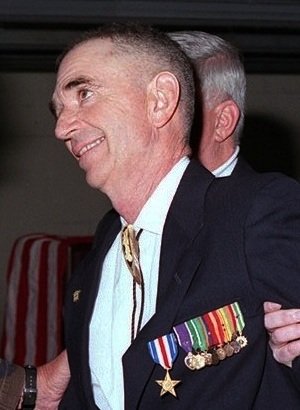
He never saw combat again. He received the Purple Heart for his wounds. The Silver Star for the men he pulled from the fire was not presented until 12 November 1996, twenty-seven years later, in a ceremony at the Weapons Training Battalion at Quantico, with his son, by then a Marine staff sergeant, beside him.4,5
Teaching
Back on duty, Hathcock joined Land, by then a major, and Major Richard Culver in setting up the first permanent Marine Corps Scout Sniper School at Quantico, Virginia, and poured his knowledge into a new generation of Marine snipers. He was in pain almost all the time from his burns. In 1975 he was diagnosed with multiple sclerosis. He stayed in the Corps as long as he could, but in 1979, just fifty-five days short of the twenty years that would have entitled him to a full retirement, he was given a permanent disability discharge.1
Leaving hit him hard. He said he felt the Marine Corps had thrown him out, and he fell into a long depression. His wife, Jo, came close to leaving him, and stayed. He found some relief in an unlikely hobby, fishing for sharks, and went on teaching sniping to police departments and to special units of the military, including the Navy’s SEAL Team Six.1
He was not a man who celebrated killing. Once, a friend showed him a passage from Ernest Hemingway about there being no hunting like the hunting of armed men. Hathcock copied it out on a scrap of paper. Hemingway got that right, he said: it was the hunt, not the killing. He told his biographer that he had never enjoyed killing anybody. It was his job, and if he did not stop the enemy, they would kill a lot of young Marines.1
The legend
Carlos Hathcock died of complications of multiple sclerosis in Virginia Beach on 22 February 1999, aged fifty-six. He is buried at Woodlawn Memorial Gardens in Norfolk, Virginia.1
His name is on a sniper range at Camp Lejeune and on the rifle and pistol ranges at Marine Corps Air Station Miramar. Springfield Armory named a rifle after him, the M25 White Feather. Marine awards for marksmanship training carry his name. Novelists and screenwriters borrowed from his life, and the shot through the scope has turned up in films from Sniper to Saving Private Ryan. His son retired from the Marine Corps as a gunnery sergeant, like his father, and a competitive shooter.1
What the Marine Corps remembers most is what he left behind at Quantico. The sniper programme he helped to build, and the methods he taught, have shaped how Marines have trained snipers ever since.
Timeline
- 20 May 1942 Born in Little Rock, Arkansas.
- 20 May 1959 Enlists in the Marine Corps on his seventeenth birthday.
- 1965 Wins the Wimbledon Cup at Camp Perry.
- 1966 Arrives in Vietnam; becomes a sniper under Captain Edward Land.
- 1967 The long stalk of the general; his record shot at about 2,500 yards.
- 1969 Returns to Vietnam to lead a sniper platoon.
- 16 September 1969 Badly burned rescuing Marines from a mined amphibious tractor.
- 1975 Diagnosed with multiple sclerosis.
- 1979 Medically discharged, fifty-five days short of twenty years.
- 12 November 1996 Presented with the Silver Star.
- 22 February 1999 Dies in Virginia Beach.
- Charles W. Henderson, Marine Sniper: 93 Confirmed Kills (Stein and Day, 1986).
- Charles W. Henderson, Silent Warrior (Berkley, 2003).
- Roy F. Chandler, White Feather: Carlos Hathcock, USMC Scout Sniper (Iron Brigade Armory, 1997).
- Silver Star citation for Staff Sergeant Carlos N. Hathcock II, for action on 16 September 1969, presented on 12 November 1996.
- U.S. Marine Corps photograph DM-SD-98-02324 and caption, 12 November 1996.
- Many of the best-known episodes, including the shot through the enemy sniper’s scope, the woman called “Apache” and the stalk of the general, come mainly from Hathcock’s own later accounts to his biographers and cannot be checked against official records. Some historians have questioned parts of them.
- MSG Dana C. Cooper and SGM James Smalls, “Gunnery Sergeant Carlos Hathcock”, U.S. Army Sergeants Major Academy research paper, cgsc.contentdm.oclc.org
- “This Marine Was the ‘American Sniper’ of the Vietnam War”, Military.com, military.com
Found an error, or hold a related record? Tell the research desk.


Share what you know