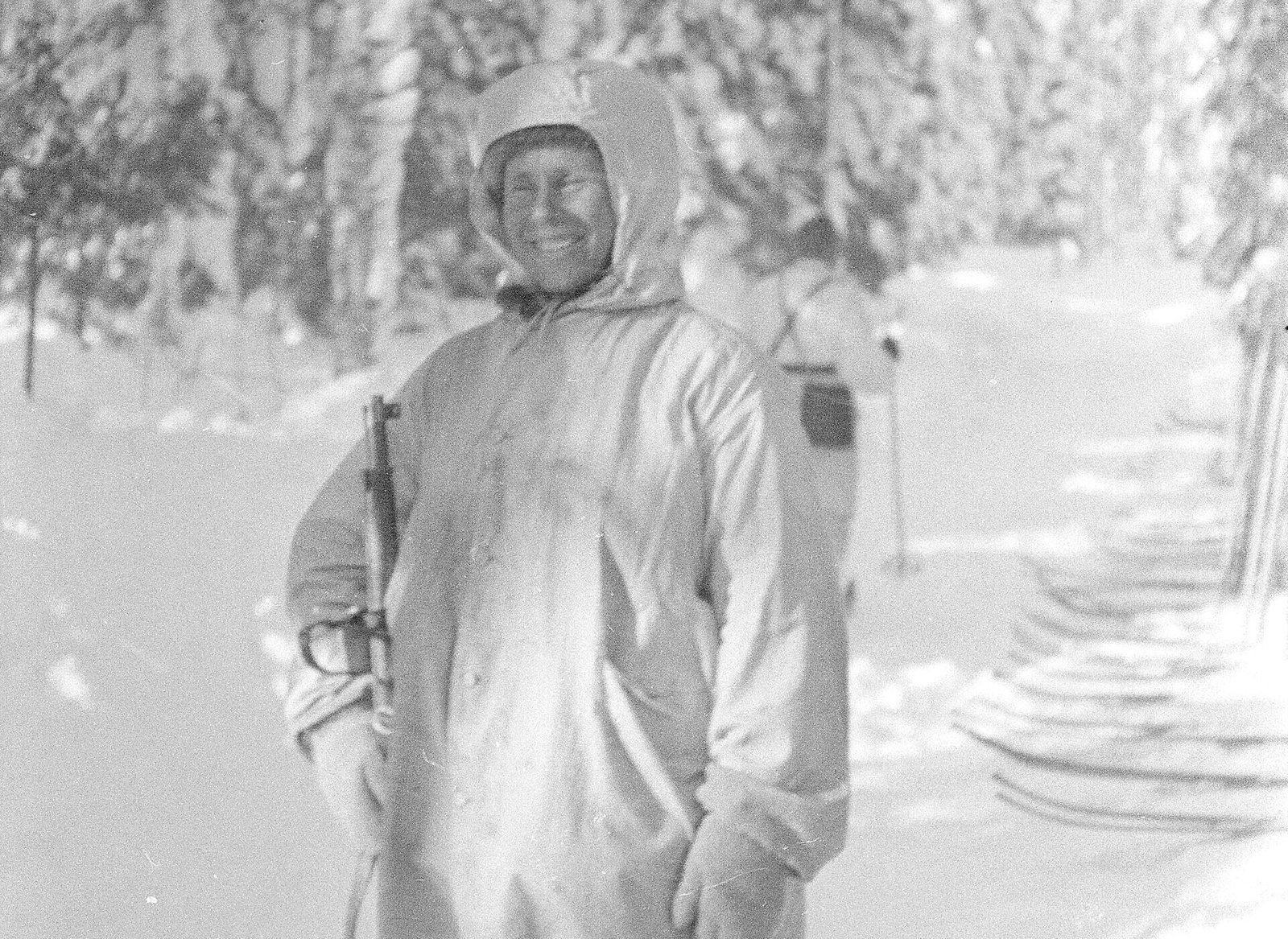

Simo Häyhä was born on 17 December 1905 in the hamlet of Kiiskinen, in the parish of Rautjärvi, in the south-east of Finland near the Russian border. He was the seventh of eight children in a Lutheran farming family; his father, Juho, owned a farm called Mattila. He grew up farming, hunting and skiing.1
At seventeen he joined the Civil Guard, Finland’s volunteer militia, and became one of its best shots, winning trophies at provincial shooting competitions. He did his compulsory military service in 1925, in a bicycle battalion, and passed through the school for non-commissioned officers. His formal training as a sniper came much later, in 1938. His instructors found that he could judge distances of up to 150 metres to within about a metre.1
The Winter War
On 30 November 1939 the Soviet Union invaded Finland. The Red Army was far larger than the Finnish forces facing it, with more men, more guns and many more tanks. Most observers expected Finland to fall within weeks.1,2
Häyhä served as a sniper with the 6th Company of Infantry Regiment 34, under Lieutenant Aarne Juutilainen, on the front along the Kollaa river, north of Lake Ladoga. The Soviet aim there was to break through the Finnish line. The Finns were determined to stop them. “Kollaa holds” became a national watchword.1
Forty degrees below
That winter was exceptionally cold, with temperatures dropping to forty below zero. The Finns, who had grown up with such winters, dressed in white camouflage and moved on skis. Many Soviet soldiers, after the purges that had stripped the Red Army of experienced officers, arrived without proper winter clothing.1,2
Häyhä used his standard-issue rifle, an M/28-30, with ordinary iron sights rather than a telescopic sight. A scope would have made him raise his head higher to aim, and its glass could fog in the cold or flash in the sun and give his position away.1
Snow in his mouth
He took up his positions before dawn and stayed still until after dark, in the short days of the northern winter. He packed snow in front of his rifle so that the muzzle blast would not throw up a telltale cloud, and kept snow in his mouth so that his breath would not steam in the freezing air.1
“I did what I was told, as well as I could. There would be no Finland unless everyone had done the same.”
Simo Häyhä, interviewed in 2001
How many?
His reputation grew during the war itself, and so did the numbers attached to it. On 17 February 1940, when his division commander presented him with an honorary rifle, he was credited with 219 confirmed kills. A regimental chaplain recorded 259 by 7 March. In 2017 a private memoir he had written after the war came to light, in which he estimated his total at about five hundred and called his tally his “list of sins”.1,2
Historians who have examined the records point out how hard it was to confirm a kill without seeing a body, and tend to accept a figure of more than two hundred. Even that is an extraordinary number for fewer than a hundred days of fighting, in months when there were only a few hours of daylight each day.1,2
6 March 1940
On 6 March 1940 an explosive bullet struck Häyhä in the lower left side of his face and shattered his jaw. Soldiers found him unconscious and carried him to the rear. Word that he had been killed spread in Finland and in the Soviet Union. He regained consciousness on 13 March 1940, the day the war ended in a peace treaty, and later wrote to the newspapers to correct the reports of his death.1
Finland had survived as an independent country, but at the cost of ceding territory to the Soviet Union. That territory included Häyhä’s home. He needed many operations to rebuild his face, and when war with the Soviet Union began again in 1941 he asked to return to the front and was turned down because of his injuries.1
What the Winter War cost
The Winter War lasted a hundred and five days. Finland kept its independence, which few outside observers had thought possible when the war began, but it had to give up about a tenth of its territory, including much of Karelia, and more than four hundred thousand Finns had to leave their homes and move west.
The human cost was heavy on both sides. Finland lost around twenty-five thousand soldiers killed or missing. Soviet losses were far higher; most historians put them at well over a hundred thousand dead. For a country of fewer than four million people, the war left a mark on almost every family.
Häyhä was one of those who had to leave. His home at Rautjärvi was on the Soviet side of the new border, and like hundreds of thousands of other Karelians he had to start again somewhere else.1
From corporal to lieutenant
On 28 August 1940 Field Marshal Mannerheim promoted him directly from corporal to second lieutenant, an almost unheard-of jump. He received the Medals of Liberty and the Crosses of Liberty, honours normally given to officers, and the Cross of Kollaa, of which his was the fourth awarded, after Mannerheim and the President.1
A hunter at Ruokolahti
After the war he farmed at Ruokolahti, not far from the new border. He became a well-known moose hunter and dog breeder, and hunted with President Urho Kekkonen. He never married. He rarely spoke about the war; asked in 1998 how he had become such a good shot, he answered with one word: “Practice.”1,4
Simo Häyhä died on 1 April 2002 in a home for war veterans in Hamina, aged ninety-six, and was buried at Ruokolahti. His gravestone reads: Home – Religion – Fatherland.
Timeline
- 17 December 1905 Born in Kiiskinen, Rautjärvi.
- 1922 Joins the Civil Guard, aged seventeen.
- 1925 Compulsory military service in a bicycle battalion.
- 1938 Formal sniper training.
- 30 November 1939 The Soviet Union invades Finland.
- 17 February 1940 Presented with an honorary rifle; credited with 219 kills.
- 6 March 1940 Badly wounded in the jaw by an explosive bullet.
- 13 March 1940 The war ends; he regains consciousness the same day.
- 28 August 1940 Promoted from corporal to second lieutenant.
- 1 April 2002 Dies in Hamina, aged 96.
- 2017 His private wartime memoir comes to light.
- Tapio Saarelainen, The White Sniper: Simo Häyhä (Casemate, 2016).
- Risto Marjomaa, Finnish military historian, published assessments of Häyhä’s record.
- Finnish Wartime Photograph Archive (SA-kuva), photograph 9479.
- Helsingin Sanomat, interview with Simo Häyhä, December 2001.
- His kill count is disputed: official credits in February–March 1940 were 219 and 259; his own private notes estimated about 500; historians who have examined the records tend to accept a figure of more than two hundred.
Found an error, or hold a related record? Tell the research desk.


Share what you know